
職場の金融教育はどこから始めるべきか
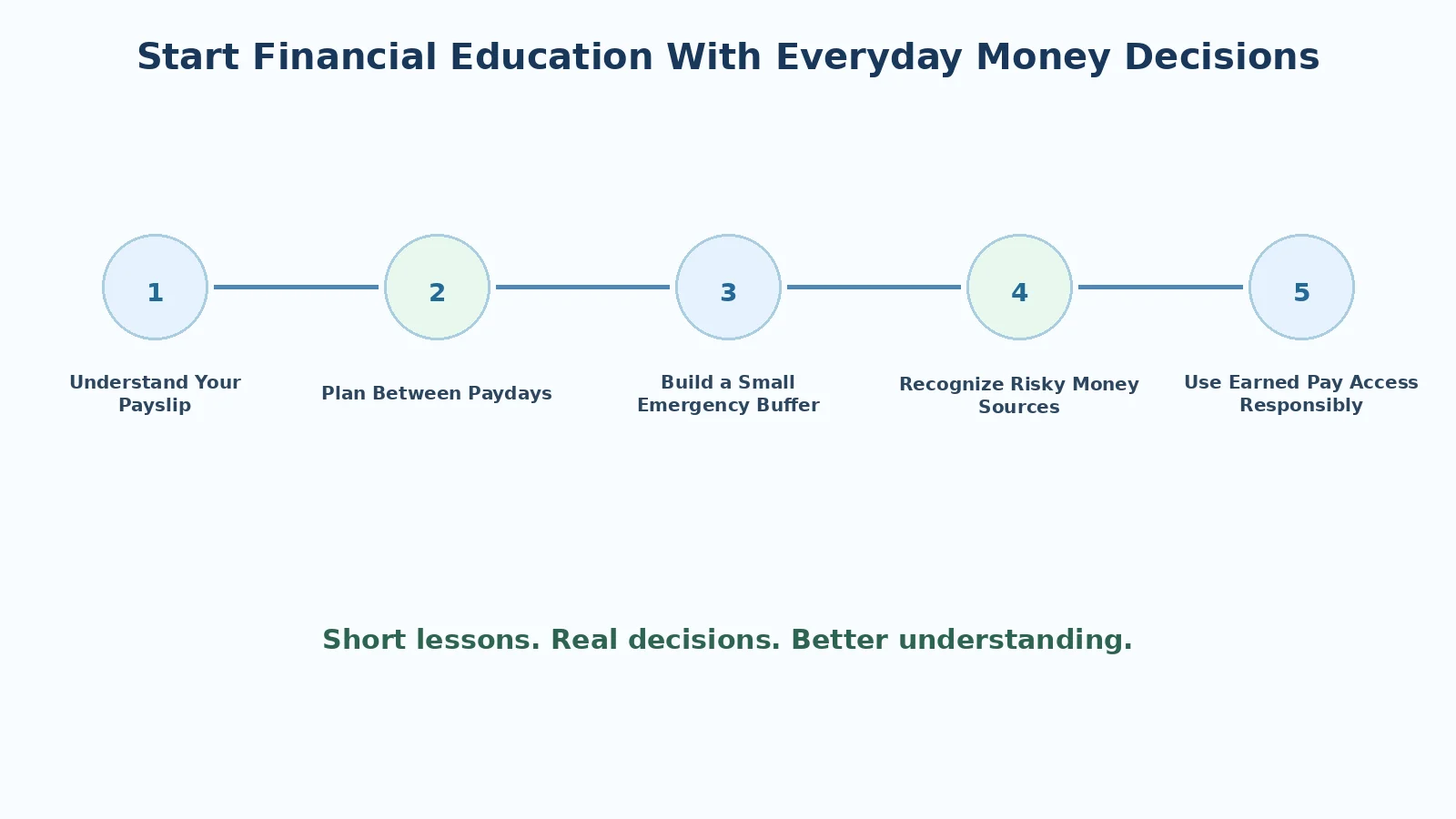
Workplace financial education should begin with problems employees meet every day, rather than complex investment concepts. The foundations are reading a payslip, managing money between paydays, building an emergency buffer, recognizing risky offers, and using earned wage access responsibly.
Start with practical needs, not theory
Long financial courses are difficult to sustain when workers do not see a direct connection. Start with questions such as why approved work is not yet reflected, how to divide monthly pay by week, how to handle a surprise cost, what remains after early access, and how to distinguish safe support.
The closer the lesson is to a daily decision, the more likely it is to be used.
Five foundations to include
1. Understand attendance and payslips
Explain approved work, who approves it, update timing, payslip items, and how to report an error.
2. Manage money between paydays
Teach weekly budgets, protecting mandatory costs, finding heavy-spending weeks, and avoiding treating early pay as extra income.
3. Build a buffer
Show how to start small, separate money on payday, keep the fund apart, and rebuild it after use.
4. Recognize risky offers
Cover advance fees, OTP requests, unknown legal entities, missing contracts, and pressure to decide quickly.
5. Use earned wage access responsibly
Explain that it is part of pay already earned, does not increase total income, should be used only for the needed amount, and requires checking the remaining payday balance.
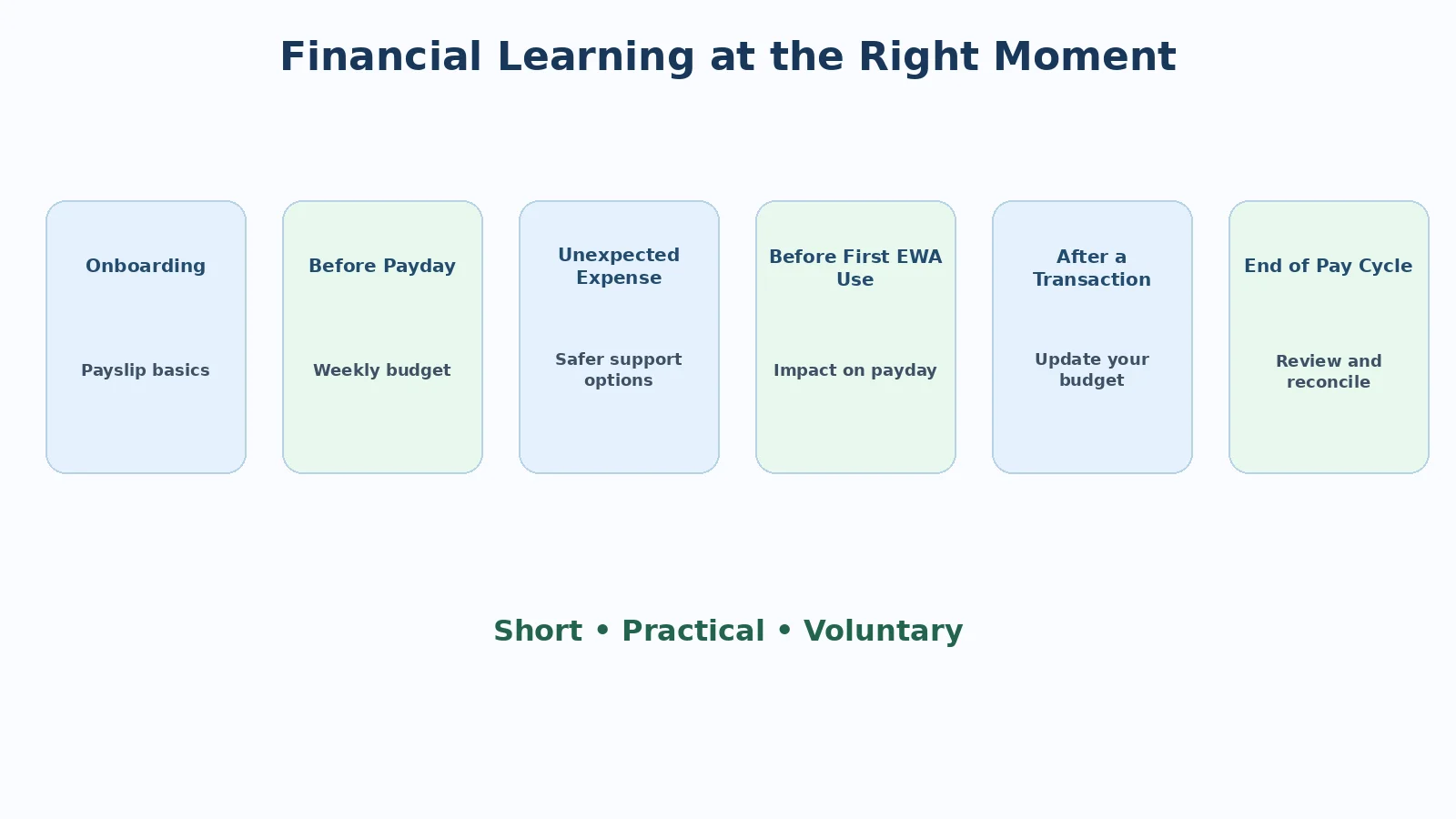
Teach through micro-learning
Instead of one two-hour session, provide three-to-five-minute lessons.
| Timing | Short lesson |
|---|---|
| Onboarding | Work, pay, and payslip basics |
| Before payday | Weekly budget |
| Unexpected expense | Order of support sources |
| Before first EWA use | Effect on payday balance |
| After a transaction | Update the budget |
| End of period | Reconcile the payslip |
Micro-learning places the lesson near the moment it is needed.
Do not make education a mandatory condition
Financial education should support choice. Do not require a long course for benefits, use scores in performance reviews, identify people who manage money poorly, or demand personal debt and family details. Offer voluntary, simple, practical content that can be revisited.
Who should help deliver it?
HR can own communication and content; payroll can explain pay; operations can provide real pain points; managers can point to support; legal or privacy staff can review data scope; and workers can test clarity. One department should not design everything alone.
How should results be measured?
Measure correct understanding of approved work, understanding that early pay is not extra money, payslip questions, errors caused by misunderstanding, use of materials, and worker feedback. In the initial stage, design the measurement framework without publishing results that are not established.
Conclusion
Workplace financial education is most effective when it is short, timely, and tied to real decisions. Begin with payslips, between-payday budgets, emergency buffers, and safe support before advanced topics. The aim is to help workers understand income-related tools without turning the employer into a personal financial adviser.
Author: Do Huy Le — Tổng Giám Đốc, Nhan Kiet Manpower Supply Co., Ltd.
Earned wage access advice for employers: Hotline 0937.022.655 · Email info@nhankiet.vn · Earned wage access for employers
よくある質問
Does financial education need to teach investing?
It is not the first priority. Start with budgets, work, pay, buffers, and safe support sources.
Should participation be mandatory?
Usually make it voluntary, short, and easy to access.
Who should teach the sessions?
HR, payroll, and a suitable specialist can share the role. Accuracy and practical use matter most.
Should earned wage access be included?
It can be, with a neutral explanation of how it works, the end-of-period effect, the right not to use it, and budget balancing.