
Why must EWA connect timekeeping, payroll and banking?
EWA must connect timekeeping, payroll and banking because each system holds a different part of the truth about pay. Timekeeping shows what work was performed and approved; payroll defines the period, rate and settlement rules; banking confirms which funds were actually transferred. Without any one of them, displayed available pay and final payroll are difficult to keep consistent.
Three systems answer three different questions
An EWA system cannot create labor data by itself or replace payroll.
The three domains have different roles:
| System | Main question |
|---|---|
| Timekeeping | Which days or shifts did the worker complete, and which were approved? |
| Payroll | How are work value, pay period and final settlement determined? |
| Banking | Which payments were actually transferred, and what is their final status? |
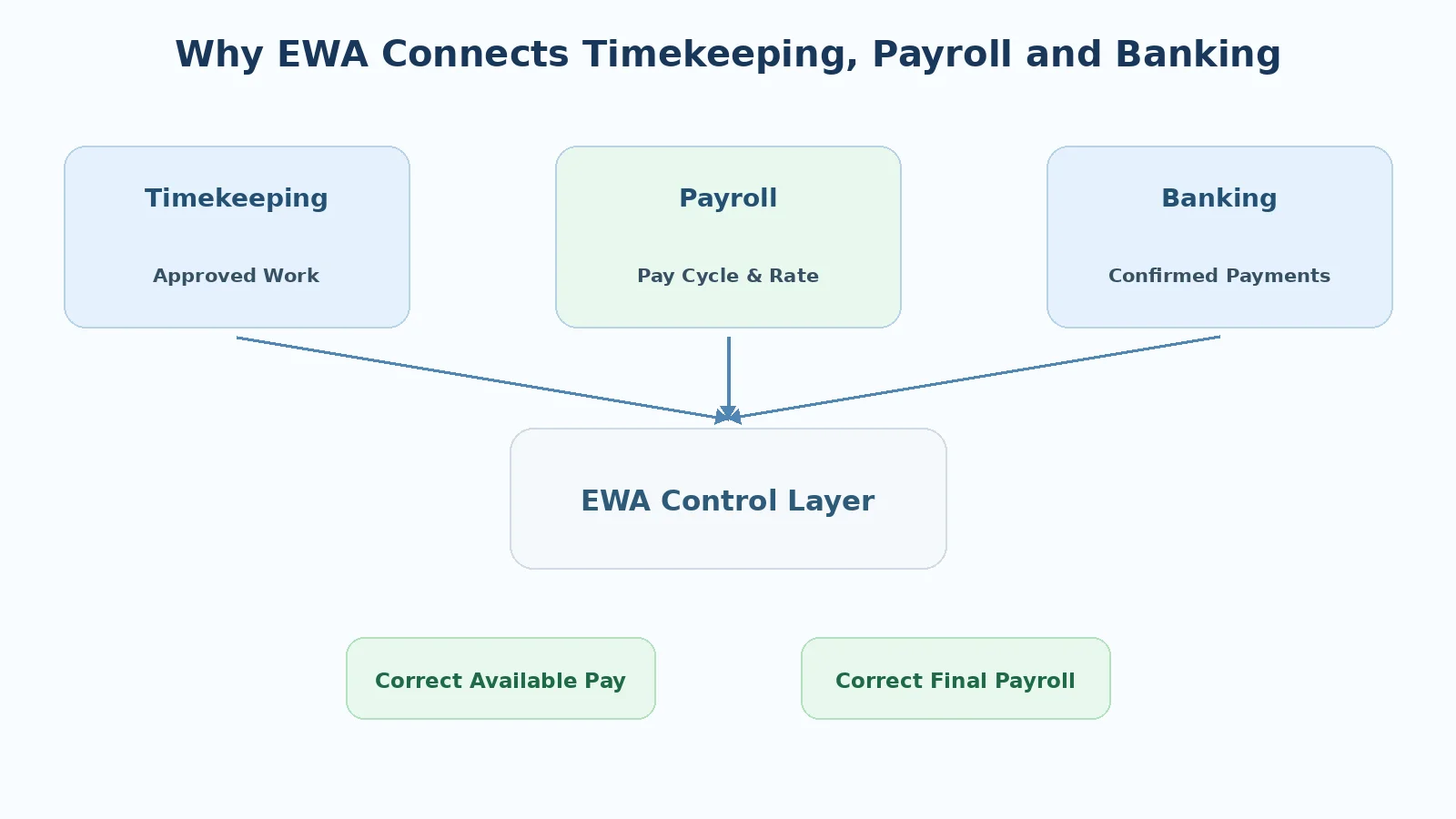
EWA sits between them and connects the three domains into an auditable chain.
Timekeeping confirms the work that has accrued
Without timekeeping data, EWA cannot know how much work a worker has actually performed.
Minimum data includes:
- worker;
- workplace;
- date;
- shift;
- hours or workdays;
- approval status;
- edit history, if any.
The key point is that recorded time is not necessarily approved time.
A record may lack a clock-out, have the wrong shift or still await confirmation. Timekeeping data should enter financial calculations only after the appropriate approval process.
Payroll provides context that timekeeping does not have
Timekeeping may show eight hours of work without necessarily knowing:
- the applicable rate;
- the pay period;
- the effective date of a pay change;
- the workplace associated with the rate;
- settlement rules;
- how amounts already received should be reflected.
That is payroll's role.
Before available pay is created, EWA must know that work belongs to the correct period and pay configuration.
For EWA, the calculation principle is:
Available pay = (approved workdays × daily rate) − amount already received in the period − reserve retained under the employer's rules.
The formula shows that timekeeping and payroll data must meet in the same calculation.
Banking confirms what actually happened to the money
An application may create a request, but that does not mean the worker received the money.
A transaction may be:
- processing;
- successful;
- failed;
- of uncertain status;
- under investigation.
The EWA ledger must therefore connect to bank payment evidence.
If the system marks an amount as received merely because a request was sent, payroll could deduct money the worker never received.
Conversely, if the bank transferred the funds but the system did not record them, payroll could pay that amount again.
The three systems must share usable linking keys
System integration is more than simply “having an API”.
The parties must identify the same entity consistently.
Stable keys are needed for:
- worker;
- client or workplace;
- timekeeping code;
- pay period;
- transaction;
- receiving account.
If a worker serves several workplaces, matching only by name can mix work records and rates.
A sound architecture uses clear business keys and a governed mapping table.
What happens if only timekeeping and banking are connected?
The system may know that a person worked and can transfer money, but without payroll it cannot:
- identify the correct period;
- apply the correct rate;
- determine where the received amount must be settled;
- prevent the same amount from being paid again at period end.
Funds can move, but Payroll Integrity remains weak.
What happens if only payroll and banking are connected?
Payroll is usually periodic, while EWA must know what work has accrued during the open period.
Without approved work data, available pay can become an estimate or a limit detached from actual work.
That is inconsistent with the EWA model described here.
What happens if only timekeeping and payroll are connected?
The employer may calculate the amount correctly but cannot be sure what the bank actually transferred.
The system will struggle to:
- prevent duplicate payments;
- handle timeouts;
- investigate transactions;
- settle the correct total already received.
Banking is therefore the source of truth for executed cash movement.
How should the data chain be closed?
An ideal chain is:
- timekeeping records data;
- an authorized person approves it;
- the Earned Wage Engine calculates accrued pay;
- the Eligibility Engine checks conditions;
- Payment Orchestration creates a transaction;
- the bank processes it;
- the status is confirmed;
- Reconciliation compares records;
- payroll records the amount received;
- the payslip reflects the correct remainder.
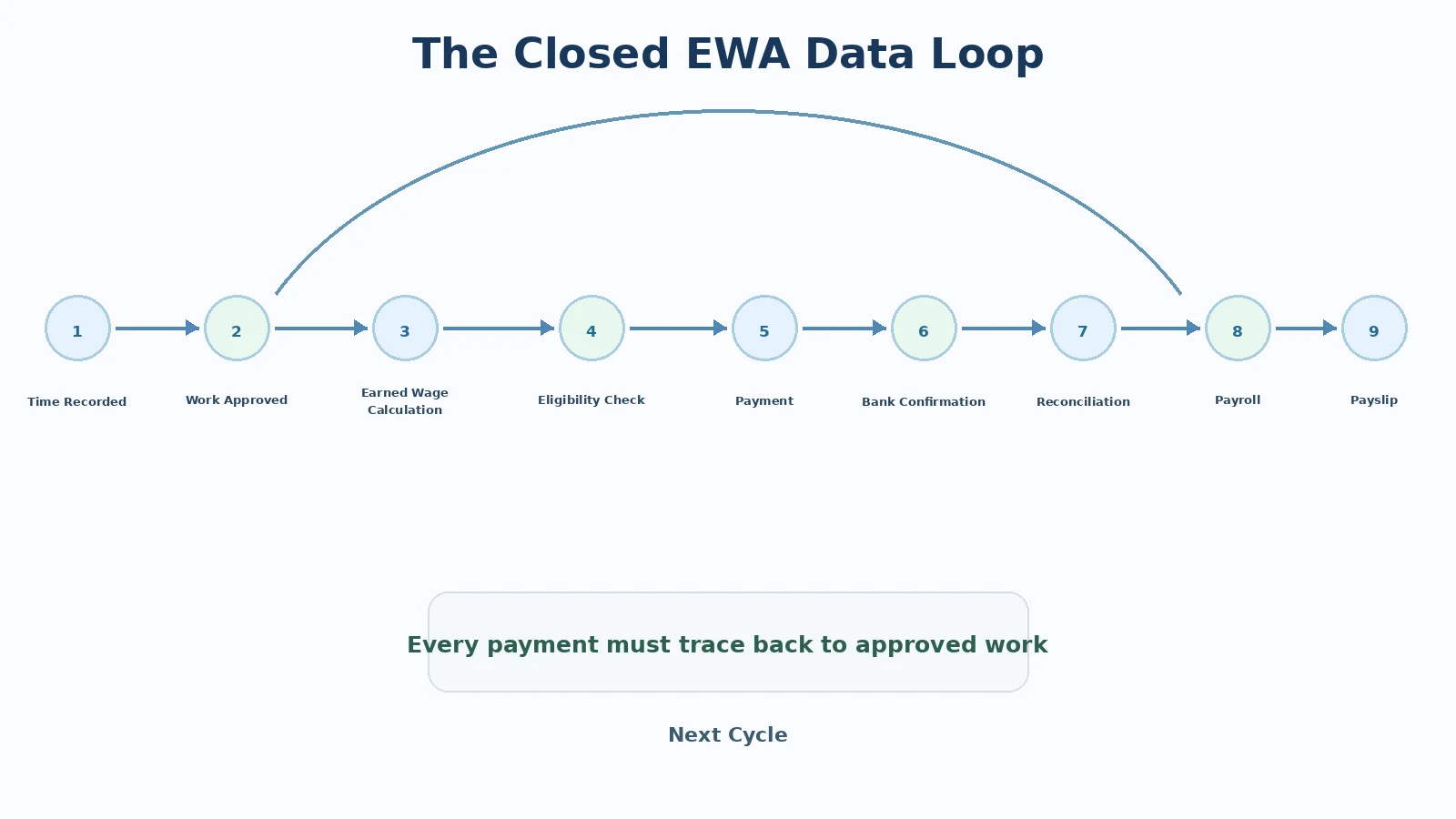
This chain makes every payment traceable to work performed.
Integration does not require one technology
The three domains may connect through:
- files;
- Google Sheets;
- APIs;
- or a combination.
What matters is that:
- data has a clear schema;
- linking keys are stable;
- the source of truth is defined;
- timestamps are retained;
- statuses are explicit;
- duplicate writes are prevented;
- an audit trail exists;
- exceptions can be handled.
A real-time API without idempotency or auditability is not necessarily better than a tightly governed batch file.
What if the three systems do not match?
The system should not choose a figure merely because it “looks reasonable”.
For example:
- timekeeping records eight hours;
- payroll receives six hours;
- EWA has paid based on eight hours.
This exception requires the organization to:
- preserve source data;
- identify the approved version;
- verify the transaction that occurred;
- calculate the impact;
- make a traceable business adjustment;
- reconcile again.
A financial system should not conceal differences by manually changing the final number.
Who should own each domain?
Responsibilities may be assigned as follows:
- operations/client: timekeeping source;
- HR/Payroll: pay period and rules;
- finance: transactions and reconciliation;
- IT/Engineering: integration and reliability;
- Product Operations: EWA flow coordination.
The exact RACI depends on the employer, but every data source must have an owner.
Integration KPIs to monitor
Useful measures include:
- rate of work records matched to workers;
- rate of work approved on schedule;
- duplicate record count;
- synchronization error count;
- pending transaction count;
- percentage of transactions matched to statements;
- payroll difference count;
- exception handling time;
- mapping correction count;
- percentage of reconciliation periods fully closed.
The goal is not merely that “the API works”, but that end-to-end data can be matched.
Conclusion
EWA must connect timekeeping, payroll and banking because no single system holds the complete truth. Timekeeping proves work performed, payroll places it in the correct period and rules, and banking confirms what money was actually paid. When the domains share linking keys, audit trails and reconciliation controls, EWA can operate quickly while preserving Payroll Integrity.
Author: Do Huy Le — General Director, Nhan Kiet Manpower Supply Co., Ltd.
EWA advice for employers: Hotline 0937.022.655 · Email info@nhankiet.vn · Learn about EWA for employers
FAQ
Must EWA replace the current timekeeping system?
Not necessarily. An existing source can be integrated if its data quality and controls are sufficient.
Can only a month-end file be imported?
That may support period-end payroll, but EWA during the period needs sufficiently current data to reflect accrued work.
Does the bank need to know timekeeping data?
Not necessarily. The bank needs appropriate transaction data; the EWA layer links transactions to timekeeping and payroll.
Which system is the final “source of truth”?
No single system is authoritative for every data type. Work belongs to timekeeping, periods and rules to payroll, and payment outcomes to banking; Reconciliation connects them.