
How do monthly, semi-monthly, weekly pay and EWA differ?
Dieser Beitrag ist noch nicht auf Deutsch verfügbar – Sie lesen die englische Fassung.
Monthly, semi-monthly and weekly pay differ in how often workers receive their regular pay and how often employers must complete payroll. Earned wage access (EWA) can instead add an option between paydays: eligible workers access part of the wages they have already earned while the main payroll cycle remains in place.
The first difference is when money becomes available
When employers discuss flexible pay, they often combine three separate questions: the unit used to calculate wages, the payroll cycle and the point at which workers can access money. These are distinct.
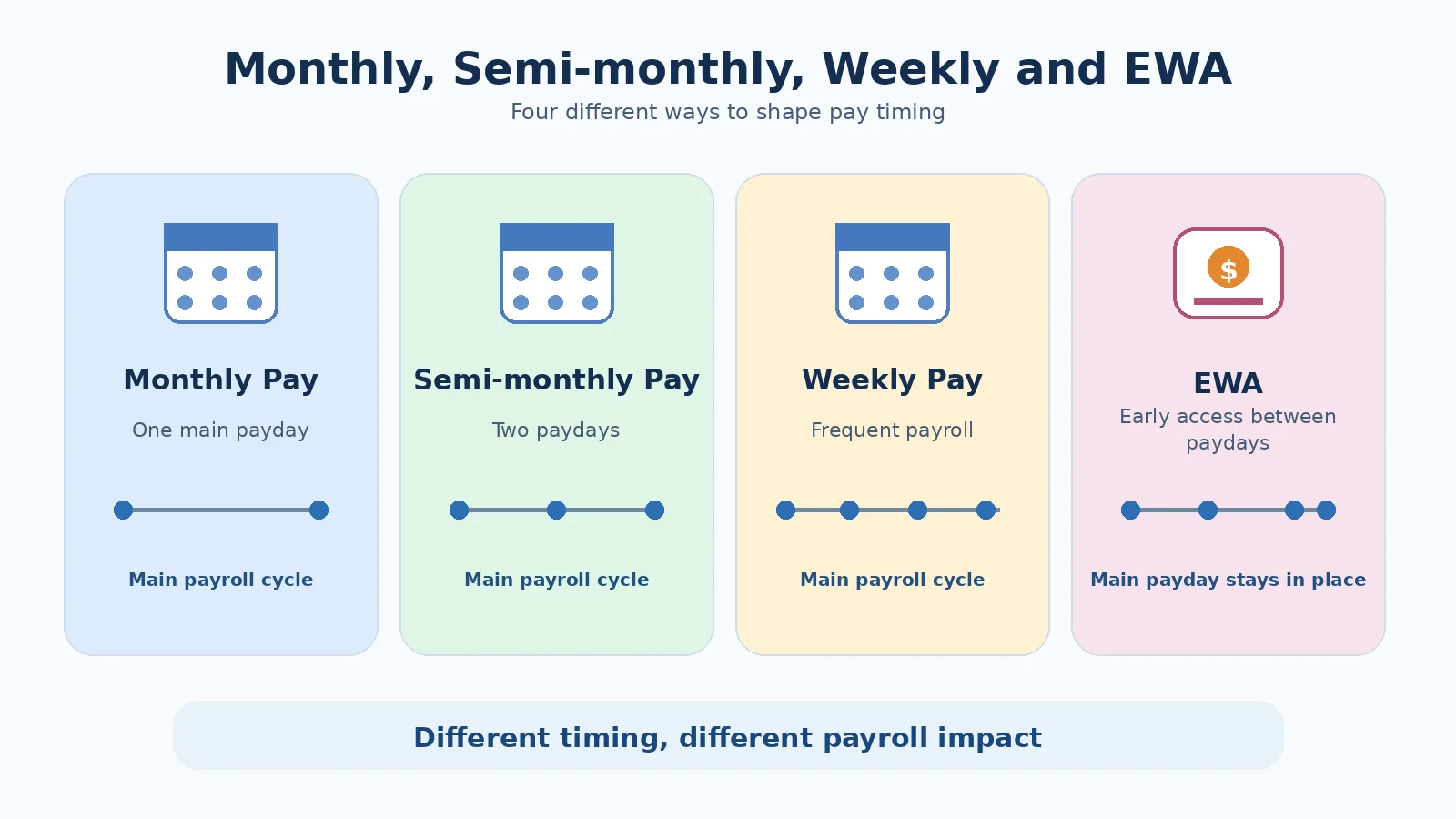
For example, a worker may earn a monthly salary while the employer pays it in two installments during the month. EWA can retain the main payroll cycle and add access to part of the wages already earned between paydays. A useful comparison therefore asks three questions: when do workers receive money, how many times must the employer run payroll, and which data must be finalized before each payment?
A quick comparison of four approaches
The table looks at the four approaches from an employer's operational perspective, rather than by the unit used to calculate wages.
| Criterion | Monthly pay | Semi-monthly pay | Weekly pay | EWA |
|---|---|---|---|---|
| Access to earnings | Once per monthly cycle | Twice a month | Weekly | Between paydays when eligible |
| Main payroll cycle | One principal cycle | More cycles than monthly pay | More frequent cycles | Existing main cycle can remain |
| Pressure to finalize time records | Concentrated at period end | More cutoff points | Higher because cutoffs are frequent | Focused on approved work records |
| Process changes | Limited if the current process works | Moderate | Greater | Concentrated in data, eligibility and reconciliation |
| Worker experience | Wait until payday | Shorter wait | More frequent income | More control between paydays |
| Key control | Accurate payroll calculation | Accurate data at each cutoff | Reliable operation of multiple cycles | Approved work, available amount and final settlement |
Monthly pay: a simple operating rhythm but a longer wait
Monthly pay suits employers that want to maintain one principal payroll cycle, with time to collect attendance, overtime, allowances, leave and adjustments before closing it.
HR, payroll and finance have one main deadline to prepare data, review it and make payments. In return, workers wait until payday to access most of that period's income. If a need arises mid-month, the employer needs a separate support mechanism.
Semi-monthly and weekly pay: more frequent access, more payroll runs
Semi-monthly pay shortens the gap between payments but adds another data cutoff. Weekly pay offers still more frequent access, but requires prompt updates to attendance, leave, overtime and adjustments. For employers with complex shifts or late time records, weekly payroll can place substantial pressure on operations. Changing the pay cycle changes the operating process, not just the date of a bank transfer.
EWA can preserve the main payroll cycle
Earned wage access takes another approach. Rather than requiring a complete payroll run several times a month, a system can determine the wages generated by work performed and approved, then allow eligible workers to access part of that amount before the regular payday.
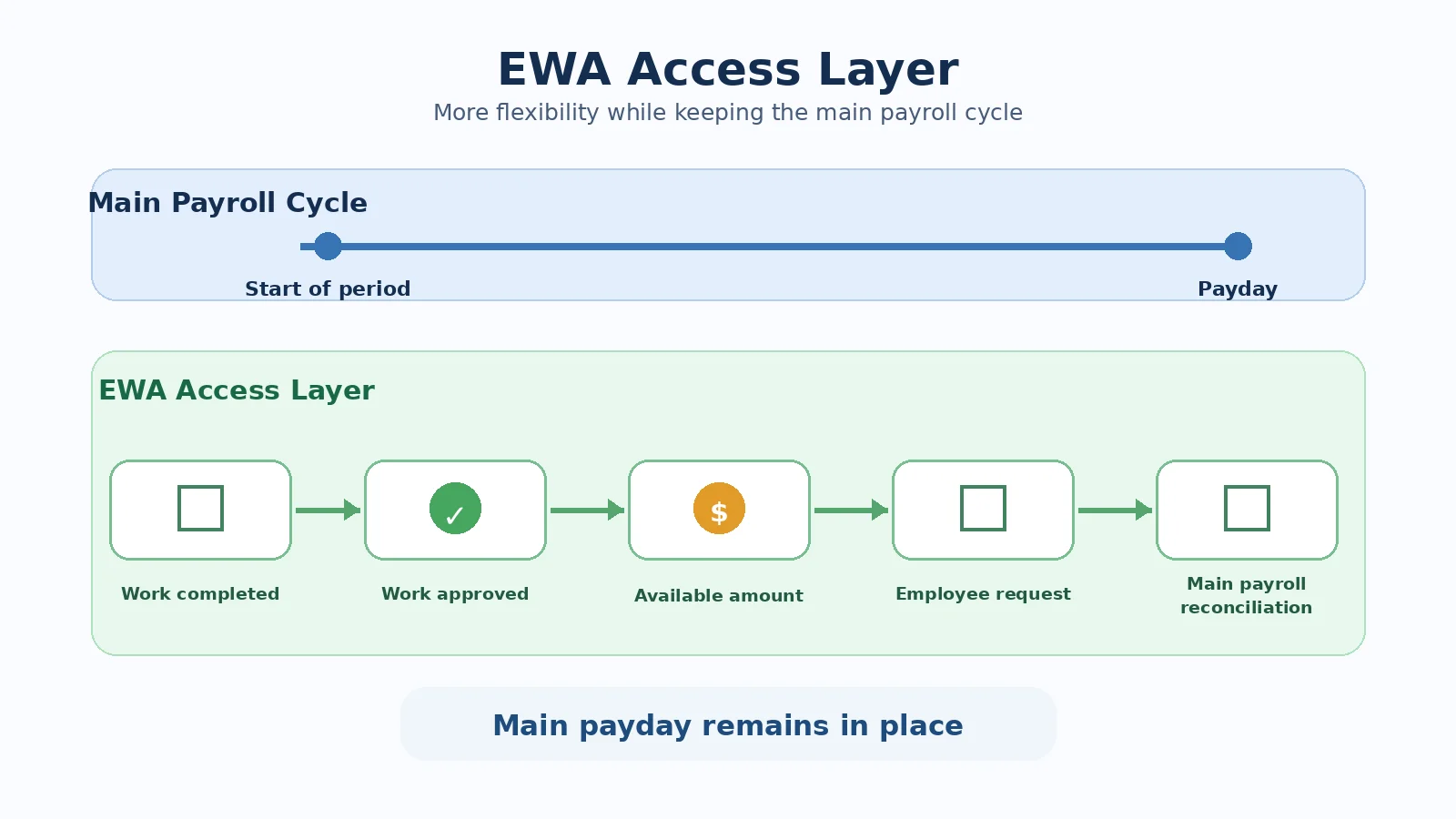
For Nhan Kiet's earned wage access solution, the calculation principle is:
Available amount = (approved workdays × daily wage rate) − amount already accessed in the period − the portion retained under the employer's policy
The amount accessed between paydays is reflected in the corresponding payroll period. EWA can therefore suit employers seeking more flexibility without turning one monthly payroll cycle into several complete payroll cycles.
Which approach should an employer choose?
Start with the problem to solve. Monthly pay suits an employer prioritizing a simple process. Semi-monthly pay shortens the wait for the whole workforce. Weekly pay suits operations that can finalize time records quickly and run payroll often. EWA can suit an employer that wants to keep its main payroll cycle while giving eligible workers more choice between paydays.
Before deciding, consider at least five questions:
- How quickly are time records completed and approved?
- How much of the current payroll process is manual?
- Do workers need more frequent regular pay, or support between paydays?
- How many additional internal steps would each increase in payment frequency create?
- Does the employer want to change the main pay cycle or add a flexible access option?
Two principles for making the right choice
First, greater flexibility does not mean paying as often as possible: every increase in frequency adds a data and control cycle. Second, separate the main payroll cycle from the need to access earnings between paydays. This gives employers more choices than a simple monthly-versus-weekly decision.
Learn more about earned wage access for employers and what earned wage access means.
Conclusion
Monthly, semi-monthly and weekly pay and EWA create different experiences of income, with different operational effects. The first three directly change the regular payment rhythm; EWA can add flexibility while retaining the current main payroll cycle. Employers should choose according to the quality of time records, payroll capacity and workers' actual needs.
Author: Do Huy Le — General Director, Nhan Kiet Manpower Supply Co., Ltd.
Advice on earned wage access for employers: Hotline 0937.022.655 · Email info@nhankiet.vn · Earned wage access for employers
FAQ
Is EWA the same as weekly pay?
No. Weekly pay changes the main payroll rhythm to a weekly cycle. EWA can preserve the existing cycle while allowing eligible workers to access part of their earned wages between paydays.
Is semi-monthly pay the same as EWA?
Not exactly. Semi-monthly pay establishes two scheduled main payment dates. EWA depends on each worker's eligibility and needs within the employer's policy.
Must an employer change employment agreements when changing the pay cycle?
A change to the pay cycle needs to align with employment agreements, internal policies and current rules. Employers should review the relevant documents before changing their main payment arrangements.
Does EWA increase a worker's total wages?
No. EWA changes when a worker can access part of wages generated by work performed and meeting the relevant conditions. Total earnings for the period still depend on the actual payroll calculation.