
Qu’est-ce que l’integrite de la paie ?
Payroll Integrity is the ability to keep the entire pay data chain consistent, traceable, and free from duplicate calculation or payment. It covers time capture, work approval, eligible amount calculation, payments, reconciliation, and the payslip. With EWA, it matters even more because money may move before the main pay period closes.
Payroll Integrity is more than “calculating pay correctly”
A month-end payroll can look correct while earlier data lacks an audit trail or systems disagree. Payroll Integrity asks where work data came from, who approved it, which work created value, how the amount was calculated, what was paid or pending, how it was reconciled, and how the payslip reflects it.
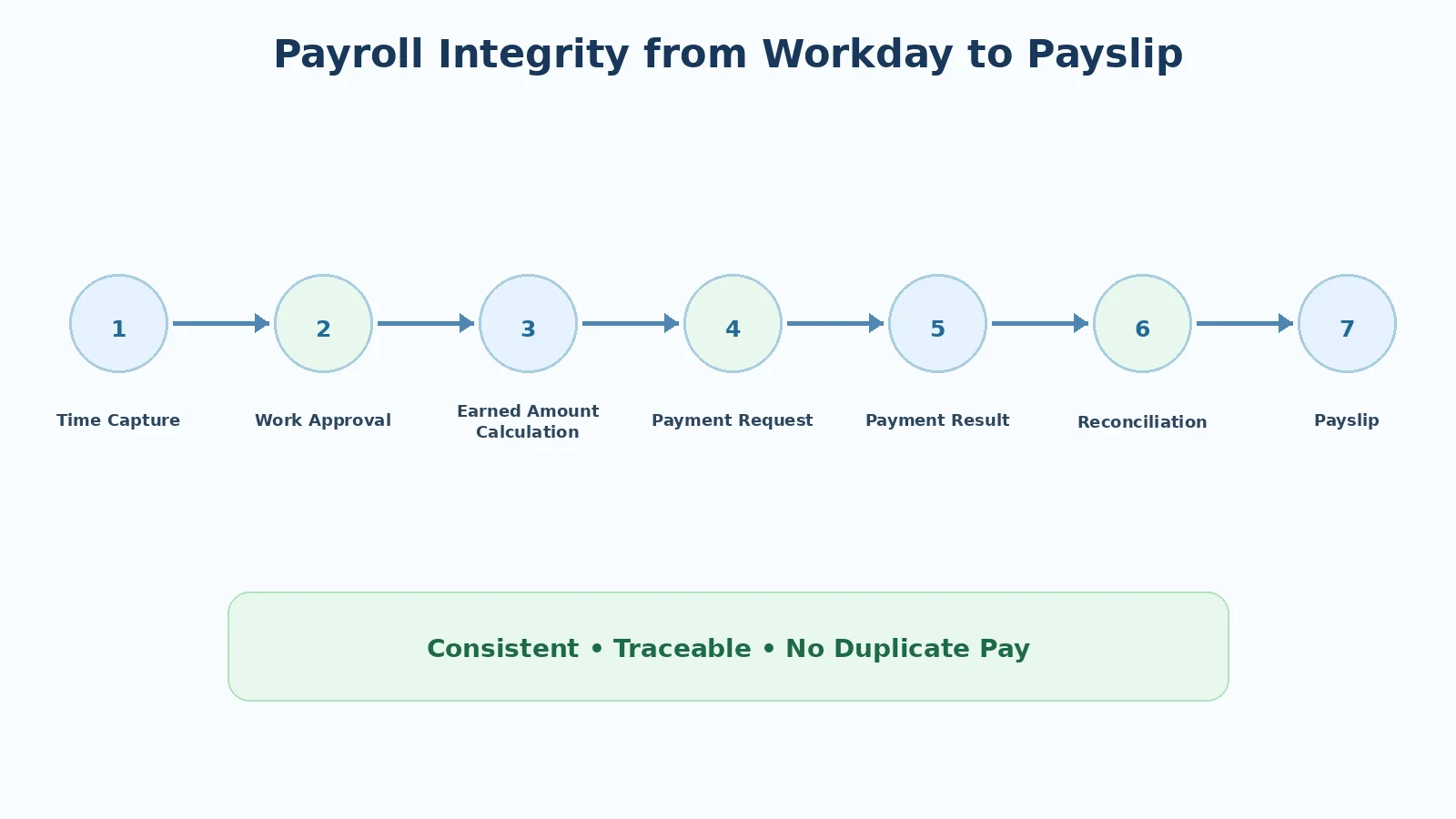
The central rule is that systems must not each hold a different version of the truth.
Four core principles of Payroll Integrity
1. Every data point has a clear origin
For each workday, identify the worker, workplace, date or shift, source, current status, approver, and whether it changed after approval.
2. Every change is traceable
Keep the before value, after value, editor, time, reason, and post-change status. Do not retain only the final value.
3. One amount is never paid twice
Amounts already used to create a payment must be recognized during reconciliation. Prevent duplicate EWA, full repayment of an amount already received, replay of an unclear bank transaction, and duplicate work from several sources.
4. Ledgers reconcile at period end
The chain should connect approved work → calculated amount → paid transaction → bank or reconciliation record → amount received → payslip. A mismatch should enter an exception process rather than be guessed away.
Points where integrity is easily lost
| Risk point | What may happen |
|---|---|
| Unapproved work is calculated | Payment uses untrusted data |
| Approved work changes silently | Calculated amount no longer matches |
| One worker has several sources | Work is counted twice |
| Unclear bank status is resent | Duplicate payment risk |
| EWA and payroll use different keys | Final deduction is wrong |
| Edit history is deleted | No explanation is possible |
| Payslip omits received amount | Worker cannot check it |
Payroll Integrity is therefore a data and control problem, not just a pay formula.
The role of approved work
Approved work is a key input for EWA.
Available amount = (approved workdays × daily rate) − amount already received in the period − portion retained under employer policy.
Unapproved work should not create an available amount because shifts, hours, and records may still need correction. If approved work is edited, returning it to pending approval prevents an old approval from automatically covering new data.
Why does Payroll Integrity matter more with EWA?
Traditional payroll can catch many errors before the end-of-period payment. With EWA, money may leave while the period is open. Strong controls are therefore needed for approval, recalculation, duplicate locks, transaction status, daily or period reconciliation, and work edited after payment.
Three control layers
Data layer
Correct worker, workday, rate, and period.
Transaction layer
Correct amount, recipient, and status; unclear status remains pending; no duplicate sending.
Settlement layer
Reconcile received amounts once across EWA, bank, payroll, and payslip.
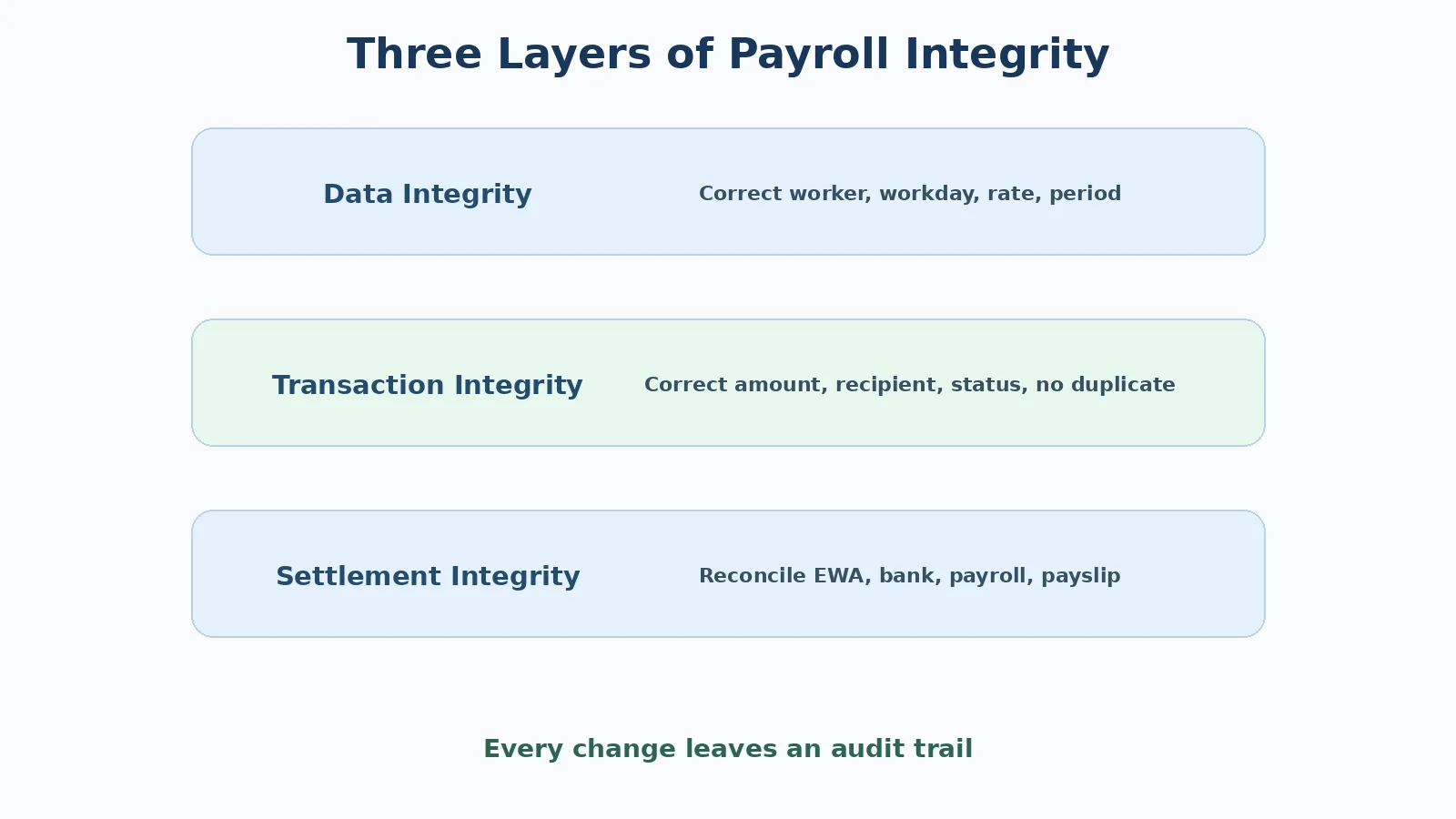
The three layers must connect through the same keys and audit trail.
What should an audit trail answer?
Who created, approved, and edited the record; what changed and when; amounts before and after; related transaction; affected payroll period; and who handled the exception. An audit trail also speeds up complaint handling.
Payroll Integrity and the worker experience
Workers should see approved and pending work, amounts received, successful or pending transactions, and the pay period where the amount is reflected. Self-checking narrows questions about why pay differs.
Which KPIs reflect Payroll Integrity?
Track timely approval, edits after approval, duplicate transactions, unclear statuses, reconciliation match rate, EWA-payroll differences, payslip complaints, and exception handling time. Do not measure payment speed alone.
Conclusion
Payroll Integrity keeps the pay chain correct, consistent, and traceable from start to finish. With EWA, work must be confirmed before creating value, every edit needs a trail, payments must resist duplication, and the period must reconcile across work, EWA, bank, payroll, and payslip. Speed matters only when integrity is preserved.
Author: Do Huy Le — Tổng Giám Đốc, Nhan Kiet Manpower Supply Co., Ltd.
Earned wage access advice for employers: Hotline 0937.022.655 · Email info@nhankiet.vn · Earned wage access for employers
FAQ
Is Payroll Integrity a software product?
No. It is a control principle spanning data, process, and technology.
Is correct month-end payroll enough?
No, if in-period data cannot be traced or was paid incorrectly or twice.
Why is approved work important?
It confirms the work data before it creates an eligible amount.
Should old values remain in the audit trail?
Yes. Before and after values are needed for explanation and reconciliation.