
How do file, Google Sheet and API integration differ for EWA?
Files, Google Sheets and APIs can all feed data into EWA, but suit different stages and operating needs. Files are simple, controlled batches; Sheets are flexible for pilots and spreadsheet workflows; APIs suit frequent automation and large-scale sources.
There is no single “best” option for every employer
The right question is not whether an API is more modern than a file, but which option fits current data sources, scale, speed and controls.
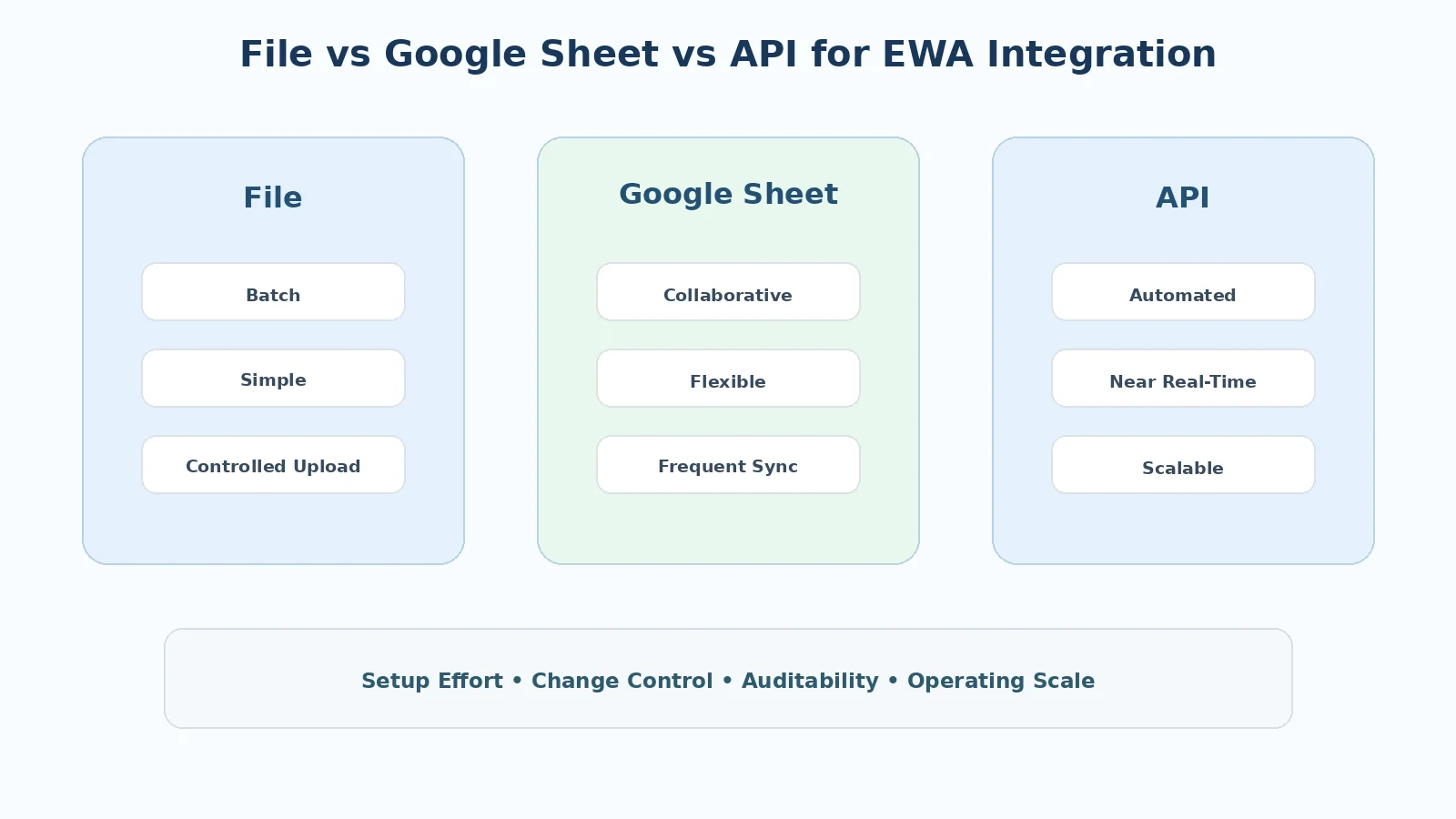
A sound system may use several methods for different clients.
How does file integration work?
The employer exports CSV or another agreed format. The file is created on schedule, placed in a controlled location, read by EWA, schema-checked, processed and followed by an error/result report.
Advantages: simple start, little dependency on source APIs, clear import snapshots and good batch support.
Disadvantages: not real-time, vulnerable to format changes and duplicates, dependent on cut-offs and sometimes manual work.
When is a file appropriate?
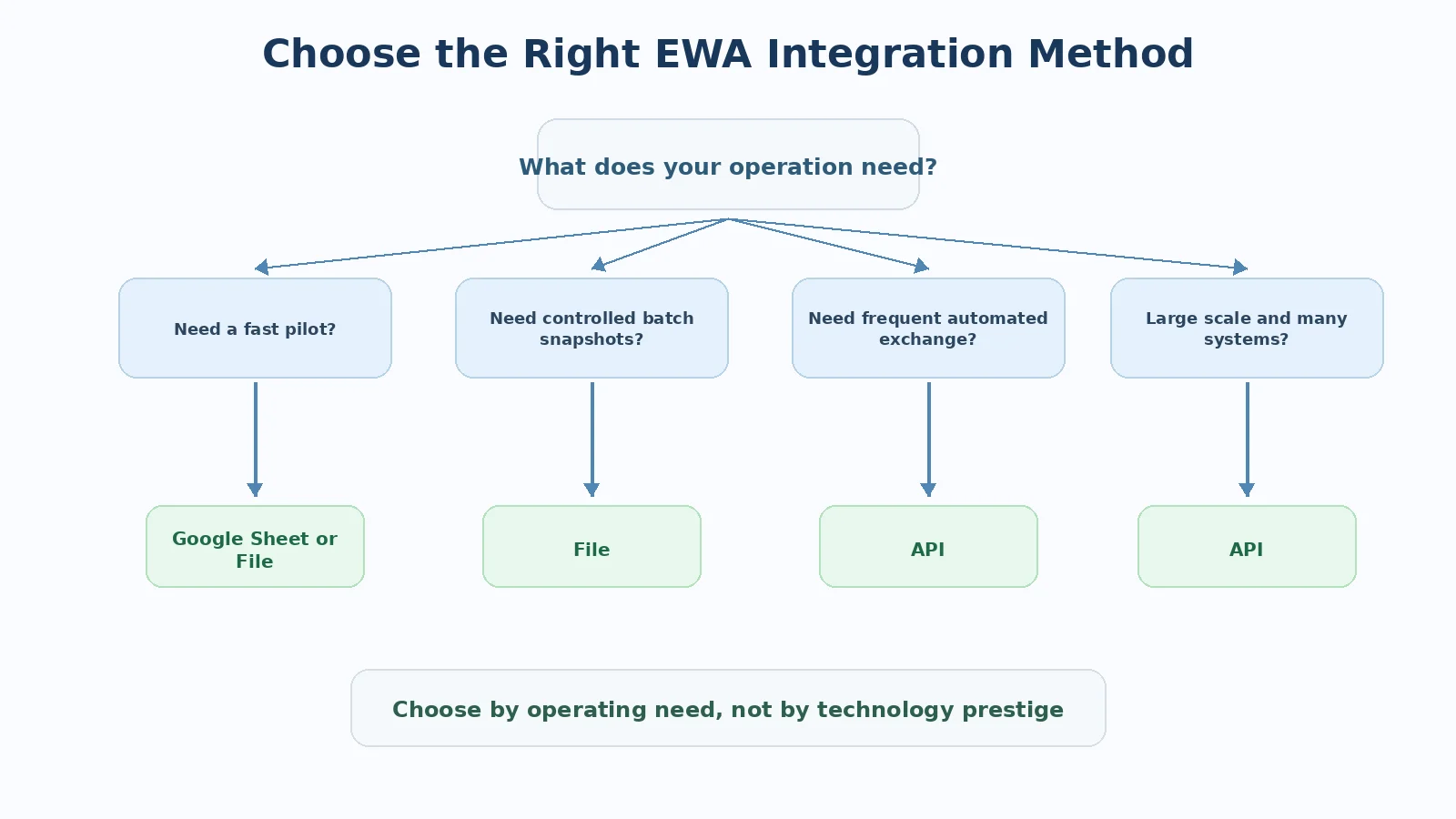
Use it when the source cannot expose an API, updates are periodic, the project is a pilot, source count is limited or clear snapshots are required. Daily or period snapshots also support reconciliation.
How is Google Sheet different from a file?
A Sheet is a living table that several people can edit.
Advantages include quick deployment, familiar operation, direct client updates, no repeated file sending and good transition support.
Risks include changed columns or permissions, inconsistent cell types, edits after synchronization and weak control when many people edit. Sheets therefore need stronger change control than batch files.
When is Google Sheet most suitable?
It suits clients already running timesheets in Sheets, fast pilots, unstable structures, direct data observation and scales that do not yet require deep automation.
Parser, timekeeping codes, night shifts and layout changes belong in a separate detailed guide; this article compares architecture.
How is an API different?
An API lets systems exchange structured data through a defined protocol.
Advantages: high automation, frequent updates, status responses, scale, schema contracts and less manual work.
Disadvantages: engineering effort, design and testing cost, uptime dependency, versioning, authentication, authorization, retries and idempotency. An API makes transfer more structured, but does not guarantee correct data.
Practical comparison table
| Criterion | File | Google Sheet | API |
|---|---|---|---|
| Update | Batch | Changes plus synchronization | Automated |
| Speed | Low–medium | Medium | Medium–high |
| Easy pilot | High | Very high | Medium |
| Initial cost | Low | Low | Higher |
| Audit snapshot | Good | Needs change logs | Good if designed well |
| Manual-edit risk | Medium | Higher | Lower |
| Scalability | Medium | Medium | High |
| Feedback | Result file | Column/status/log | API response/event |
| Versioning | File name/schema | Template control | API version |
| Multiple sources | Yes | Yes, harder at scale | Strong |
This is a qualitative framework, not an absolute ranking.
What controls does file integration need?
Control file name, period, schema, encoding, worker key, duplicate import, checksum/version, receipt timestamp, row-level errors and missing-file handling. Never overwrite a same-named file without detecting content changes.
What controls does Google Sheet integration need?
Control view/edit rights, owner, data range, column changes, date/time types, leading zeros, synchronization schedule, before/after logs and alerts when approved work is edited.
Flexibility requires stronger change governance.
What controls does an API need?
It needs a clear schema, authentication, authorization, request IDs, idempotency, timeout, safe retry, versioning, rate limits, monitoring, logs and, where appropriate, a dead-letter/error queue.
Public material should not expose real security details.
Choosing by implementation stage
Pilot stage
Sheets or files launch quickly. Priorities are validating data, mapping, time records, reconciliation and exceptions.
Stable stage
Continue with well-run files/Sheets or move high-volume flows to APIs.
Expansion stage
As users, clients or frequency grow, APIs reduce manual work and increase automation. Sources need not migrate at once.
Can a hybrid model be used?
Yes: client A's time data via API, client B via Sheet, period-end payroll via file, banking via API and reconciliation via file or statement.
The EWA normalization layer must map every source into one data model. Hybrid architecture is normal in large employers.
Do not let the integration channel decide the source of truth
File, Sheet and API are only transport channels. Define separately where work, payroll and bank status come from and who approves them. Without this, even an API can produce conflicting data.
Handling schema changes
Every method can change.
File
Columns may be added, removed or change type.
Google Sheet
Users may insert rows, rename columns or merge cells.
API
Endpoint versions or fields may change.
The process should detect the change, avoid guessing, quarantine bad data, test, approve the new configuration and record its version.
Integration KPIs to compare
Track successful reads, source-to-EWA latency, schema errors, duplicates, mapping errors, manual interventions, resynchronization, post-change errors, operating cost and reconciliation match rate.
Real performance determines whether an API migration is justified.
When should a Sheet or file move to an API?
Consider it when data volume and update frequency rise, many people edit, locations multiply, two-way status is needed, manual work grows, schema errors recur, audit requirements increase and a capable technical team exists.
Do not migrate merely to appear “more modern”.
Conclusion
Files, Google Sheets and APIs are three data transport methods, not absolute quality levels. Files suit controlled batches, Sheets suit pilots and flexible operations, and APIs suit deep automation and scale. Choose according to required speed, data quality, auditability, operating cost and source-system maturity.
Author: Do Huy Le — General Director, Nhan Kiet Manpower Supply Co., Ltd.
EWA advice for employers: Hotline 0937.022.655 · Email info@nhankiet.vn · Learn about EWA for employers
FAQ
Is a file only a temporary solution?
No. A batch flow can run long term when schema, cut-off and audit are well governed.
Is Google Sheet secure?
Security depends on access, structure, change logs and operating controls; the Sheet itself does not guarantee it.
Is an API always faster?
No. Speed also depends on source systems, queues, approvals and downstream processing.
Can all three methods be used?
Yes. Hybrid models often suit employers with varied clients and systems.