
為什麼形成可領取金額前必須審批工作日?
A workday should be approved before it creates an amount that a worker can receive because raw timekeeping data may not yet be accurate enough to calculate money. Approval confirms the worker, date, shift, hours, and exceptions before the record enters the earned wage calculation.
Timekeeping and work approval are different steps
Timekeeping answers: has the system recorded a work event?
Approval answers: is that record reliable enough to calculate money?
A time record may exist while still having a missing clock-out, wrong shift, wrong workplace, unconfirmed overtime, missing leave update, duplicate data, or an unmatched worker code.
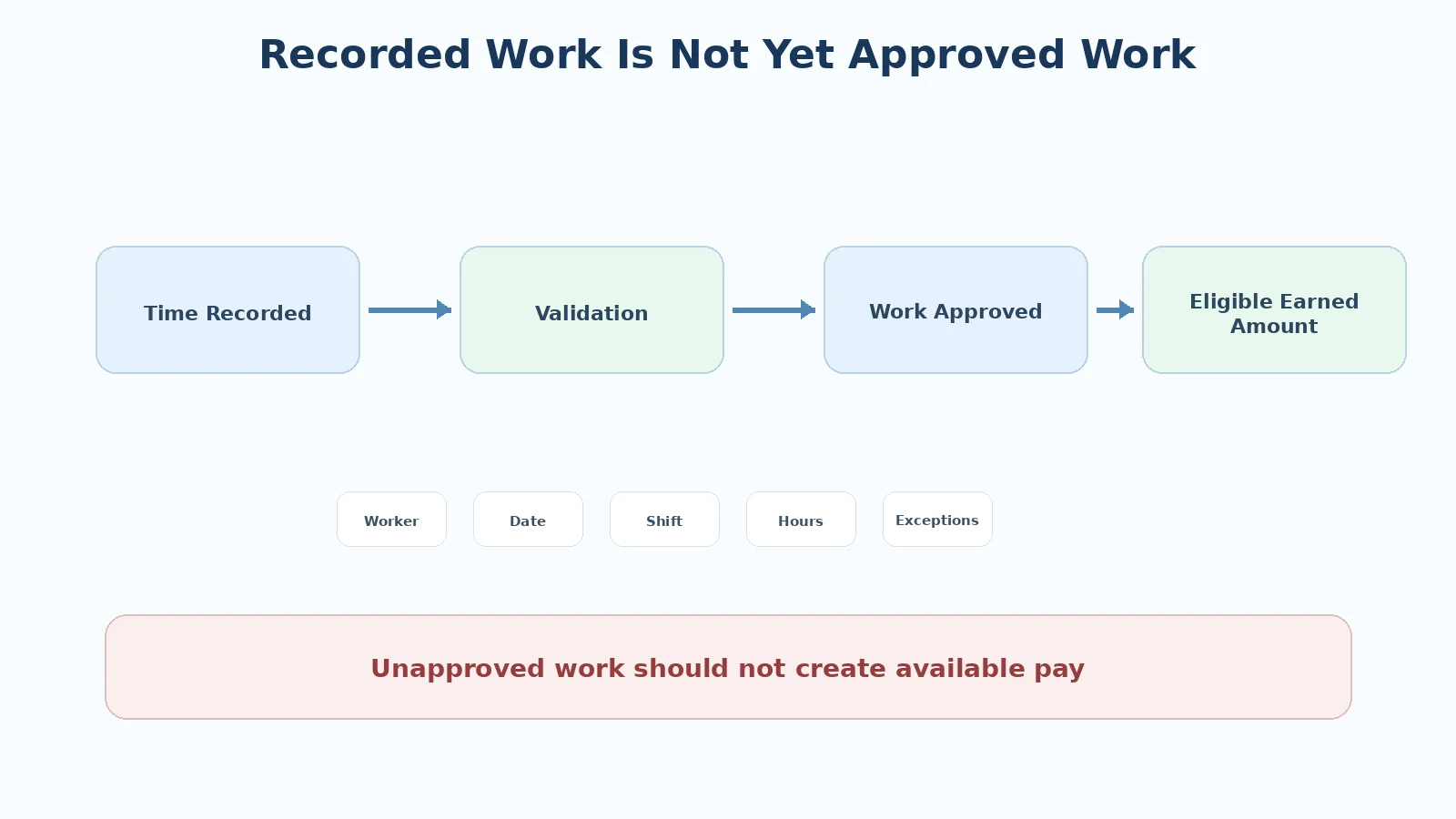
If approval is skipped, an incomplete record can become money.
How does approval protect workers?
Approval does not protect only the employer. It also helps workers avoid receiving money from incorrect work and then facing an adjustment at period end. It reduces wrong workplace, wrong overtime, sudden changes to the available amount, and disputes over data that has not completed review.
Preventing an error before payment is usually easier than recovering or adjusting money after it has moved.
How does approval protect the employer?
For an employer, approval confirms the data before a payment obligation is created. It reduces payment above actual work, duplicate records, a wrong daily rate from a wrong workplace, wrong shifts, difficult period-end reconciliation, and differences after payroll is locked.
With a large workforce, a small repeated error can create a significant difference.
How is the available amount formed after approval?
In Earned Wage Access, approved work is an input to the amount that can be received.
Available amount = (approved workdays × daily rate) − amount already received in the period − amount retained under the employer policy.
This means unapproved work does not enter the calculation, prior receipts reduce the remaining amount, and the full value of approved work is not necessarily opened for early receipt.
Approval is necessary, but it is not the only condition.
Why not use recorded work immediately for speed?
Using recorded work immediately may be faster, but it increases risk.
| Situation | If calculation uses unapproved work |
|---|---|
| Missing clock-out | Hours may be calculated incorrectly |
| Wrong shift | The wrong rule may be used |
| Duplicate data | Money may be added twice |
| Unconfirmed overtime | An ineligible amount may be included |
| Wrong worker code | Money may attach to the wrong profile |
| Work edited later | A difference must be handled after payment |
A sound financial system should not trade away accuracy for a few minutes of speed.
What happens if approved work is edited?
An approval confirms the data version at that time. If clock-in, clock-out, or shift data changes after approval, the new record should not automatically remain approved.
In the Earned Wage Access design, edited approved work returns to pending approval so it can be reviewed again.
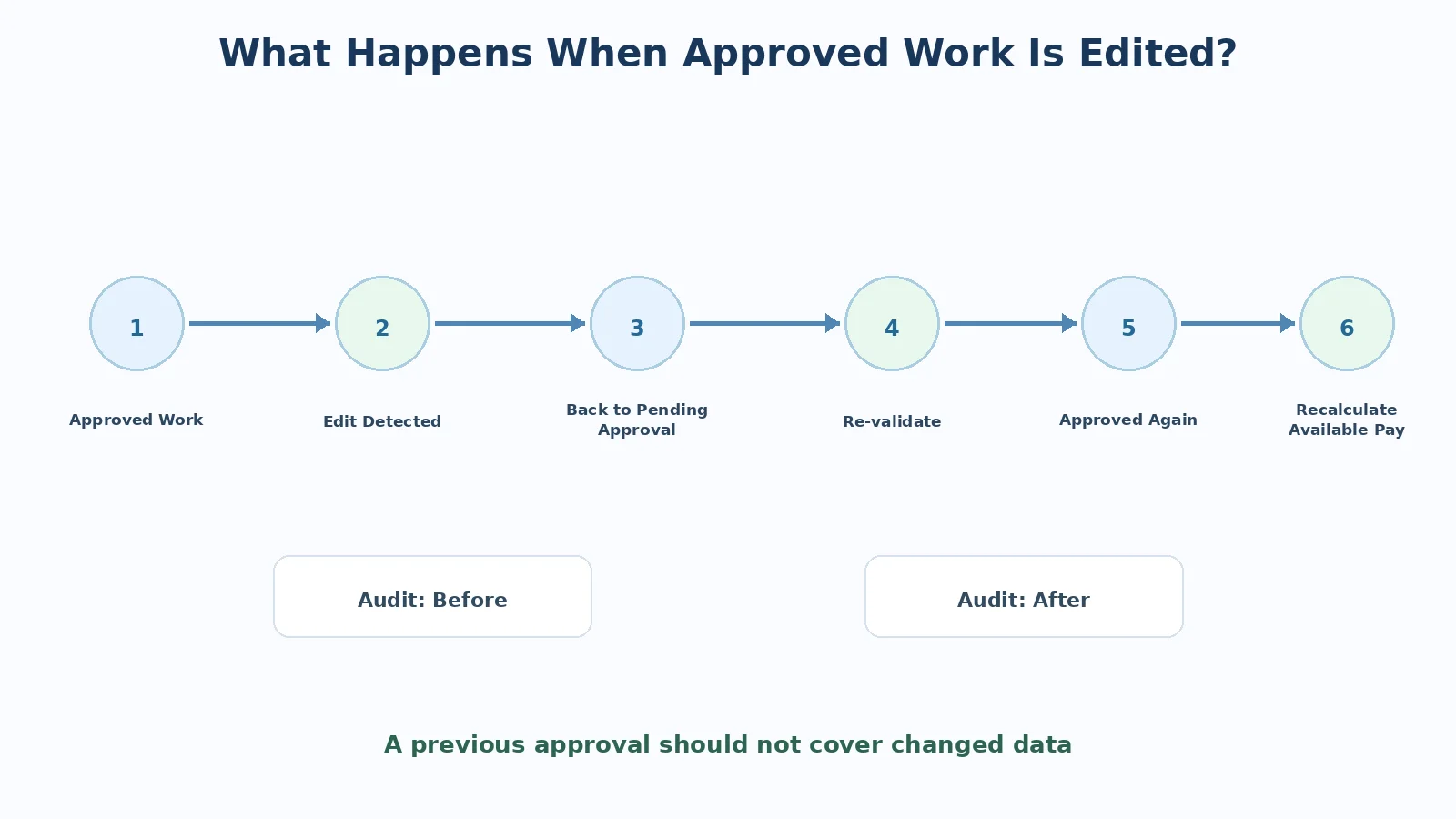
This prevents an old approval from covering new data.
Who should approve work?
Depending on the operating model, the approver may be a team leader, shift leader, supervisor, manager, client representative, operations, or HR.
The key questions are whether the person has the right authority and scope, carries responsibility, leaves an action history, and has a replacement when absent. One person should not create, edit, and approve every exception without control.
What is the impact of slow approval?
If work is approved slowly, a worker may have already worked while the available amount has not increased. This weakens the value of EWA.
Employers should track people with pending work, records waiting too long, median time from capture to approval, people with no available amount because approval is missing, and each approver's backlog.
Approval is a leading operating metric, not only an administrative action.
How can control and speed be balanced?
Adding more approval levels does not automatically make a process safer. A good process defines authority, filters exceptions automatically, approves normal records quickly, reviews unusual records carefully, provides a substitute, syncs after approval, and keeps an audit trail.
The goal is fast approval without removing control.
What should workers see in the application?
To reduce confusion, the application should show recorded days, pending approval, approved days, rejected or incomplete work, the update time, and instructions for reporting an incorrect record.
It should not show only a zero available amount without explaining the reason.
Conclusion
Workdays must be approved before they create an available amount because raw timekeeping data is not yet reliable financial data. Approval confirms the worker, date, shift, and exceptions before money is calculated. For EWA, this control protects workers and preserves Payroll Integrity for the employer.
Author: Do Huy Le — Tổng Giám Đốc, Nhan Kiet Manpower Supply Co., Ltd.
Earned wage access advice for employers: Hotline 0937.022.655 · Email info@nhankiet.vn · Earned wage access for employers
常見問題
I have clocked in. Why is there no available amount yet?
The new record may still be pending approval, or another condition may not be complete.
Does approved work equal final pay?
No. Approved work is an important input, while final payroll includes other components and adjustments.
Does work approval mean approval for every receipt request?
No. Approval confirms the input data. A worker can request a receipt when the other conditions are also met.
Does edited approved work need approval again?
Yes, as a control principle. The new data should be confirmed before it is used again for calculation.