
已审批工时被修改后为什么必须重新审批?
When an approved work record is edited in a way that affects work value, it should return to pending approval. The earlier approval applied only to the old data version. The new version must be confirmed before it is used to calculate an available amount or settle payroll.
One approval confirms one data version
Suppose a manager approves an eight-hour shift. Someone later changes the record to six hours.
If the status remains approved, the system implies that the manager approved six hours even though the manager only approved eight. That is a control gap.
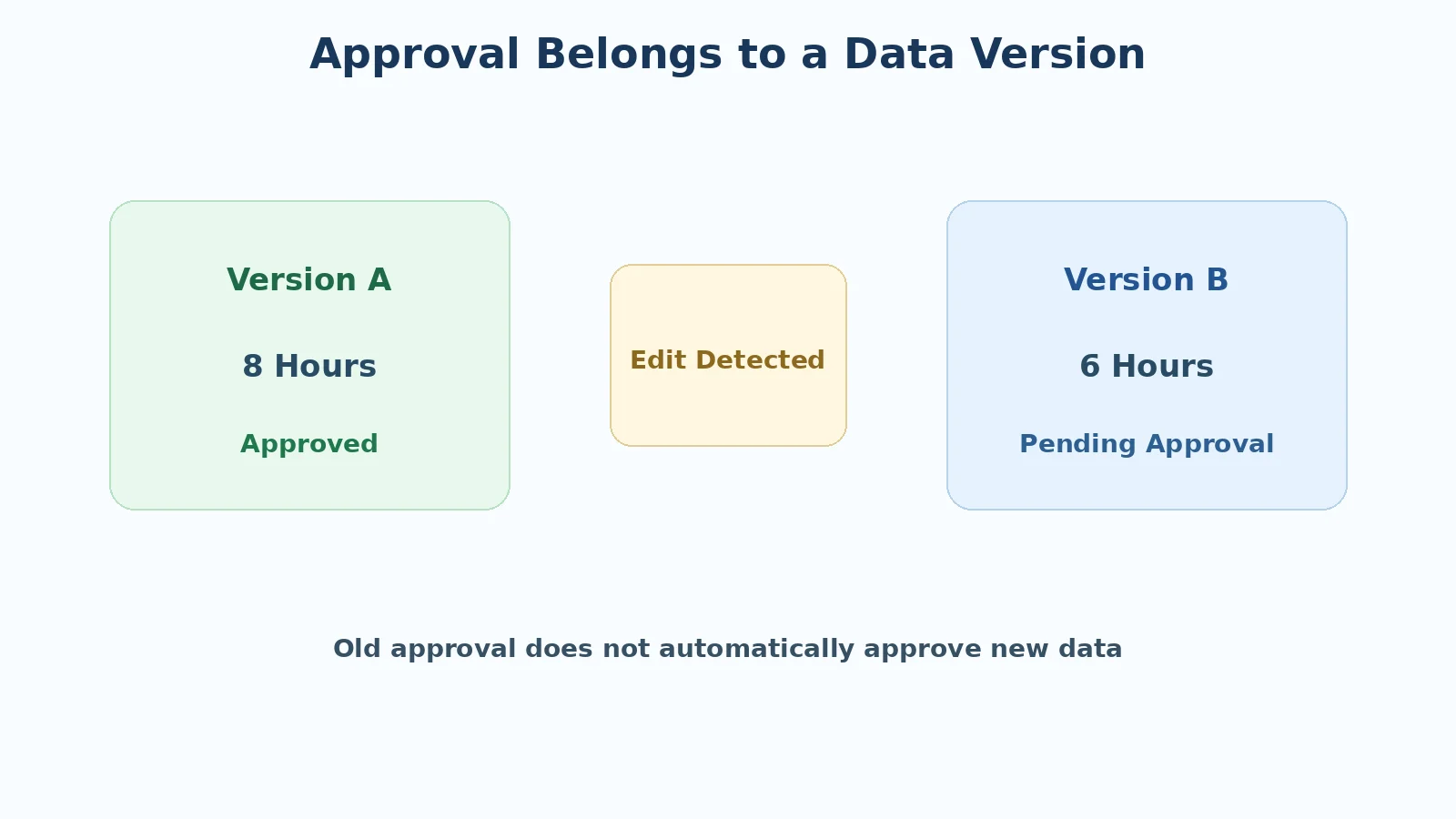
The correct principle is: a material data change makes the old approval invalid for the new version.
Which changes may require approval again?
Depending on the process, changes that often affect work value include clock-in, clock-out, shift, hours worked, overtime, leave or work status, workplace, a work code linked to the rate, and deleting or merging a record.
Not every display change carries the same risk, but data that affects money should be tightly controlled.
A standard process after an edited work record is found
A safe flow is:
- record that the work record changed;
- save the before and after values;
- return the status to pending approval;
- pause use of the new version to create additional value;
- have an authorized person verify it;
- approve or reject the new version;
- recalculate the eligible amount;
- if a transaction already exists, move the difference into reconciliation.
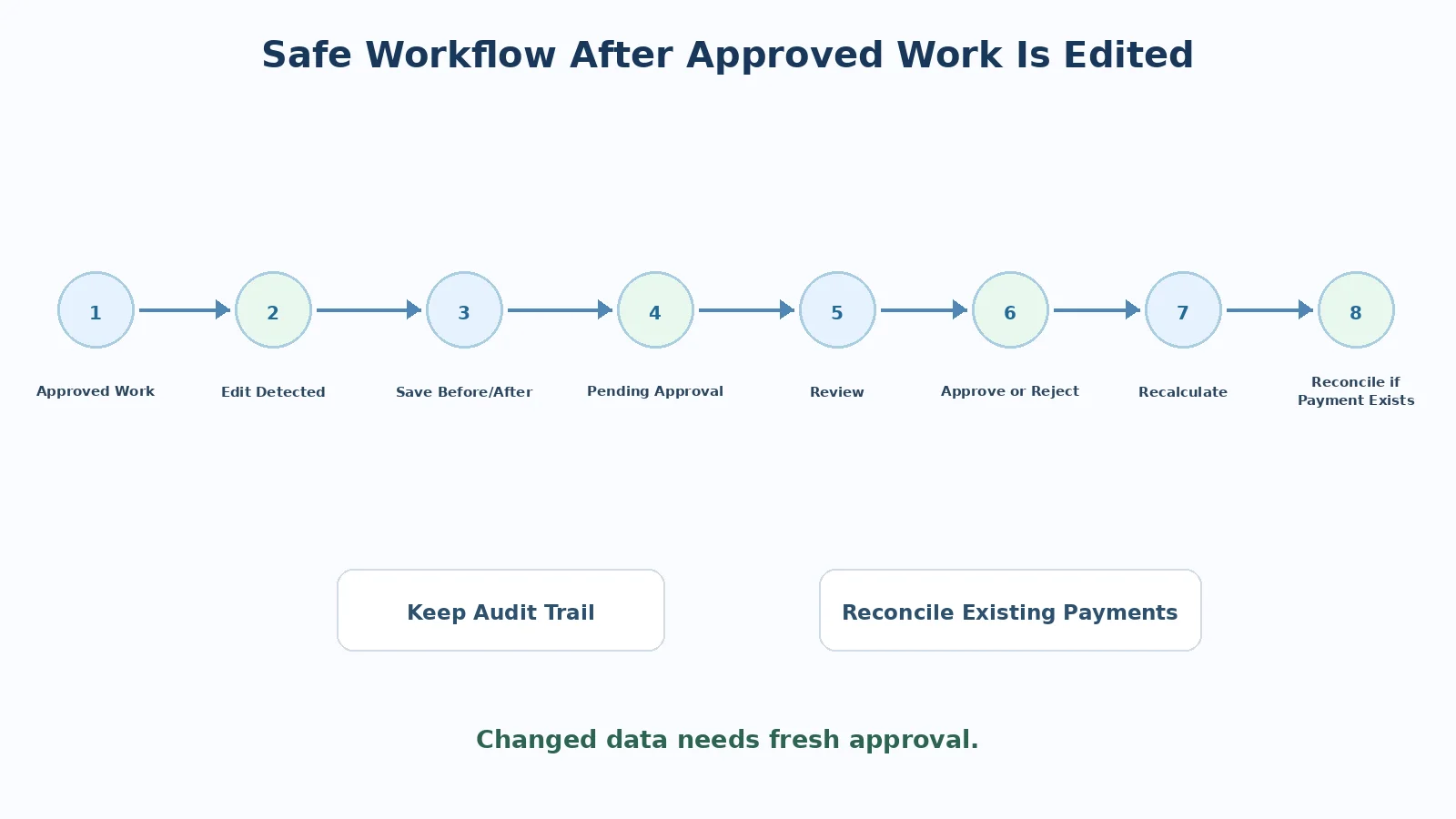
This protects both data and money.
Why should before and after values be saved?
If only the new value is kept, the employer cannot answer what the old record was, who changed it, when and why it changed, which data the earlier approver saw, or how much the available amount changed.
A minimum audit trail should include:
| Field | Content |
|---|---|
| Record | Work ID, date, shift |
| Before edit | Old value |
| After edit | New value |
| Editor | Account and role |
| Time | Date and time |
| Reason | Reason code or description |
| Status | Before and after |
| Re-approver | If any |
| Money impact | Before and after value |
This is the foundation for explaining changes to workers and payroll.
Work edited before the worker receives money
This case is simpler. If no transaction exists, the record returns to pending approval, the available amount is recalculated from the currently eligible work, and the available balance is updated after the new version is approved.
No money needs to be recovered because no transaction has occurred.
Work edited after money was received
This case is more complex. A completed payment is a real financial event. The transaction must not be deleted simply because the work data changed.
The system should keep the transaction history, recalculate work value from the newly approved version, compare it with the amount received, identify any difference, handle that difference through the appropriate settlement or approval process, and retain the full trail.
A difference should not automatically become a new worker obligation when the policy and basis for handling it have not been clearly established.
What if work increases after the edit?
For example, a record changes from six hours to eight hours after verification. Once the new record is approved, the eligible value may increase under the formula and other rules.
The server must recalculate the value; the interface should not merely add a difference.
What if work decreases after the edit?
If work value decreases, the next available amount may decrease. If the worker has not received more than the revised amount, the system updates the remaining amount. If total receipts exceed the revised value, the case enters reconciliation.
The system should not silently deduct an amount that the worker cannot trace.
Why should the editor not re-approve every change?
In internal control, letting one person edit and approve their own change can create risk.
For material changes, the employer should consider separating the editor, approver, and exception controller. The degree of separation depends on the size and system, but money-affecting changes need clear responsibility and a trace.
Effect on the available amount
After re-approval, Earned Wage Access follows this principle:
Available amount = (approved workdays × daily rate) − amount already received in the period − amount retained under the employer policy.
An edit may make the available amount increase, decrease, become zero, or remain unchanged when the change does not affect the calculation. Workers should be informed when a change affects the amount shown.
What should the client portal display?
A manager should see the edited record, current status, before and after value, editor, reason, related transaction, and processing priority.
Records linked to a transaction should receive a higher exception priority.
Which KPIs should be tracked?
An employer can track edits after approval, edits after a transaction, time from edit to re-approval, financial differences, common edit reasons, workers or units with an unusually high edit rate, and complaints about edited work.
These indicators improve the source process; they are not intended to judge users.
Conclusion
Edited approved work is a new data version that needs confirmation again. Returning it to pending approval, saving before and after values, recalculating the available amount, and keeping payment history are the foundation of Payroll Integrity. A good system does not block every edit; it ensures that every money-affecting edit is controlled and traceable.
Author: Do Huy Le — Tổng Giám Đốc, Nhan Kiet Manpower Supply Co., Ltd.
Earned wage access advice for employers: Hotline 0937.022.655 · Email info@nhankiet.vn · Earned wage access for employers
常见问题
Does editing a note require approval again?
Not necessarily. Classify which changes affect pay calculations. Material changes should require approval again.
Should a worker know that work was edited?
There should be a notification or a status view so the worker can understand why the available amount changed.
Does editing approved work remove the old transaction?
No. A completed transaction stays in history and enters reconciliation.
Can the employer block all edits after payment?
Permissions can be restricted, but an exception process is still needed to correct real errors. An absolute lock may leave incorrect data unresolved.