
预留缓冲如何降低期末对账风险?
A reserve buffer reduces reconciliation risk by keeping part of the estimated earned value unavailable for early receipt until the pay period closes. The retained portion creates room for work edits, late data, employment changes, and valid payroll adjustments that may appear between early access and final settlement.
Where does the reserve buffer sit in the Payroll Integrity chain?
In Earned Wage Access, approved work is the basis for an available amount. Approved work during the period does not mean that the full payroll has been settled.
Between early receipt and pay-date closing, work can be edited, overtime can be updated, leave can be adjusted, another source can arrive, a worker can change workplace, or payroll can have another valid adjustment.
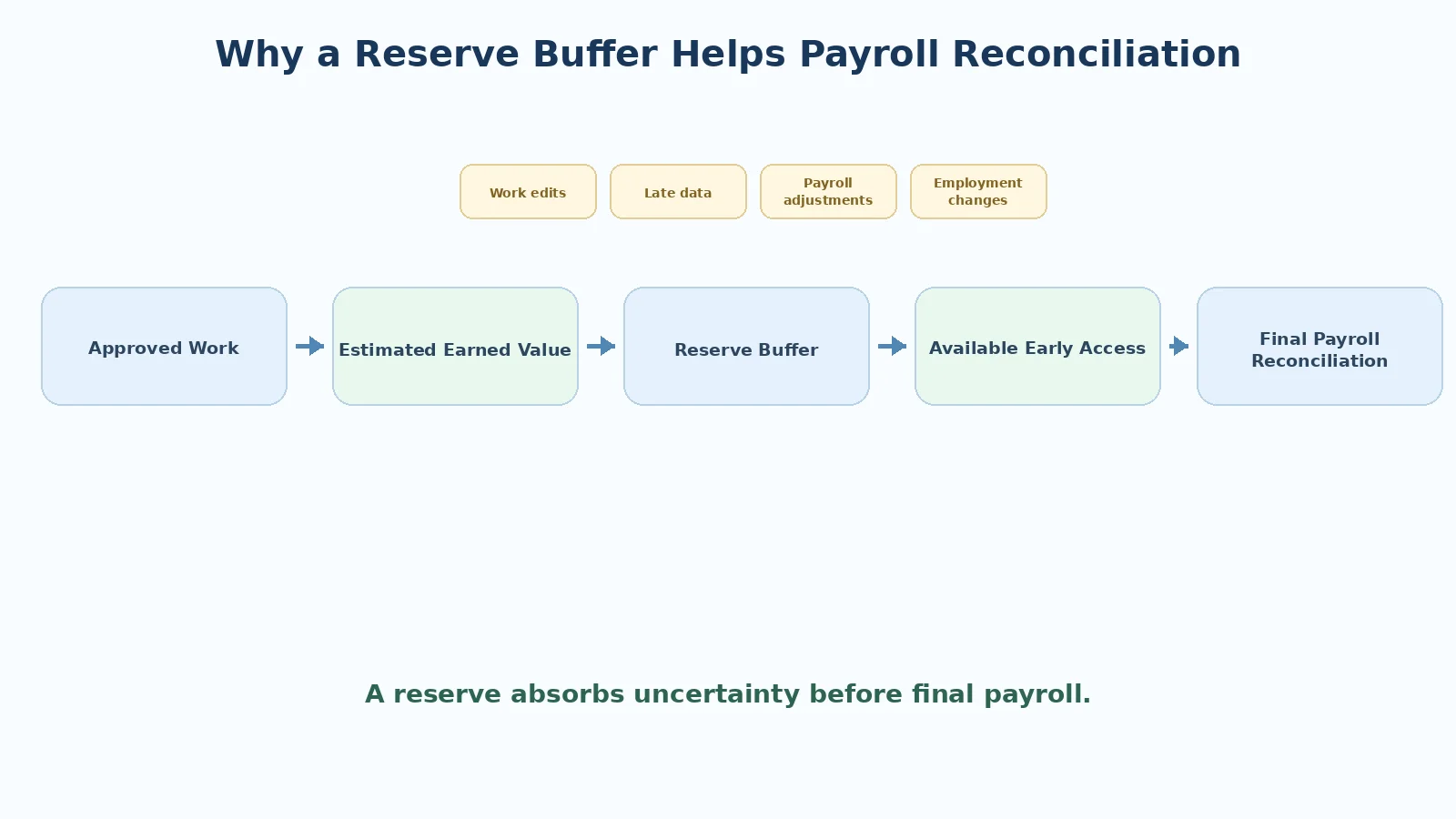
The reserve buffer is a cushion between the estimated in-period value and the final value after settlement.
Why should the full approved work value not be opened?
If the system opens the entire estimated value as soon as work is approved, one later reduction can make paid money exceed the final eligible value.
For example, approved work may initially equal 3,000,000 VND and the worker may receive nearly all of it. If one workday is later reduced, the final value may be 2,700,000 VND. A difference then needs handling.
A reserve buffer does not remove all risk, but it reduces the chance and size of the difference.
How is a reserve different from the amount already received?
These are different concepts.
| Component | Meaning |
|---|---|
| Approved work | Confirmed work data |
| Amount received | Money actually paid early |
| Reserve buffer | Value not opened for early receipt |
| Remaining period amount | Handled when payroll closes |
The general formula is:
Available amount = (approved workdays × daily rate) − amount already received in the period − reserve buffer.
The reserve is not paid money and should not be treated as a completed transaction.
What risks does the reserve reduce?
1. Work is reduced after approval
If a workday is reduced after a worker received money, the value must be recalculated. The reserve creates room so the difference does not exceed the remaining final value.
2. Data arrives late
Work data can come from several sources at different times. A reserve helps prevent temporary data from being treated as final data.
3. Workplace or employment status changes
A worker may work for several clients or change status during the period. The reserve adds safety while sources are being fully matched.
4. Payroll adds period-end components
In-period EWA reflects eligible value under work data and system rules. Final payroll can contain other components under the pay policy. A reserve reduces how much value is opened before the full calculation closes.
A reserve is not a recovery fund
The reserve should not be understood as money the employer holds to recover. It is value temporarily not opened for early receipt.
If work and final conditions remain valid, the corresponding pay is handled in the regular pay period.
The interface should therefore distinguish it from a fee, interest, penalty, lost money, or a fixed deduction.
How should the reserve be calculated?
The design depends on the employer policy and data stability. Options may include holding the newest workdays, holding a portion of value, combining multiple reserve layers, or changing the reserve according to data status.
More important than a single number, the system should explain the formula, keep configuration history, apply it consistently, recalculate when needed, and never turn the reserve into a hidden fee.
How does the reserve support reconciliation?
At period end, connect final work data, successful payments, and payroll or the payslip.
With a reserve buffer, the chance that paid money exceeds final value is lower.
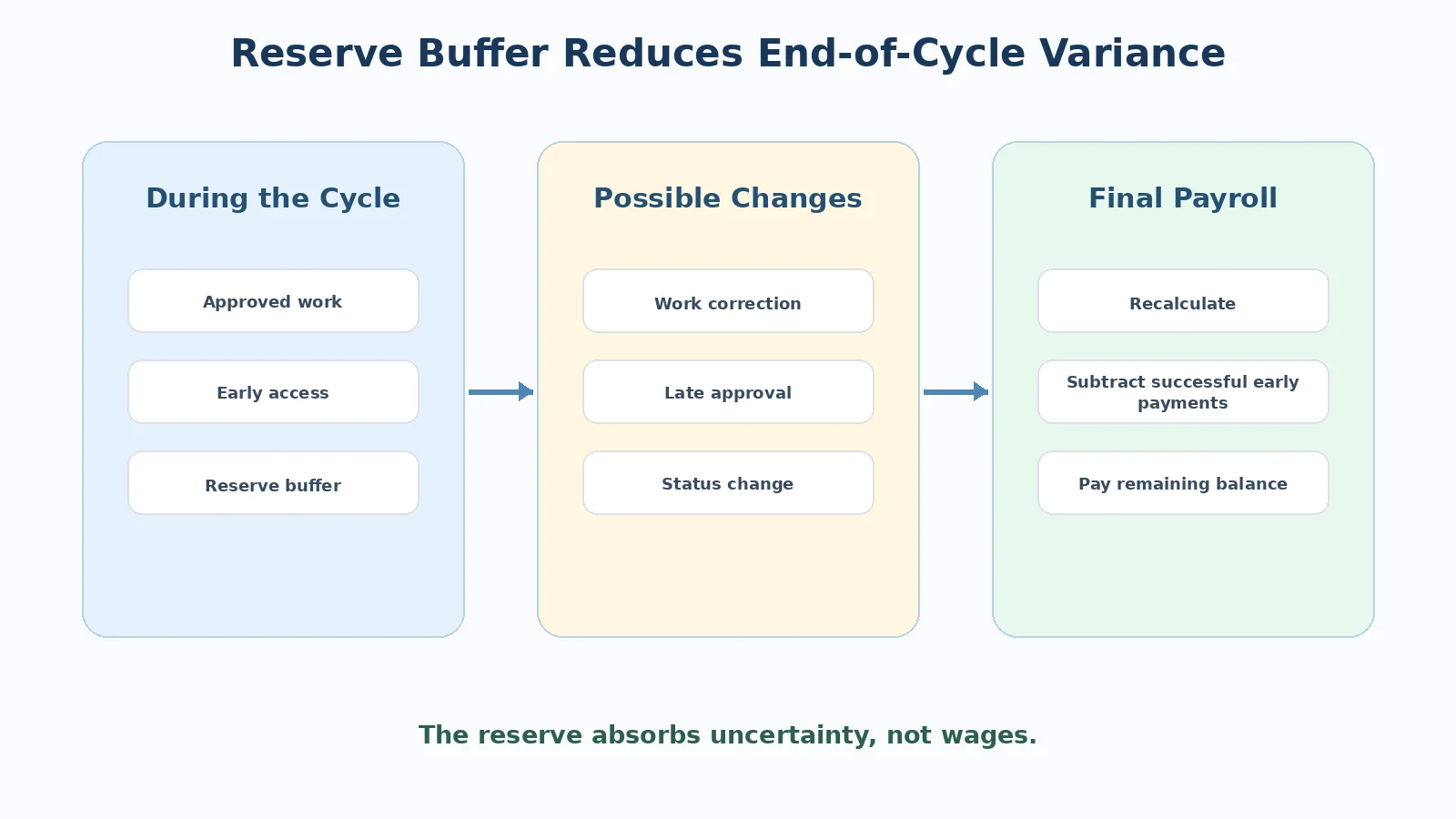
A reserve does not replace reconciliation; it makes reconciliation easier to control.
When should the reserve be investigated?
Review it when workers do not understand the reason, the reserve does not update after work changes, one client applies it inconsistently, the received amount and reserve are deducted twice, the reserve is still unexplained at settlement, configuration changes have no history, or the reserve is very large without a clear operating basis.
A guardrail has value only when it is transparent and justified.
What should the dashboard track?
Track total approved work value, total received, total reserve, work reduced after payment, end-of-period differences, cases where receipts exceed revised value, reconciliation match rate, and complaints about the reserve.
If data shows that the reserve is too low or too high, the employer can review the configuration.
Should every client have the same reserve?
Not necessarily. Work volatility, approval cycle, shift types, data sources, and payroll differ by client.
Policy should be based on data quality, approval speed, edits after approval, difference rate, and reconciliation process. Do not choose a rate only because it is easy to remember.
Conclusion
A reserve buffer is a risk control before settlement. It prevents the system from opening all estimated value while final data can still change. It reduces differences but does not replace Payroll Integrity, the audit trail, or reconciliation. A good design is transparent, explainable, and ensures that valid final pay is processed correctly.
Author: Do Huy Le — Tổng Giám Đốc, Nhan Kiet Manpower Supply Co., Ltd.
Earned wage access advice for employers: Hotline 0937.022.655 · Email info@nhankiet.vn · Earned wage access for employers
常见问题
Is the reserve buffer a fee?
Not in the sense described here. It is value temporarily not opened for early receipt.
Does the reserve reduce total pay?
Not automatically. The valid remaining pay is handled when final payroll closes.
Does a reserve eliminate differences entirely?
No. It creates a safety margin; work approval, audit trail, and reconciliation are still required.
Why is a reserve needed when work is already approved?
Because approved work during the period can still be adjusted before payroll closes.