
วิธีล็อกวันทำงานที่รับเงินแล้วเพื่อป้องกันการคำนวณซ้ำ
When a worker receives part of their earned pay, the system must record which workday value was used by the transaction so that it is not added again as if it were unused. “Locking workdays” means preventing the paid value from being reused for another calculation or payment. If an error is found, the work record can still be edited through an authorized process with an audit trail and reconciliation.
Why must workday value be locked after payment?
In Earned Wage Access, a workday can move through several states: recorded, approved, used to calculate an available amount, and partly received before the regular pay date.
If the system still treats the full workday value as unused after payment, the same value may be added to the next available amount. The direct risk is double calculation and duplicate payment.
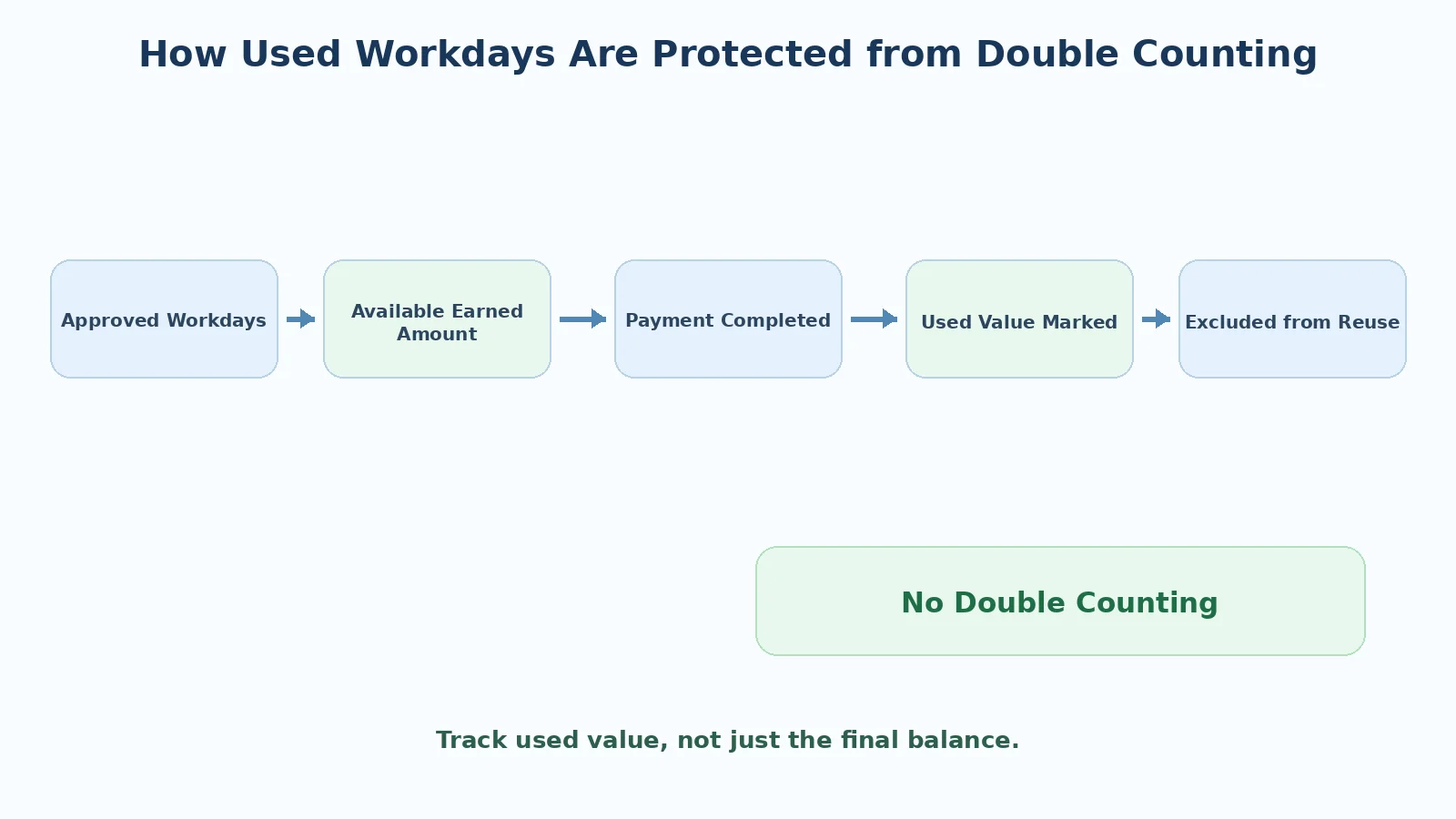
A good system remembers which value has been paid, rather than keeping only one total in a single field.
“Locking workdays” does not mean that the source data cannot be edited
This distinction is easy to miss.
A workday may need correction when the employer finds a wrong clock-in or clock-out, wrong shift, leave that was not updated, incorrectly entered overtime, changed client data, a duplicate record, or a wrong timekeeping code.
If locking meant “nothing can ever be edited,” the employer could not correct bad data.
A sound control therefore separates two actions:
- Lock reuse of the value already paid so it cannot be calculated a second time.
- Allow workday corrections through authority, an audit trail, and recalculation of the impact.
A work record may be edited, but the completed transaction must not disappear from history.
What must the system record after a successful transaction?
At minimum, it should record the worker ID, client or workplace, pay period, related workdays, work value used, transaction amount, transaction ID, payment status, completion time, and cumulative amount received in the period.
These records connect work → paid amount → final payroll.
Two layers that prevent double calculation
Layer 1: Deduct the amount received in the period
The Earned Wage Access formula follows this principle:
Available amount = (approved workdays × daily rate) − amount already received in the period − amount retained under the employer policy.
When a transaction succeeds, the amount received in the period increases accordingly. The next available amount therefore decreases.
Layer 2: Link the payment to the work value that created it
Subtracting only one total is not enough for long-term reconciliation. The system also needs to know which workdays or value portions were used so it can avoid carrying an error into a new period, explain a transaction, handle edited work, reconcile with payroll, and stop the same data from being used through another path.
The two layers support each other.
A simple example
Assume a worker has five approved workdays, with a demonstration value of 300,000 VND per day.
Total work value:
5 × 300,000 = 1,500,000 VND
After retained amounts, the system allows 900,000 VND to be received. The worker receives 600,000 VND.
After the transaction:
- the amount received in the period increases by 600,000 VND;
- the work value that created that 600,000 VND is marked as used by a transaction;
- the next calculation must not treat the full 1,500,000 VND as completely new.
Without this record, the system could recalculate from the beginning and create an error.
Should a pending transaction be locked immediately?
A transaction with an unclear status should not be handled like a confirmed success.
A safe fail-closed rule is:
- a submitted transaction without a clear result remains pending;
- it is not automatically treated as failed;
- a duplicate order cannot be created for the same value;
- the result is investigated until known;
- the final financial status is updated only after the result is determined.
While the result is pending, the related value should be held away from a new order. This reduces the risk that money has moved while the system believes it has not.
What if paid work is edited later?
This is why linking a transaction to workdays matters.
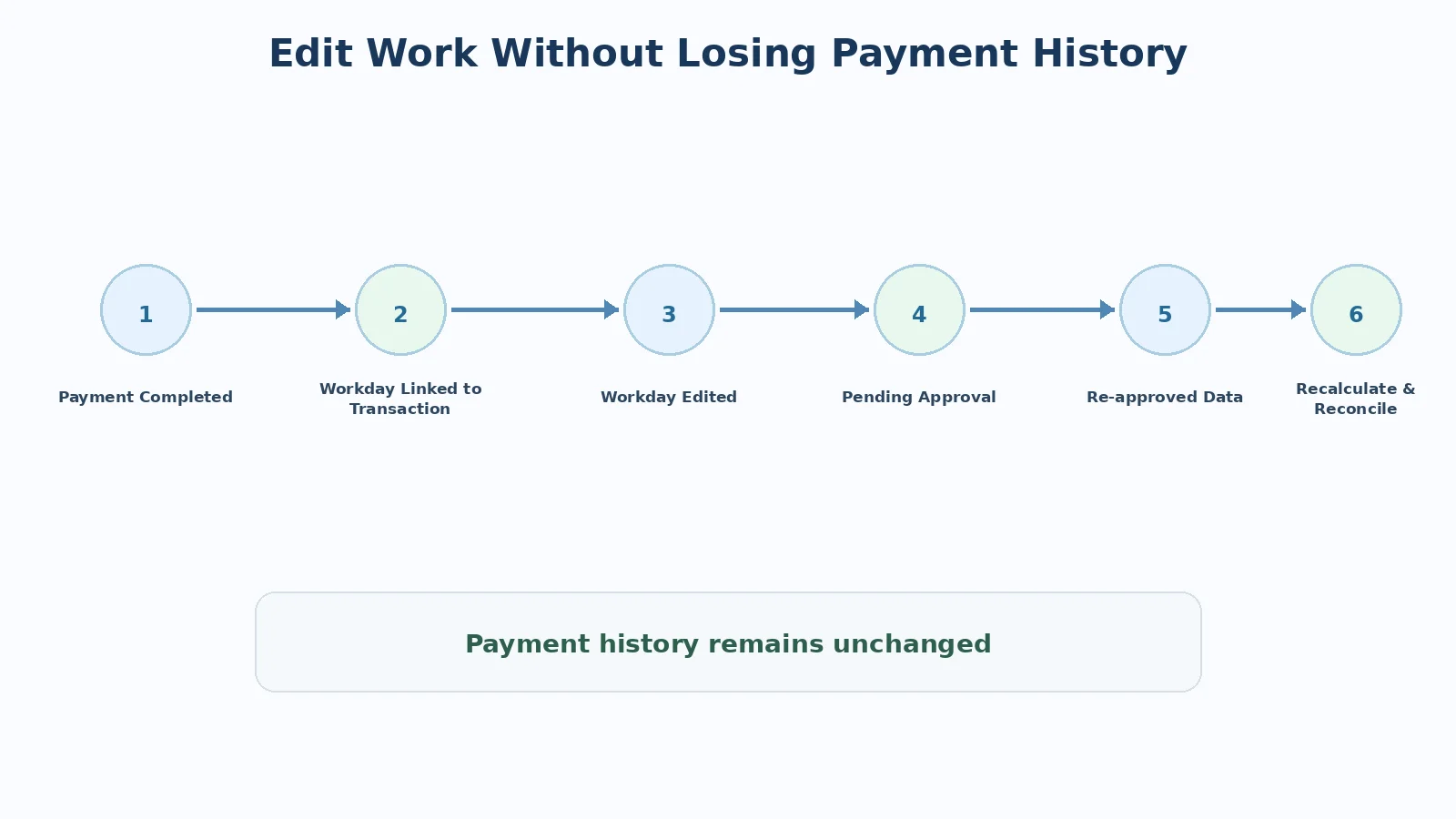
If work is edited after a transaction:
- the work record returns to a status that requires review;
- the paid transaction history remains unchanged;
- the new work data is approved again;
- the available amount is recalculated;
- any difference enters the settlement process.
A transaction should not be deleted simply because the workday changed.
How is workday locking different from locking a payroll period?
These are different controls.
| Control | Purpose |
|---|---|
| Lock used work value | Prevent the paid portion from being reused |
| Return edited work to approval | Confirm the new data |
| Lock the payroll period | Close data for the pay-period settlement |
| Audit trail | Keep every change and operator |
A workday may be linked to an EWA transaction while the payroll period is still open.
What happens at period end?
At period end, the system should reconcile at least three layers: final work data, successful payments, and payroll or the payslip.
The amount received in advance must appear once in the settlement. The objective is to avoid both workers being deducted twice and an amount already received being paid again.
What should the operations dashboard track?
An employer can track workdays edited after payment, workdays linked to transactions, pending transactions without a determined status, differences waiting for handling, cases where work value fell after payment, transactions at risk of duplication, and the EWA-bank-payroll match rate.
These indicators measure Payroll Integrity with operating data.
Conclusion
“Locking paid workday value” protects against reusing the same work value to calculate and pay twice. It must work with transaction history, an audit trail, and a process for work edited after payment. The final chain should prove which work created the money, which money was paid, and that it was settled exactly once at period end.
Author: Do Huy Le — Tổng Giám Đốc, Nhan Kiet Manpower Supply Co., Ltd.
Earned wage access advice for employers: Hotline 0937.022.655 · Email info@nhankiet.vn · Earned wage access for employers
คำถามที่พบบ่อย
Does locking workdays mean a worker cannot dispute their work?
No. Workers still need a channel to report incorrect work. The lock prevents reuse of paid value; it does not block a correction through the proper process.
Can one workday be connected to several receipts?
That depends on how the system allocates value. The required control is to track total used value so it does not exceed the eligible portion.
Should a pending transaction be paid again immediately?
No, not before the first transaction is known to be successful or failed. Investigate it first to avoid duplicate payment.
How can the employer know the period-end deduction is correct?
Reconcile transaction history, amount received, work data, and the matching line on the payslip.