
How can EWA increase flexibility without changing the whole pay cycle?
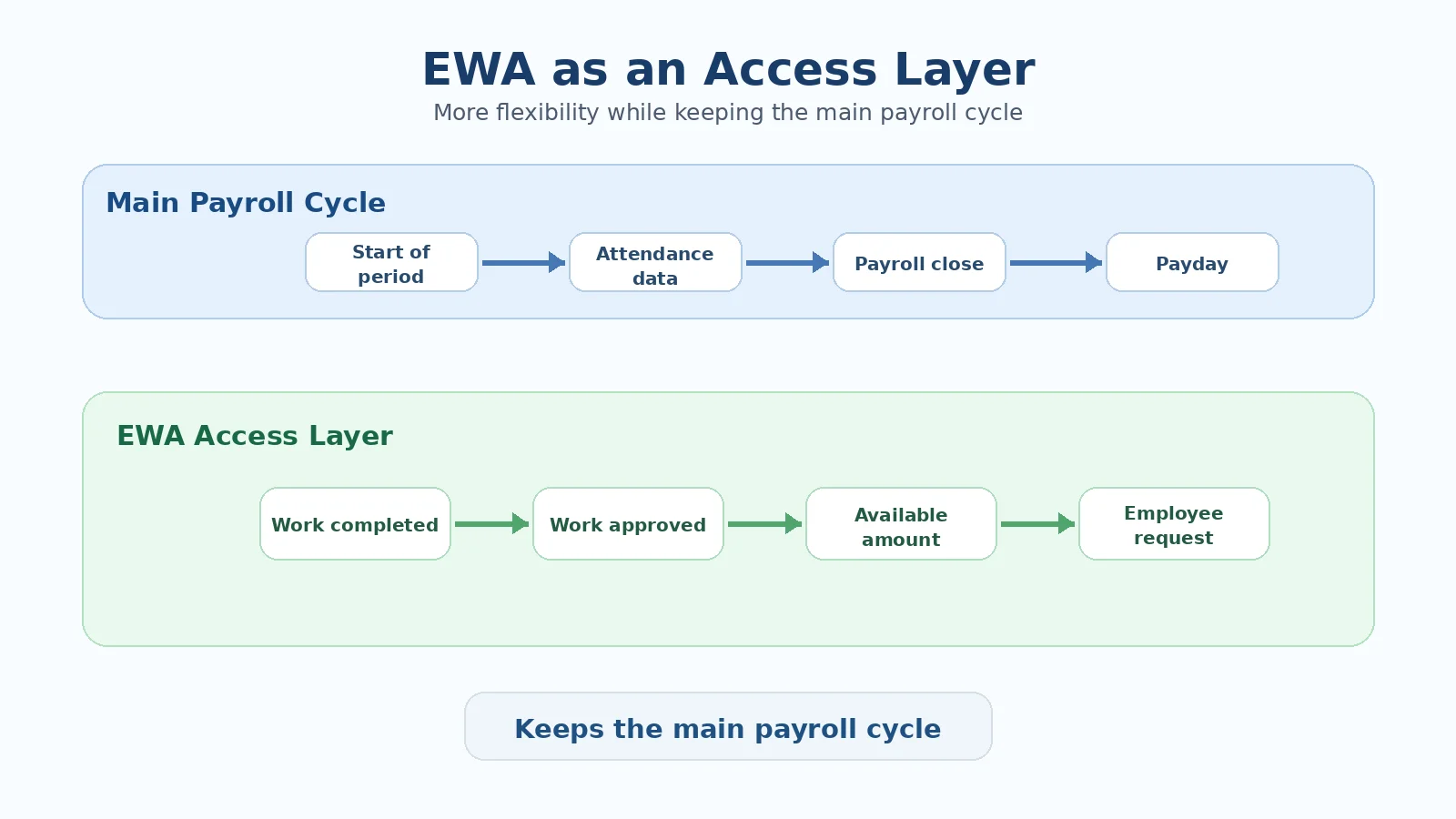
Earned wage access (EWA) adds an option to access income between paydays rather than replacing an employer's existing payroll. Eligible workers can receive part of the wages earned from approved work, while the main pay cycle, period-end payslip and core payroll process remain in place.
EWA adds a layer between paydays
One common misunderstanding is that EWA requires employers to pay a full salary every day. It can instead be designed as a separate access layer between recording work and running the main payroll.
The main payroll still consolidates earnings for the period and determines the final amount due. EWA uses only data meeting its conditions to determine what portion of wages workers can access before payday.
Separating these layers prevents EWA from becoming a second full payroll run. The system determines the value generated by approved work under established rules.
How do EWA and the main payroll differ?
They are closely connected, but they do different jobs.
| Component | EWA between paydays | Main payroll |
|---|---|---|
| Core data | Approved work and eligibility | All earnings data for the period |
| Purpose | Determine accessible earned wages between paydays | Calculate final pay for the period |
| Frequency | Can update during the period | Follows the payroll cycle |
| Calculation scope | Eligible portion of value | All relevant pay components |
| Transaction | Amount already received by the worker | Amount remaining due at period end |
| Reconciliation | Record for reflection in payroll | Finalize the period's figures |
The EWA flow is: work recorded → work approved → available amount calculated → worker requests payment → payment made → transaction recorded → reflected in payroll.
EWA starts with approved work, not merely a new clock-in. This avoids relying on data that remains under review or may change.
Why is approved work the foundation?
A clock-in is an initial record. It may need review because of an incorrect shift, missing clock-out, changed schedule or a manager's confirmation.
Using only approved work gives the system a clearer reference for calculating eligible wages. It also helps HR, payroll and workers understand where the amount comes from.
For Nhan Kiet's earned wage access solution, the principle is:
Available amount = (approved workdays × daily wage rate) − amount already received in the period − the portion retained under the employer's policy
The available amount is not all the expected earnings for the period. It is a portion determined at a point between paydays; the remainder stays within the main payroll.
How does EWA retain the main pay cycle?
The essential point is that the main pay cycle continues. The employer need not turn every day into a complete payroll period.
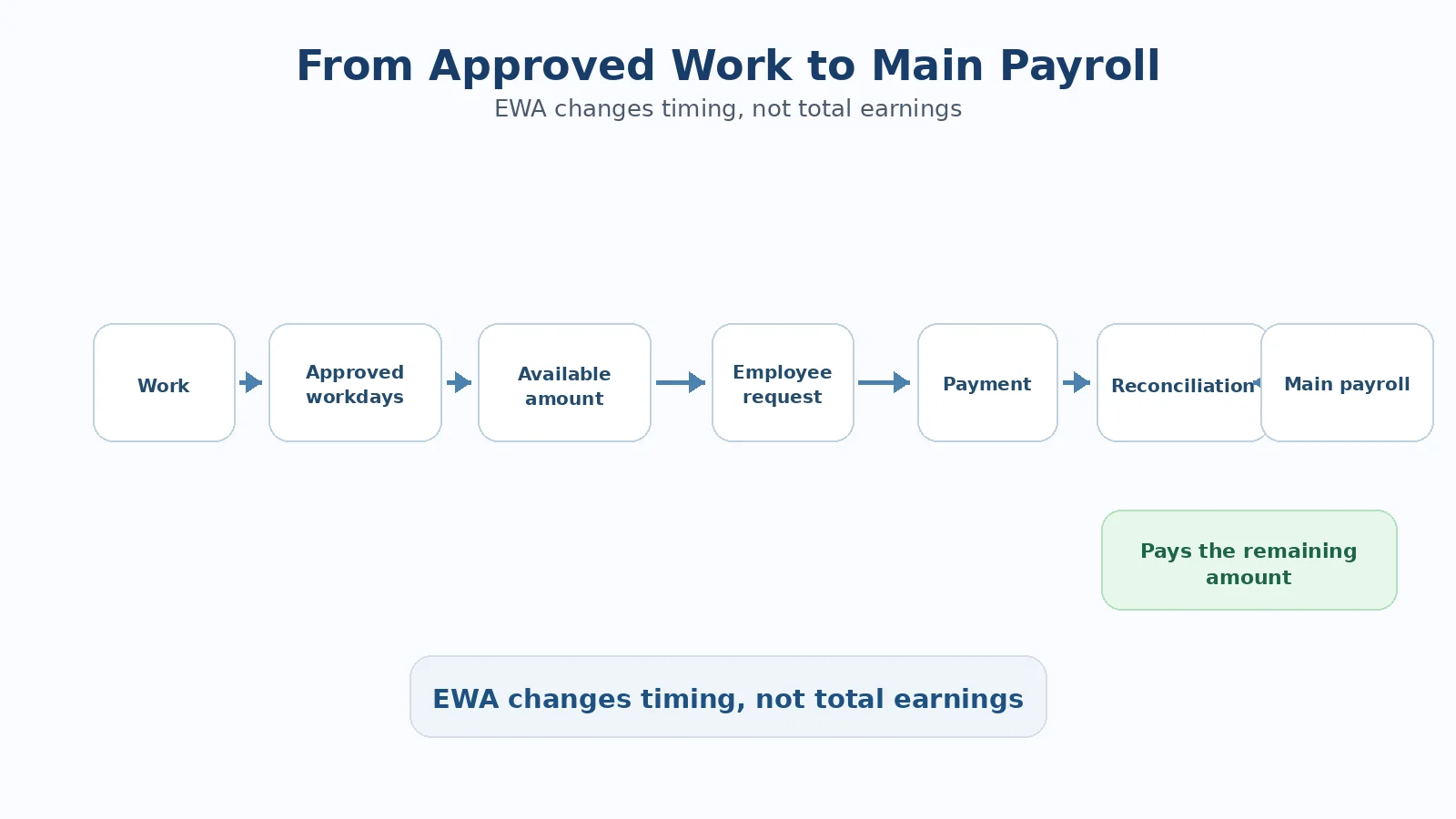
At period end, payroll still brings together attendance, earnings components, adjustments and other items under employer policy. Amounts workers received earlier are recorded so the remaining payment accurately reflects the period's total earnings.
The employer can therefore retain its payroll calendar, closing process and main way of working. The additional work is tracking approved work, available amounts, payments between paydays and payroll reconciliation.
EWA changes when workers can access part of their earnings; it does not create extra earnings.
Where can EWA limit system changes?
Moving from monthly to weekly pay may require the whole payroll process to run more often. EWA can focus changes on specific areas:
- a reliable source of work records;
- clear approval status;
- a formula for the accessible amount;
- a worker request process;
- a ledger of payments between paydays;
- a way to reflect earlier payments in payroll; and
- processes for exceptions and investigations.
The main payroll close and its responsibility for total earnings can remain. Employers can introduce flexibility layer by layer instead of changing everything at once.
Conditions for smooth operation
First, assign clear responsibility for approving work. If approval is delayed, workers have no eligible amount even if the rest of the system works.
Second, payroll must receive reconcilable information about payments between paydays. Each amount needs the correct worker, period and transaction status to avoid double counting.
The system must distinguish successful transactions from pending ones and those requiring investigation. Where status is unclear, hold the transaction for verification rather than guessing and creating another payment.
Finally, workers need clear information: approved workdays, available amount, amount already received in the period and the effect on the remaining pay at period end. Transparency keeps flexibility from becoming a source of confusion.
Conclusion
EWA adds a way to access earnings between paydays without turning monthly payroll into daily payroll. Eligible workers can receive part of their wages based on approved work, while the main payroll still handles total earnings and the balance due at period end.
The model works best with clear work data, reliable approvals, traceable payments and transparent information for workers. Under those conditions, EWA gives workers more choice while preserving disciplined payroll operations.
Author: Do Huy Le — General Director, Nhan Kiet Manpower Supply Co., Ltd.
Earned wage access advice for employers: Hotline 0937.022.655 · Email info@nhankiet.vn · Earned wage access for employers
FAQ
Does EWA force employers to pay salaries every day?
No. It can operate between paydays while employers retain their existing main payroll cycle.
Can workers receive all their expected pay between paydays?
That is not the right assumption. The available amount depends on approved work, amounts already received and the portion retained under employer policy.
Does EWA replace payroll?
No. Payroll still calculates total earnings and the remaining amount at period end. EWA adds access to part of the wages already earned.
What if approved work is later changed?
The data is updated under the employer's process, and differences are handled in reconciliation and payroll for the relevant period.