
Responsible Earned Wage Access: When to Use and When Not to Use?

Responsible Earned Wage Access: When to Use, When Not to Use, and How Should Businesses Protect Employees?
Responsible Earned Wage Access allows employees to proactively access a portion of the value from work already done and approved, while maintaining protective layers to understand costs, remaining balance, and the right not to use. EWA is suitable for planned short-term needs; it is not a solution for prolonged income shortages.
> In short: Consider EWA for necessary expenses with a clear amount and a known way to balance the remaining salary. Avoid using it for impulsive spending, continuous cycling, or covering recurring shortages. Businesses must be transparent, non-coercive, and monitor signs of harmful use.
> Note: Nguyen Minh Khang — Strategy Team Specialist, and legal conclusions must follow the official documents currently applied by Nhan Kiet and businesses.
1. “Responsible” does not mean prohibiting employees from using it
A responsible model balances two objectives:
- autonomy: employees decide whether to access when eligible;
- protection: the system does not obscure information, does not encourage excessive use, and does not allow access to unearned value.
If overly controlled, EWA loses its proactive meaning. If transactions are maximized, the product may leave employees short at the end of the period. A good design allows convenient use but requires important information to appear before decisions.
2. Five questions before accessing early wages
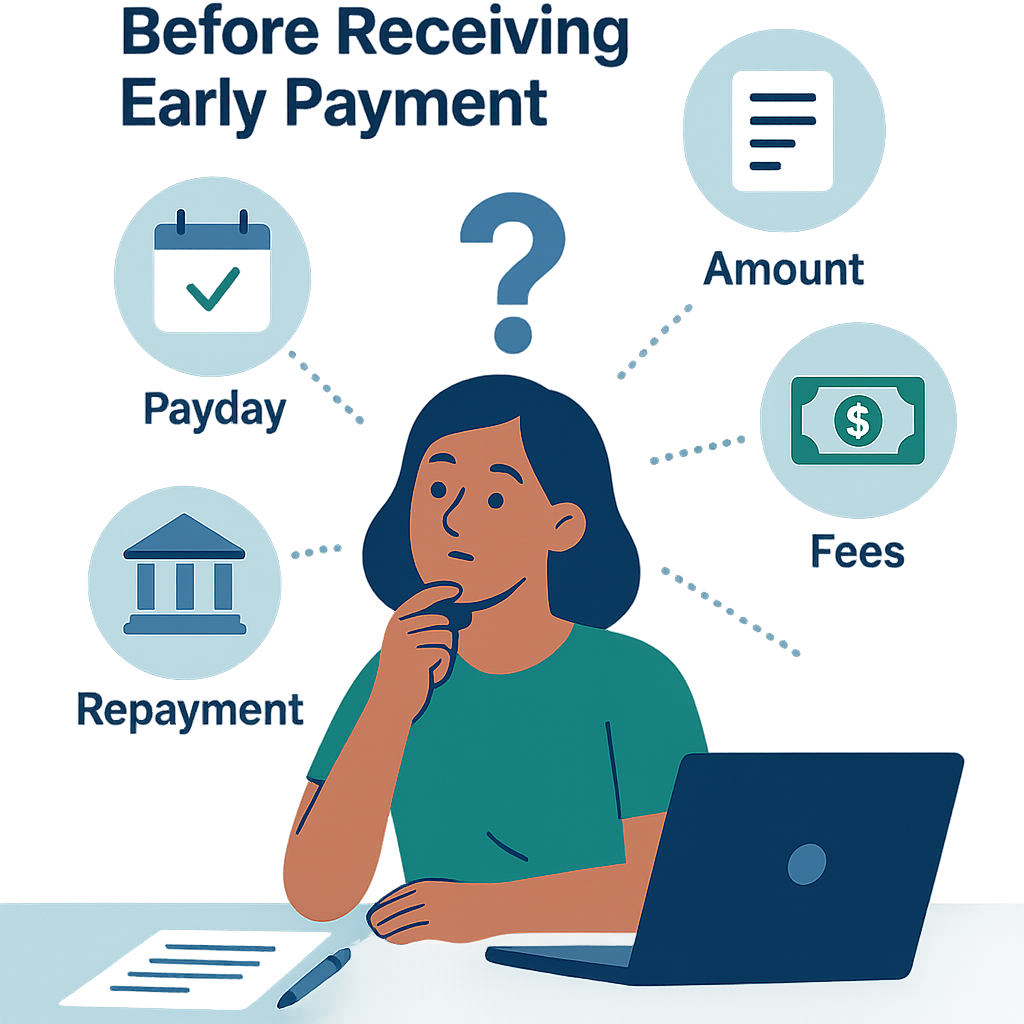
- What is this amount for? Is it a necessary and specific need?
- How much do I exactly need? Can I take less than the maximum amount?
- How much will remain at the end of the period? Have deductions and mandatory expenses been accounted for?
- Are there any fees or conditions? Have I read the official information?
- Is this a one-time need or recurring? If recurring, what is the root cause?
If unable to answer questions 3 or 4, review details on the app or consult official channels before confirming.
3. When might EWA be suitable?
(See also: When to Access Early Wages? and 7 Situations to Use or Avoid Early Wage Access.)
Pre-salary work expenses
Fuel, bus tickets, minor vehicle repairs, or necessary commuting costs to continue working.
Essential medical needs
Medication, consultations, or urgent expenses within the scope of the remaining balance at the end of the period.
Short-term bill deadlines
Electricity, water, rent, or tuition due before payday, where delays incur costs or greater consequences.
Minor family emergencies with a defined amount
An immediate need that does not exceed the ability to balance from earned wages.
Avoiding a more expensive option
In some cases, accessing earned wages can help avoid payday loans or penalties. However, only compare after knowing all fees and conditions of all options.
These situations do not automatically justify usage. Employees should still review their budget and remaining salary.
4. When should it not be used?
- impulsive shopping or chasing promotions;
- gambling, betting, or risky investments;
- accessing the maximum just because the app allows it;
- continuously using this period's amount to cover the previous period's shortage;
- not knowing the remaining salary at the end of the period;
- disputes over work or available amounts;
- using someone else's account/device;
- using it to pay a new loan without a debt management plan;
- creating new requests while previous transactions are pending;
- being pressured by managers, colleagues, or family to access it.
If needs recur each period, solutions should shift to budgeting, financial advice, adjusting obligations, or appropriate support; EWA only changes the timing of access, not the total income.
5. Understanding the available amount
(Details: see How Much is Left After Using Earned Wage Access? and What is the Reserve Amount?.)
According to the current system logic:
Available amount = approved work × daily rate per client − received in the period − reserve amount
The result is rounded down to the nearest 1,000 VND. This means:
- it is not the entire monthly salary;
- it does not include future work;
- it may change when work is updated/adjusted;
- it decreases after each access;
- there may be a portion held for settlement;
- it is not a fixed credit limit.
Employees should review details of each workday and history, not just the large number on the screen.
6. Example of hypothetical balance
An individual expects a net salary of 8 million VND at the end of the period. Remaining mandatory expenses before the next period include:
| Item | Hypothetical Amount |
|---|---|
| Rent | 2,000,000 VND |
| Food | 1,800,000 VND |
| Transportation | 600,000 VND |
| Family/tuition | 1,500,000 VND |
| Reserve | 500,000 VND |
| Total to Keep | 6,400,000 VND |
If the individual has accessed 1.2 million VND early, they need to understand the remaining estimated salary is only 6.8 million VND before other adjustments. The buffer compared to the total to keep is 400,000 VND. Accessing an additional 1 million VND just because there is a limit may create a shortage at the end of the period.
This is an educational example, not advice for an individual or how the system officially forecasts salary.
7. Eight principles of a responsible EWA program
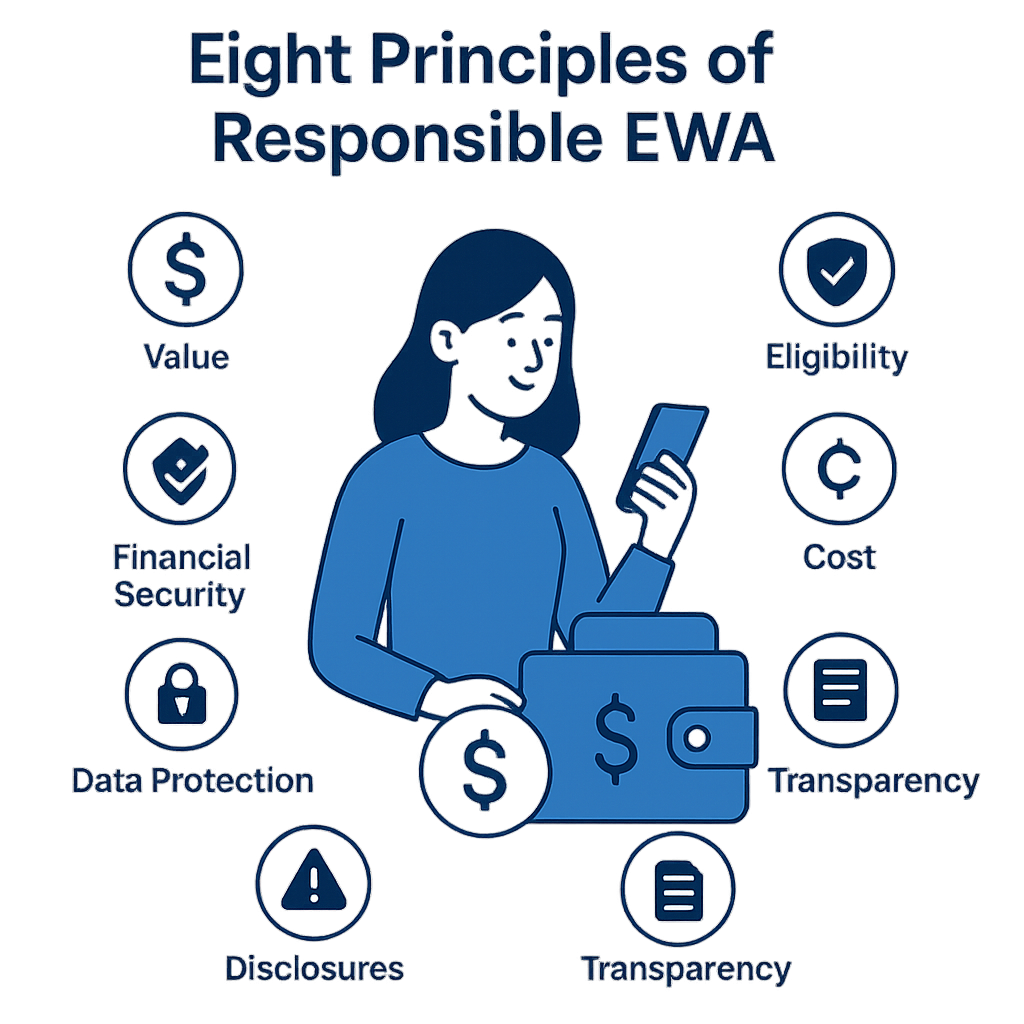
7.1. Only earned value
Do not create available amounts from future days or unapproved work.
7.2. Transparency before confirmation
Display amount, fees if any, received amount, reserve, deduction period, and status.
7.3. Right not to use
Do not turn transaction rates into KPIs that pressure managers or employees.
7.4. Reasonable limits
Limits and reserves are for risk management and protecting remaining salary; they should not be used as tools to encourage maximum access.
7.5. Correct user authentication
Main account, ID verification, and device control help reduce misuse/misallocation.
7.6. Unclear transactions must be held
Do not allow repeated commands when the initial transaction's success is unknown.
7.7. Human support
Employees need help channels for incorrect work, authentication errors, or pending transactions; do not force sharing of sensitive data publicly.
7.8. Measure harmful impact
Businesses must monitor signs of repetition, salary shortages, complaints, and misunderstandings; not just measure the number of accesses.
8. Existing protective layers in Earned Wage Access design
From system information:
- only completed and approved work generates money;
- block current unfinalized days and future days;
- employees view work, received amounts, and reserves;
- each access requires a commitment tick for salary deduction;
- default minimum of 50,000 VND per access;
- default maximum of 3 million VND per transaction and 5 million VND per person per day;
- can hold the N most recent workdays and/or reserve percentage per configuration;
- ID verification and main VPBank account;
- one person linked to one device;
- anti-fake GPS in attendance flow;
- unclear transactions are held, with tracking;
- received amounts are included in salary settlement.
Default levels do not imply usage recommendations. Configuration per customer and official policy needs Nhan Kiet confirmation.
9. Guardrails still need policy-level consideration
Frequency limits
Not just limit amount/day; may need to limit the number of times per week/period to reduce behavior of splitting transactions, depending on fee model and actual data.
Display estimated remaining salary
If data is reliable, the screen can show employees the impact of new requests on the remaining amount; must clearly state whether this is an estimate or settlement amount.
Voluntary pause
Allow employees to turn off notifications or set lower limits themselves.
Behavior-based warnings
If there are many consecutive accesses, the system can provide financial education content, not label negatively or block arbitrarily.
Referral support
Those showing signs of prolonged difficulty can be referred to appropriate advice/welfare channels, on a voluntary and confidential basis.
Any intervention based on behavioral data needs legal, privacy, and discrimination risk assessment.
10. Non-coercive interface design
Should do
- show received and remaining amounts equally prominently;
- allow users to choose smaller amounts than the maximum;
- explain reserves in simple language;
- confirm the salary period being deducted;
- display clear pending status;
- provide access to history and support;
- use neutral reminders.
Should not do
- default to the maximum amount;
- create artificial countdowns;
- use colors/words to create fear of missing out;
- obscure fees or end-period impact;
- reward transaction frequency;
- send continuous notifications on rest days;
- rank users;
- make it difficult to choose "not to access."
Choice only has meaning when the choice architecture does not lead users towards the provider's interests.
11. Warning indicators to monitor
| Indicator | Signal to Investigate |
|---|---|
| Access frequency/person/period | Continuous increase or unusual splitting |
| Usage rate near limit | Consecutive periods |
| Remaining salary | Falls to risk threshold defined by policy |
| Misunderstanding tickets | Users think this is extra money/loan |
| Repeat requests while pending | Status content not clear enough |
| Work reduced after access | Risk of recovery/settlement |
| Group usage | Unusual discrepancies need fairness check |
| Data complaints | Concerns about GPS, ID, account |
Signals do not automatically prove employee "abuse." They only trigger review of design, communication, and support.
12. Roles of businesses, Nhan Kiet, and employees
| Party | Main Responsibility |
|---|---|
| Client business | Confirm work, policy, and communication at the workplace |
| Nhan Kiet | Accurate calculation, expense control, reconciliation, support, and data protection |
| Employees | Protect account, read information, balance, and report discrepancies |
| Bank/partner | Perform services within agreed scope and status |
Responsibility cannot be entirely shifted to employees with a long checkbox. Providers and businesses must still design transparently, control errors, and resolve complaints.
13. How should EWA and financial education connect?
(Tools: see Weekly Budgeting and Building an Emergency Fund.)
Educational content should be short, timely, and actionable:
- before the first time: distinguish needs and wants;
- before confirmation: view remaining salary;
- after transaction: update budget;
- when using repeatedly: identify frequent shortages;
- end of period: reconcile payslip;
- periodically: emergency fund, bills, and high-cost loans.
Do not require employees to complete long courses before using in necessary situations. Micro-learning and voluntary materials can be combined.
14. Five questions to evaluate a responsible EWA provider
(Full criteria: see How Businesses Evaluate EWA Providers.)
- Is the available amount based only on completed and approved work?
- Do employees see full fees, received amounts, reserves, and end-period impact?
- Does the provider profit from employees transacting more?
- Are there guardrails, complaints, reconciliation, and handling of unclear statuses?
- Do they measure financial health and harmful impact, or just report increased usage?
If answers lack evidence, businesses should request demos, documentation, and pilots with protective metrics.
15. When should businesses adjust or pause the program?
- duplicate or incorrect person detection;
- widespread incorrect work/available amounts;
- many employees short at the end of the period due to misunderstandings;
- fees or conditions not clearly communicated;
- managers pressuring use;
- increased pending transactions without adequate support;
- personal data incidents;
- uncollectable amounts exceeding thresholds;
- prolonged harmful usage signs;
- policy/contracts no longer matching actual flow.
Pausing part of the program to protect employees and funds is not a failure; it is a sign of responsible management.
16. Frequently Asked Questions
Does accessing early wages increase total income?
No. It changes the timing of accessing a portion of earned value; the accessed amount is included in the end-period settlement.
Should I access the maximum amount allowed by the system?
Not necessarily. Start with the amount truly needed and check the remaining salary for mandatory expenses.
Is frequent usage bad?
Frequency alone does not conclude anything. However, using near limits for many periods and recurring shortages signal a need to review the budget or seek support.
Should businesses set KPI for access frequency for managers?
No, as it may create pressure and conflict with voluntary rights. Measure accessibility, correct understanding, timely work approval, and service quality instead.
Is Earned Wage Access a loan?
According to the described design, the available amount is linked to completed and approved work, not future work; the current flow does not charge interest/fees to employees, and the accessed amount is deducted from salary. Official legal conclusions must follow Nhan Kiet-approved documentation.
17. Conclusion
The best value of EWA is not making employees access money more frequently, but providing them with a transparent choice when needs arise. A responsible program must maintain the boundary of completed work, explain end-period impact, protect the right people, handle unclear statuses, and respect the right not to use. When businesses measure both benefits and harmful signs, EWA truly becomes a financial benefit rather than just a transaction button.
---
Author: Nguyen Minh Khang — Strategy Team Specialist, Nhan Kiet Manpower Supply Co., Ltd.
Earned Wage Access solutions for businesses: Hotline 0937.022.655 · Email info@nhankiet.vn · Earned Wage Access for businesses