
Should employers switch from monthly to weekly pay?
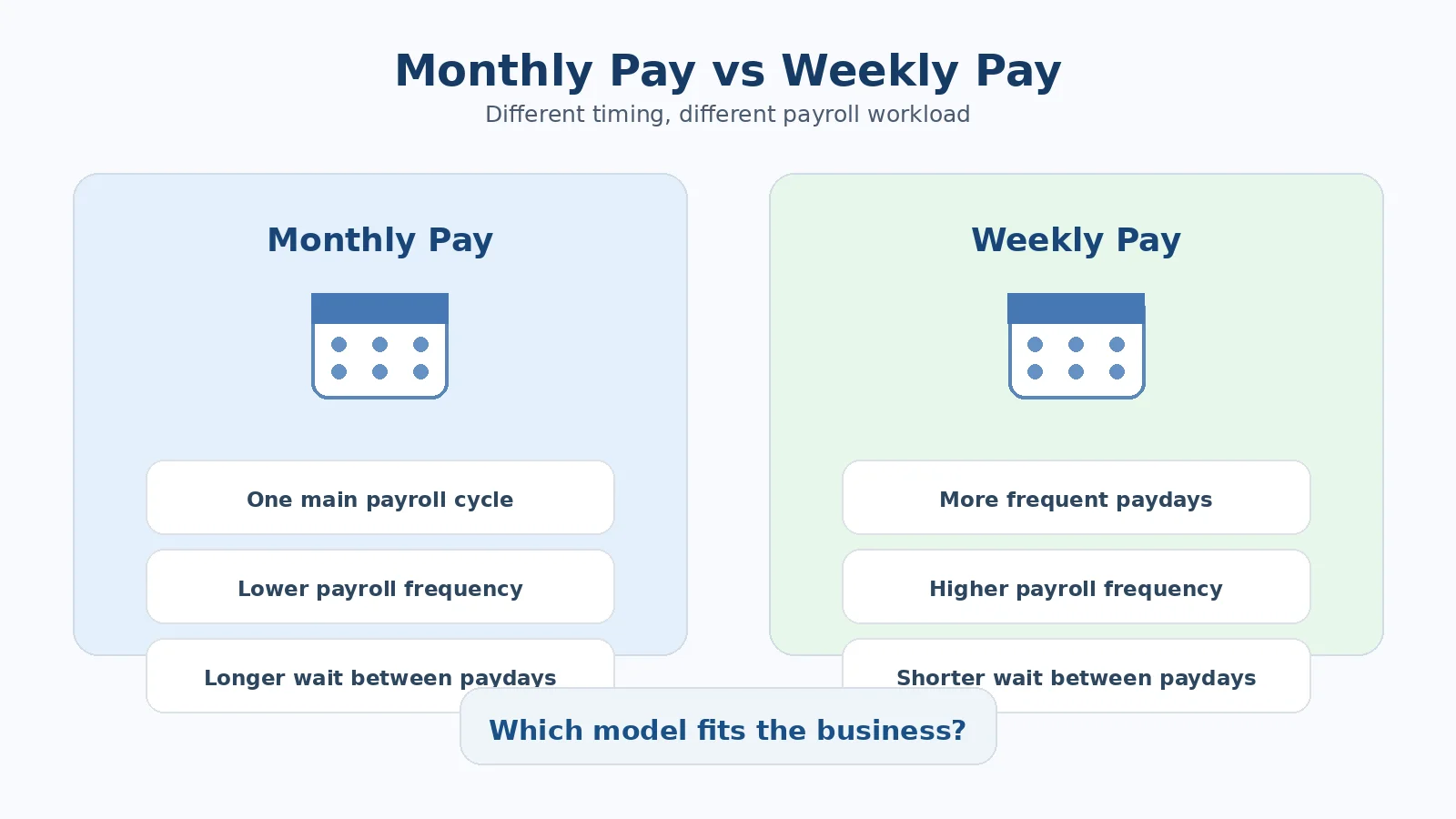
Employers do not necessarily need to move from monthly to weekly pay to give workers more flexibility. Weekly pay can shorten the time between work and payment, but it also increases the frequency of payroll processing, approvals and reconciliation. Another option is to keep monthly payroll and add earned wage access (EWA), allowing eligible workers to receive part of their earned wages between paydays.
What problem does weekly pay solve?
Employers often consider weekly pay to shorten the gap between working and receiving income. When expenses arise between paydays, a shorter interval can give workers more control over their cash flow.
Changing the pay cycle means more than changing the transfer date. Every cycle requires collecting work records, reviewing adjustments, calculating and approving pay, making payments and reconciling them. More cycles mean the whole chain must run faster.
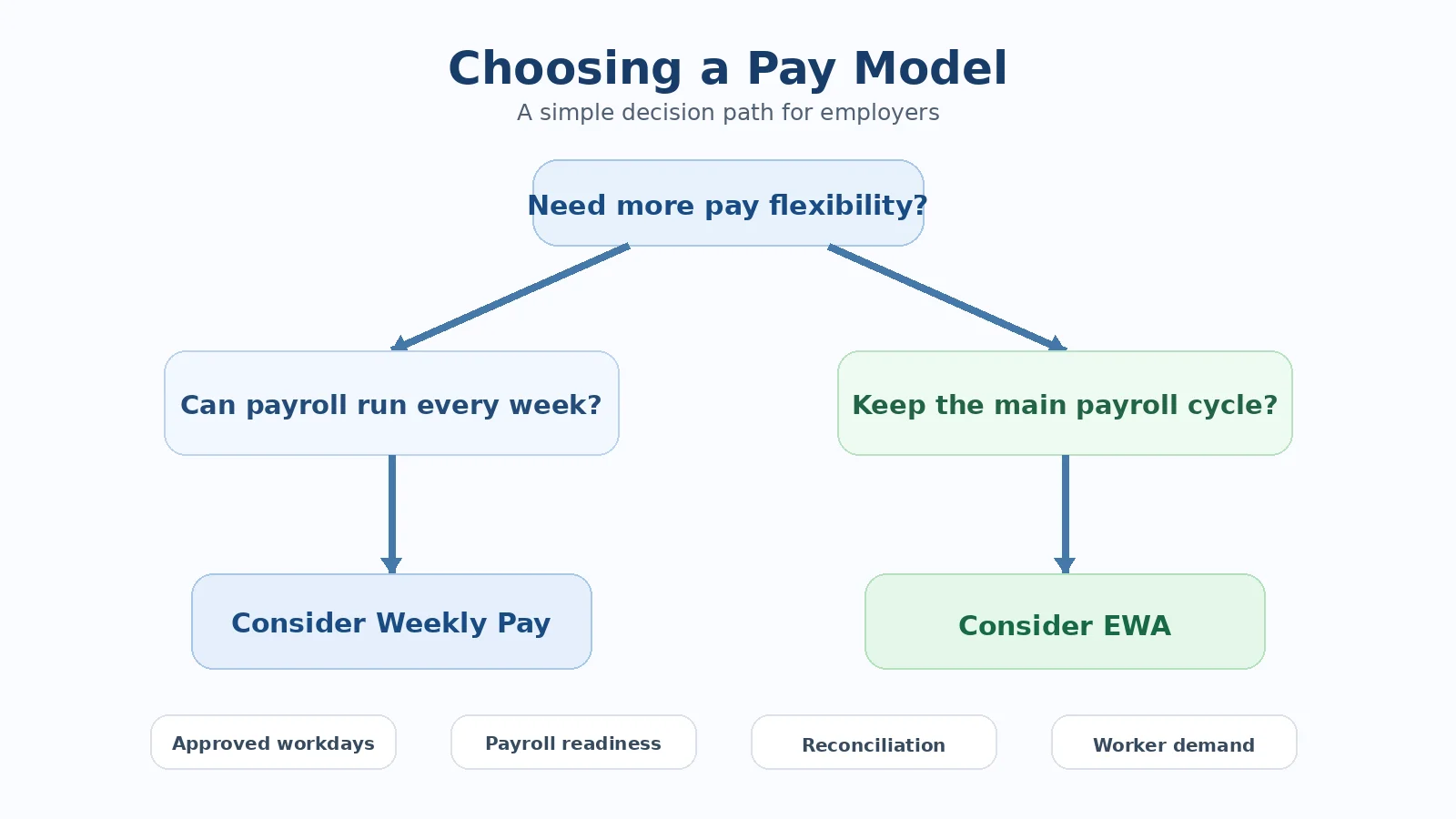
The management question is therefore: what problem is the employer trying to solve? If workers mainly need earlier access to part of the wages already earned, changing the whole payroll cycle may not be the only option.
How do monthly and weekly pay differ?
They differ mainly in payment timing and the operational work that follows.
| Criterion | Monthly pay | Weekly pay |
|---|---|---|
| Payment rhythm | Monthly cycle | Weekly cycle |
| Wait between payments | Longer | Shorter |
| Payroll frequency | Fewer cycles | More cycles |
| Closing work records | By month | Must be reliable each week |
| Handling adjustments | More time | Must be faster |
| Reconciliation | Less frequent | More frequent |
| System changes | Limited if already in use | Greater when moving from monthly pay |
Weekly pay is more suitable when work records are approved regularly, earnings are relatively straightforward and payroll is well automated. Employers with complex shifts, changing allowances or late time records will face more pressure as the cycle shortens.
When is weekly pay worth considering?
Consider it when:
- workers genuinely want weekly payments;
- attendance is recorded consistently with few repeated corrections;
- managers approve work on a reliable schedule;
- payroll can run often without extensive manual intervention;
- few earnings components can only be determined at month end; and
- finance and accounting can reconcile more frequent payments.
The appeal of receiving money sooner is not enough on its own. A shorter cycle creates value only when the data, people and systems behind it can keep pace.
When might monthly pay remain the better fit?
Monthly pay gives many employers a clear, manageable payroll cycle compatible with their existing systems. If most workers do not need more frequent pay or payroll still depends heavily on spreadsheets and manual steps, a weekly cycle may increase operational friction.
Monthly pay can also make more sense where many earnings components become known only at period end or several departments must help close payroll. Improving data quality and processing speed may then yield more value than running payroll more often.
How does EWA provide a middle option?
The choice is not limited to monthly or weekly pay. An employer can keep its main pay cycle and add EWA.
Eligible workers can access part of their wages based on work performed and approved. The main payroll continues on its existing schedule, while amounts received between paydays are recorded for the corresponding payroll period.
For Nhan Kiet's earned wage access solution, the calculation principle is:
Available amount = (approved workdays × daily wage rate) − amount already received in the period − the portion retained under the employer's policy
This separates two needs: the employer keeps its familiar payroll cycle, while workers have another way to access part of the income already earned. EWA can therefore be an added layer of flexibility rather than a new payroll system.
What framework should employers use to decide?
Ask four questions.
What problem needs solving? If the goal is to shorten the wait between paydays, both weekly pay and EWA may help. If the goal is simpler payroll, weekly pay may increase the workload.
Are work records reliable enough? Both models depend on clear recording and approval of work.
Can current systems handle the new rhythm? Consider HR, payroll, finance, payment and reconciliation as one connected process.
What do workers actually need? Some groups may prefer weekly pay; others may only need an option between paydays. Understanding demand avoids a large change with little benefit.
Conclusion
Moving from monthly to weekly pay significantly changes payroll operations, not just the transfer date. Weekly pay is more suitable when work records are dependable, systems are well automated and workers truly need a shorter payment interval.
If the main goal is flexibility while keeping the regular pay cycle, EWA is worth considering. Choose based on the problem, operating capacity and actual demand rather than assuming that one model fits every organization.
Author: Do Huy Le — General Director, Nhan Kiet Manpower Supply Co., Ltd.
Earned wage access advice for employers: Hotline 0937.022.655 · Email info@nhankiet.vn · Earned wage access for employers
FAQ
Is weekly pay always better than monthly pay?
No. It shortens the wait but makes payroll run more often. Suitability depends on data, systems and workers' needs.
Can an employer retain monthly pay and still add flexibility?
Yes. EWA can give eligible workers access to part of their earned wages between paydays while retaining the main payroll cycle.
Does weekly pay make payroll more complex?
It can. More cycles mean more attendance cutoffs, adjustments, approvals and reconciliations.
Should an employer change the whole company at once?
First assess demand, data and operations, then select a suitable scope to observe how the approach works in practice.