
Reconciling work, payments and payslips: a three-layer process for employers
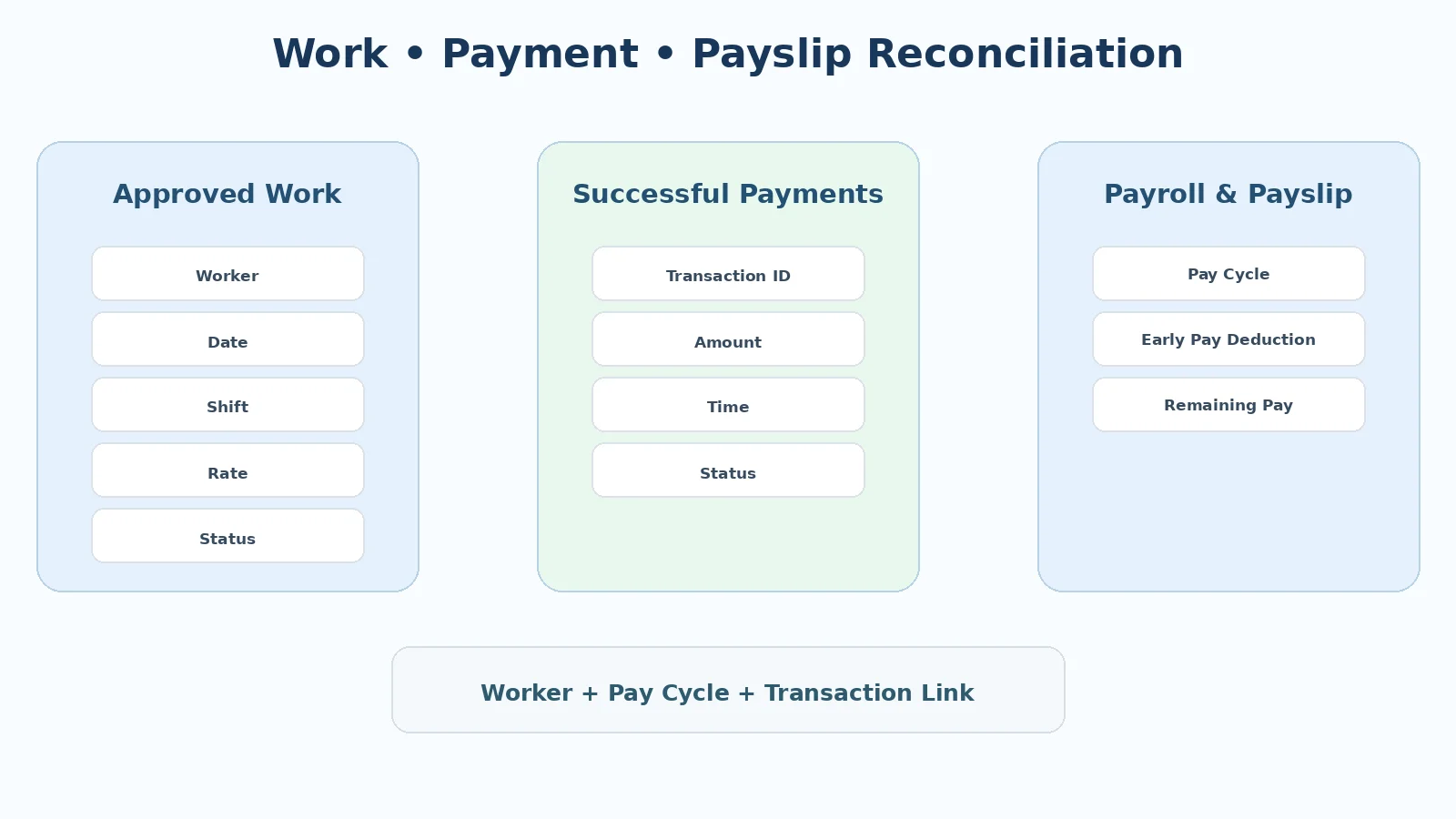
Employers should reconcile EWA across three layers: approved work establishes the eligible value; payment records establish what was actually paid; and payroll and payslips confirm that the amount already received is settled for the right person and period, exactly once. Every difference should be traceable to source data and assigned to an owner.
Why reconcile across three layers?
Bank totals alone do not show which workdays generated a payment. Work records alone do not show which payments actually went through. Looking only at end-of-period payroll may reveal a difference too late.
Connect the three layers:
Approved work → Successful payment → Payroll/payslip
A difference is resolved only when its source layer is known.
Layer 1: reconcile work records
Check the correct worker, client, pay period, date and shift, approval status, applicable rate and data version.
Prioritize pending approval, work edited after approval, duplicate records, workers at several sites, overnight shifts, late data and changes of workplace. Only eligible work records should feed the amount calculation.
Layer 2: reconcile payments
Not every request means money was paid. Distinguish newly created, submitted, pending, successful, failed, under investigation, and refunded or adjusted transactions. Count an amount as received only when there is appropriate evidence of its transaction status.
A pending transaction should neither be treated as failed and resubmitted, nor as permanently successful and deducted, nor deleted from history. Keep it in the investigation queue.
Layer 3: reconcile payroll and payslips
At period end, the total successfully received must appear exactly once. Check the worker, period and successful transaction total; exclude failed transactions, include all successful ones, prevent duplicate deductions, and calculate remaining pay through official payroll. The payslip should make the earlier payment understandable to the worker.
Keys linking the three layers
Reliable reconciliation does not rely on a worker's name or free-form transfer description. Use stable keys such as worker ID, pay period, client, transaction ID and workday reference. When one person works for multiple clients, separate the relevant work source and period correctly.
Daily reconciliation process
Each day, the team can:
- Set the scope of transactions to check.
- Retrieve transactions by status.
- Match them with payment evidence.
- Mark matches and exceptions.
- Check associated work records for unusual cases.
- Assign an owner to every exception.
- Keep differences open until evidence supports closure.
The daily aim is to address payment risks early, before payroll day.
End-of-period reconciliation process
At period end, the scope is broader:
- Take a final snapshot of work records.
- Gather all successful payments for the period.
- Separate failed transactions and those still awaiting a status result.
- Match each payment to the correct worker and period.
- Calculate the amount already received.
- Post that total to payroll.
- Compare it with the payslip.
- Investigate differences.
- Approve exceptions.
- Lock the reconciliation bridge report.
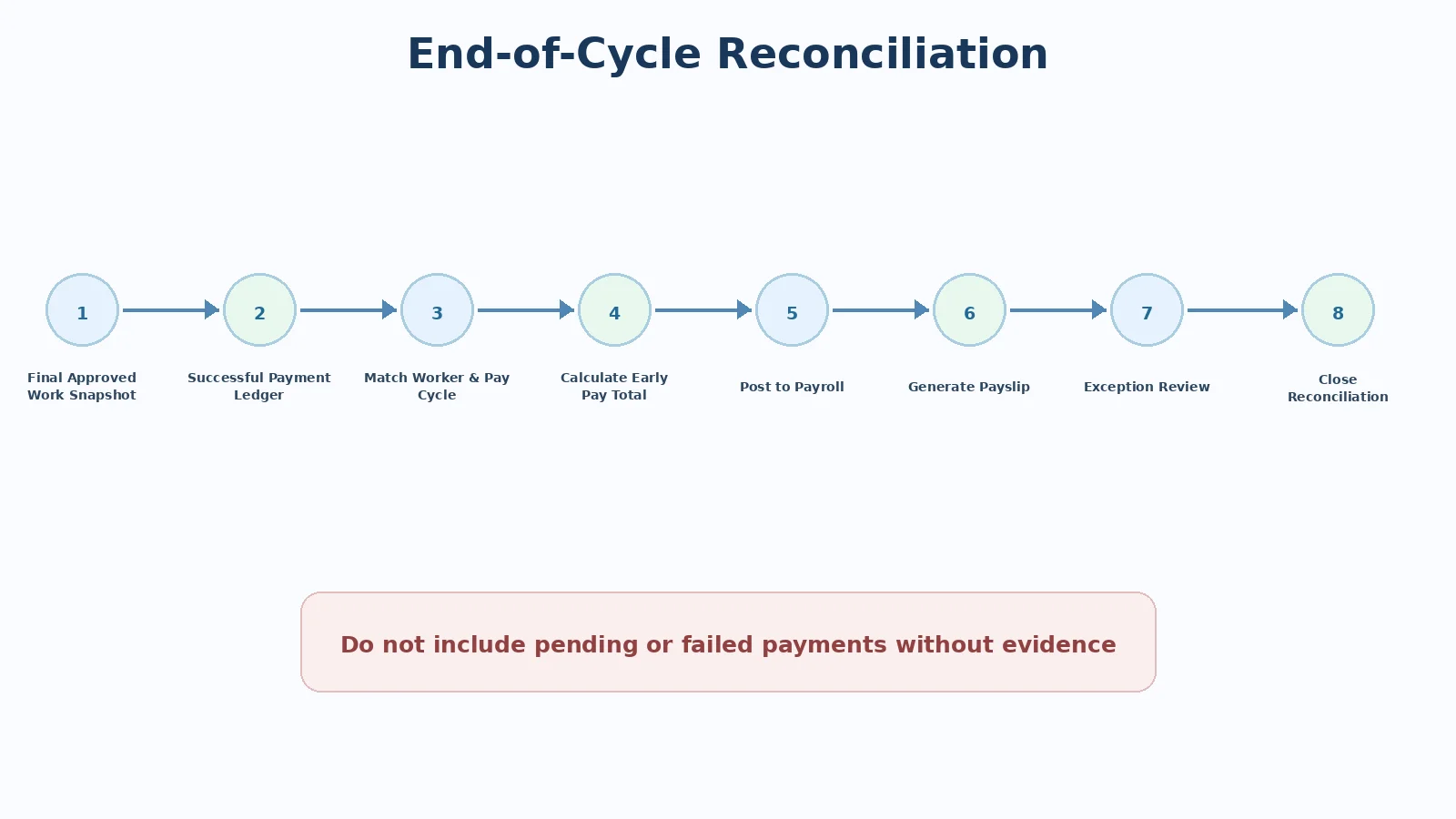
This closes the EWA lifecycle.
What should a minimum reconciliation table contain?
| Field | Purpose |
|---|---|
| Worker ID | Worker key |
| Client | Source of work records |
| Pay period | Reconciliation scope |
| Approved work total | Input data |
| Value of approved work | Calculation basis |
| Successful payment total | Amount paid |
| Pending payments | Open exceptions |
| Refunded payments | Adjustments |
| Amount posted to payroll | Amount settled |
| Difference | Needs explanation |
| Status | Open/resolved |
| Owner | Responsible person |
A single matched/unmatched column is insufficient.
Common differences
Work is correct but a payment is missing
The payment may have failed or not yet been submitted.
Payment succeeded but is missing from payroll
The worker may receive the already paid amount a second time.
Payroll deducts an amount but the payment failed
The worker's remaining pay may be reduced despite never receiving the money.
Work is changed after a successful payment
Recalculate and handle the difference through the exception process.
A pending payment crosses the cutoff
Determine its pay period under the applicable policy; do not change its date arbitrarily.
Rules for resolving exceptions
Record the error code, cause, related data, owner, opening date, action, closure evidence and closing date for every exception. For example:
| Exception | Primary owner |
|---|---|
| Incorrect work record | Manager/HR/Operations |
| Incorrect transaction status | Finance operations |
| Incorrect payroll entry | Payroll |
| Incorrect receiving account | Support and Finance |
| Bank statement mismatch | Accounting/Reconciliation |
Correct routing reduces tickets passed repeatedly between departments.
When should a difference remain open?
Do not close a difference automatically when bank status is unclear, work awaits renewed approval, a transaction may be duplicated, a change occurs after cutoff, the amount differs from source data, or the receiving account does not match. Good automation matches clear cases; it does not legitimize exceptions automatically.
Reconciliation KPIs to monitor
Track the automatic match rate, open exceptions, exception age, pending transactions, payroll differences, work records changed after payment, duplicate transactions, time to close period-end reconciliation and EWA-related payslip complaints. Transaction volume alone is not enough.
What should workers be able to see?
Although reconciliation is internal, workers need enough information to check approved work, successful transactions, the amount already received during the period, the settlement period, the payslip entry and the complaint channel. Transparency helps reduce disputes and detect errors sooner.
Conclusion
Effective EWA reconciliation connects approved work, successful payments and payroll/payslips through consistent data keys and the same pay period. The three-layer process identifies where a difference arose, who must address it and what evidence closes it. When every payment can be traced from workday to payslip, payroll integrity is complete.
Author: Do Huy Le — General Director, Nhan Kiet Manpower Supply Co., Ltd.
Earned wage access advice for employers: Hotline 0937.022.655 · Email info@nhankiet.vn · Earned wage access for employers
FAQ
Should daily reconciliation be done if there is also a period-end check?
Yes. Daily checks catch unusual transactions earlier; period-end checks focus on matching payroll.
Should a pending transaction be posted to payroll?
Do not decide without evidence of its final status. Apply the cutoff and investigation policy.
What if a work record is edited after payment?
Keep the payment history, approve the work again, recalculate and record the difference as an exception.
Should the payslip show the earned wage access amount clearly?
Yes. Present it clearly enough for the worker to recognize the amount received earlier and the remaining pay.