
How Does Earned Wage Access Affect Personal Income Tax, Social Insurance, and Payroll?

Does Early Wage Access via Earned Wage Access Affect Personal Income Tax, Social Insurance, and Payroll?
Employees receiving a portion of their earned wages before payday often ask three questions: will there be additional tax, will social insurance contributions change, and how much will they receive at the end of the month? The answer does not lie in the number of withdrawals but depends on the nature of the income, the basis for contributions, the timing as defined by law, and how the company finalizes payroll.
> In short: Earned Wage Access primarily changes the timing of access to a portion of money, not automatically creating additional wages. However, businesses must still correctly determine taxable income, social insurance contribution bases, declaration periods, and documentation according to current regulations. This statement should not be used as a tax conclusion for all models.
> Warning: This content provides a general explanation and is not tax, social insurance, or legal advice for a specific case. Models with fees, support, other benefits, third-party funding, or separate repayment obligations need independent analysis.
1. First, Separate Three Concepts
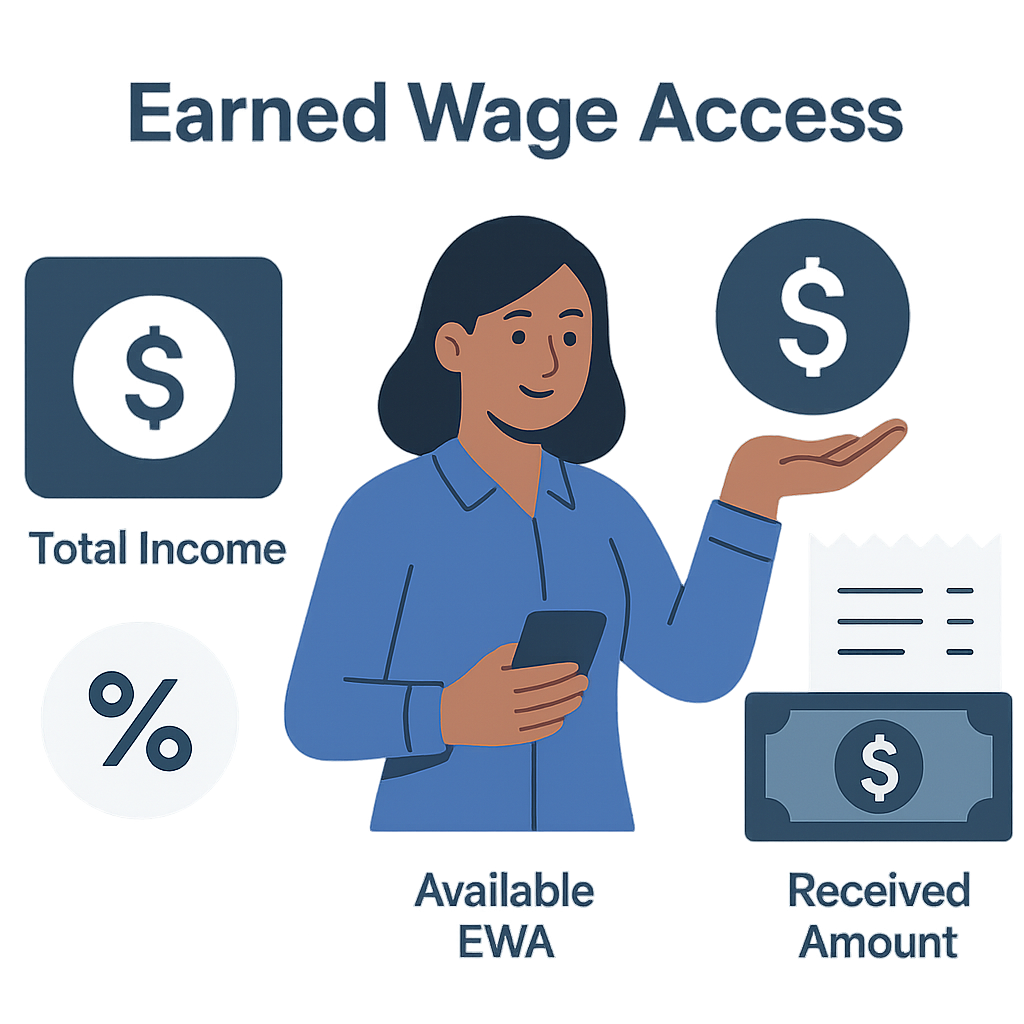
Total Income for the Period
This includes wages, salaries, and related amounts determined by contract, policy, actual work, and law.
Amount Available for Early Access
This is the portion the system allows access to before payday, after applying approved work, amounts already received, reserves, and limits.
Final Net Pay for the Period
This is the remaining amount paid after payroll calculates total income, deductions/offsets, taxes, insurance, and other legitimate obligations.
These three figures are not identical. The Earned Wage Access available amount is not the sole basis for calculating tax or social insurance.
2. How Does Earned Wage Access Affect Payroll?
According to system logic:
- only approved work creates available amounts;
- employees choose the amount within the permissible range;
- amounts received are recorded in the period;
- at the end of the period, successfully received amounts are included in payroll finalization;
- workdays covered by early access are locked to prevent double counting in the next period;
- pay slips need to clearly show total wages, statutory amounts, and the remaining net pay.
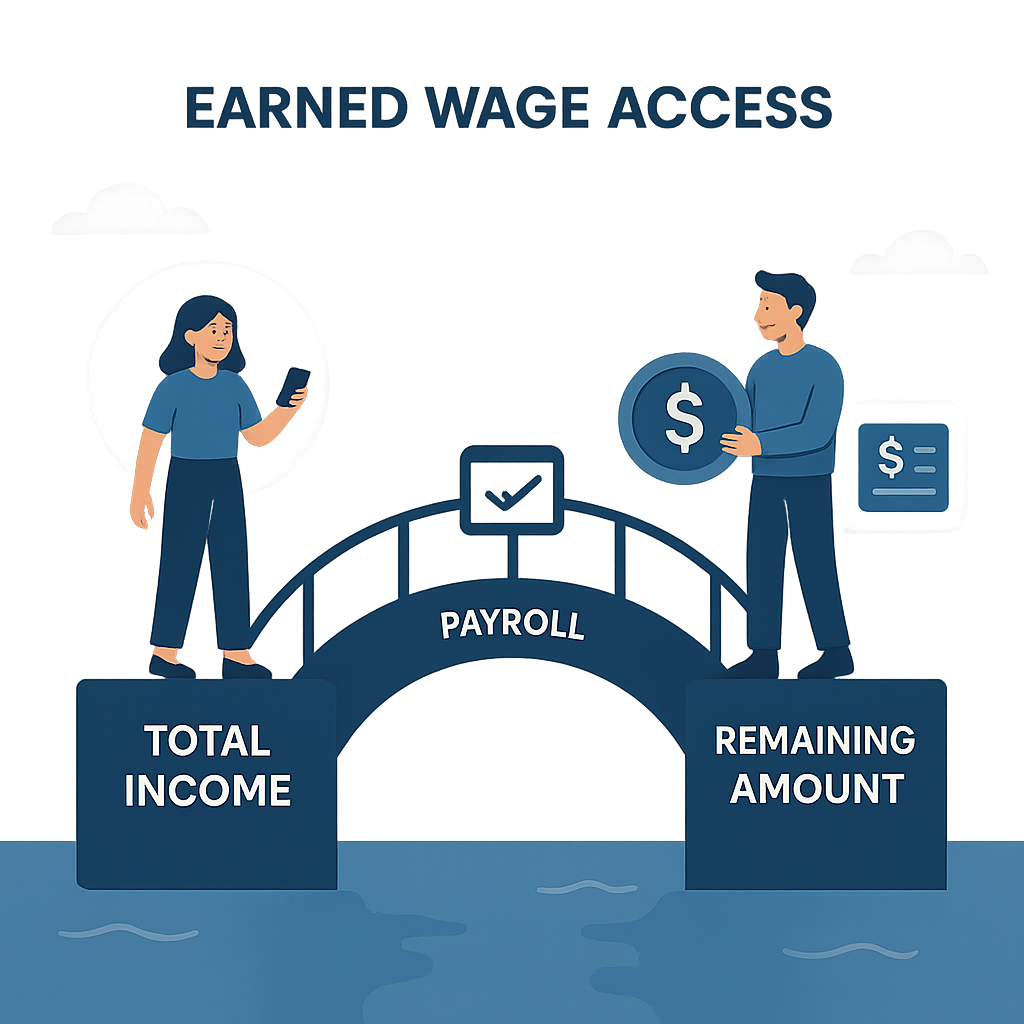
Therefore, amounts employees have received early should not be considered "lost"; they are part of the explanation bridging total income to final net pay.
3. Does Earned Wage Access Generate Additional Personal Income Tax?
(Background: see What is Salary? Legal Basis and Payment Forms.)
Tax conclusions should not be drawn solely from employees receiving money early or multiple times. From a management perspective, businesses need to analyze:
- whether the amount is wages, salaries, or another type;
- the timing of taxable income determination according to applicable regulations;
- which organization/individual is the payer or has withholding obligations;
- whether fees or additional benefits arise;
- how monthly/periodic/annual finalization is conducted.
If Earned Wage Access is merely a mechanism for early access to a portion of the same income, early transfers do not automatically increase total income. However, the declaration period and withholding timing must be confirmed by tax experts based on actual processes.
4. Tax Documents to Check at Present
The Personal Income Tax Law No. 109/2025/QH15 was issued on December 10, 2025, and takes effect from July 1, 2026. Additionally, the official document system records Law No. 09/2026/QH16 amending certain tax laws, effective from April 24, 2026.
Businesses must use the updated/consolidated versions of documents and guidelines in effect at the tax calculation period, rather than relying on an outdated article. This article does not provide specific deductions or tax rates as these parameters may change and are unnecessary to explain the nature of Earned Wage Access.
5. Three Tax Scenarios to Distinguish
Scenario A — Only Receiving Part of the Salary Early
Total income for the period is calculated as usual; the early received amount is a component in the payment bridge. The timing of income and withholding must be determined according to regulations.
Scenario B — Fees Paid by the Employee
Clarify who the fee is paid to, the nature of the service, how it is collected, documentation, and whether it is deductible for tax purposes. Fees should not automatically reduce taxable income.
Scenario C — Employer-Sponsored Fees or Additional Benefits
Accounting/tax must determine whether the employer-paid amount is a taxable benefit, deductible expense, or welfare within certain limits/conditions.
Currently, Earned Wage Access does not charge interest/fees to employees according to the described process, but official commercial policies still require confirmation from Nhan Kiet.
6. Does Earned Wage Access Change Social Insurance Contribution Wages?
The amount employees withdraw via Earned Wage Access should not be used as the basis for social insurance contributions. The basis is determined by labor relations, wage components, and applicable social insurance regulations—not by the number of transfers in a month.
The Social Insurance Law No. 41/2024/QH15 takes effect from July 1, 2025; Decree 158/2025/ND-CP also takes effect from July 1, 2025, guiding certain aspects of mandatory social insurance. Businesses must compare labor contracts, wage regulations, and actual payments with current documents.
If Earned Wage Access only changes the timing of receiving a portion already included in payroll, early withdrawal does not automatically increase or decrease the contribution basis. However, any fees, support, or non-wage structures must be separately classified.
7. Simple Illustrative Example
Assume payroll at the end of the period determines:
- total income for the period: 12,000,000 VND;
- insurance/obligations per payroll: 1,200,000 VND;
- personal income tax per hypothetical file: 300,000 VND;
- employee received early via Earned Wage Access: 3,000,000 VND.
The remaining amount to be paid at the end of the period in this example:
12,000,000 − 1,200,000 − 300,000 − 3,000,000 = 7,500,000 VND
The 3,000,000 VND is not deducted twice; it is presented as an amount already paid. This is merely an arithmetic example, not a tax/social insurance calculation for a specific individual.
8. How Should Pay Slips Be Presented?
(Details: see What Should Be Shown on Payroll and Pay Slips and How to Read Pay Slips After Receiving Earned Wage Access.)
Pay slips should help employees trace:
- work/hours and related unit prices;
- wages, allowances, overtime, and other amounts;
- total income;
- social insurance and statutory obligations;
- personal income tax if applicable;
- each or total Earned Wage Access amount received;
- Earned Wage Access fees if applicable and who bears them;
- adjustments/returns;
- remaining net pay;
- channel for reconciliation requests.
Avoid listing "other deductions" for amounts received via Earned Wage Access as it may lead employees to misunderstand it as lost wages.
9. Is the Amount Received Early a "Wage Deduction" or "Prepaid Amount"?
Language on the app, regulations, contracts, and pay slips must be legally consistent. For employee explanation, it should be clearly shown as an amount they received early from eligible portions and included in finalization, avoiding the impression of a penalty or unclear cost.
Using the legal term "wage deduction" requires cross-referencing the Labor Code and actual situations. Marketing terms should not replace legal conclusions.
10. Does Earned Wage Access Change the Payroll Period?
(See also: How is the Payroll Period Regulated?.)
Earned Wage Access may create multiple payment times within a period, but it cannot conclude that the company has changed the form/period of wage payment in labor relations. Consider:
- labor contracts and wage regulations;
- voluntariness of the request;
- when the remaining amount is paid;
- payroll/pay slip;
- how the amount already paid is recorded;
- current labor regulations.
Businesses need legal confirmation of appropriate descriptions in documents for employees.
11. When Can Tax or Social Insurance Errors Occur?
- considering Earned Wage Access available amount as total wages;
- making the early received amount a double expense;
- deducting Earned Wage Access amounts twice on payroll;
- assigning transactions to the wrong person or period;
- incorrectly handling employer-sponsored fees/benefits;
- omitting successful transactions near cut-off;
- including failed/pending transactions in amounts paid;
- work being adjusted but payroll not updated;
- one person working for multiple clients being double-counted;
- using expired tax/social insurance documents.
12. Reconciliation Report for Each Employee
| Component | Source |
|---|---|
| Total work/income | Timekeeping + payroll |
| Taxable income | Approved payroll/tax |
| Social insurance contribution basis | Labor records + payroll |
| Calculated tax/social insurance | Payroll |
| Successful Earned Wage Access | Reconciled transaction log |
| Returns/adjustments | Bank + exception log |
| Remaining net pay | Reconciliation report |
Do not take data directly from the app screen instead of reconciled reports.
13. Cut-off: The Most Challenging Issue with Multiple Withdrawals
(Accounting details: see Accounting and Reconciliation for Earned Wage Access.)
Policies must specify which period transactions created before but successful after cut-off belong to. Parties need to agree on:
- timezone;
- transaction cut-off time;
- eligible status for payroll;
- handling pending transactions across periods;
- handling returns after cut-off;
- conditions for reopening payroll;
- related tax declaration periods.
Accounting and tax advisors must approve; the system should not automatically "change the date" to match reports.
14. Employees Leaving After Receiving Earned Wage Access
Businesses need to:
- lock new requests based on leave status;
- finalize pending transactions;
- determine actual work and final total income;
- calculate tax/social insurance/benefits according to regulations;
- reconcile amounts already received;
- handle discrepancies according to legal agreements;
- prepare explainable pay slips/documents;
- transfer non-recoverable amounts to a separate process if applicable.
Do not automatically consider all discrepancies as permissible deductions.
15. Documents Businesses Should Keep
- labor contracts and wage regulations;
- Earned Wage Access policies/regulations;
- employee consent/confirmation;
- work and approval/edit history;
- formulas, unit prices, limits, reserves;
- transactions and reconciled statements;
- reconciliation reports with payroll;
- pay slips;
- tax declaration, withholding, and finalization records;
- social insurance records;
- fee invoices/documents;
- exceptions, returns, and non-recoverable amounts;
- versions of legal documents used.
16. Checklist for HR, Payroll, and Accounting
HR
- Confirm the correct person, contract, and work status.
- Communicate that Earned Wage Access is not additional wages.
- Provide a channel for explaining the remaining net pay at the end of the period.
Payroll
- Only use successfully reconciled transactions.
- Assign to the correct period and do not deduct twice.
- Separate total income from amounts already paid.
- Check for work adjustments, terminations, and returns.
Accounting/Tax
- Determine the nature and timing of recognition.
- Determine withholding/declaration obligations.
- Separate fees and amounts paid to employees.
- Reconcile bank, liabilities, and payroll.
Legal/Social Insurance
- Review terminology, regulations, and contribution bases.
- Check the appropriateness of discrepancy handling.
- Update documents in effect at the period.
17. Statements to Avoid in Communication
- "Earned Wage Access has nothing to do with taxes."
- "Receiving multiple times has no impact."
- "Earned Wage Access is definitely not a loan in all models."
- "Amounts received are deductible in all cases."
- "Available amount is actual wages."
- "Reserve is the amount the company retains."
Use conditional expressions, explain data, and guide readers to official policies.
18. Frequently Asked Questions
Will receiving wages early twice a month result in double taxation?
The number of transfers does not determine tax amounts. Payroll must accurately compile income, timing, and deducted taxes according to regulations; Earned Wage Access transactions should not be duplicated.
Is the amount withdrawn via Earned Wage Access used as the basis for social insurance contributions?
Do not use the withdrawn amount as a direct basis. The contribution basis is determined by labor relations and wage components according to law, contracts, and payroll records.
Why is the end-of-month salary lower?
Because a portion has already been received. The pay slip should show total income, obligations, Earned Wage Access amounts received, and remaining net pay.
Is the reserve amount immediately taxable?
It cannot be concluded based on the name reserve. Reserve is merely a parameter reducing the amount available for early access; tax is determined by the nature of income and timing according to regulations.
Who answers when the app and pay slip differ?
HR/payroll needs to coordinate with the Earned Wage Access operations unit and accounting, reconciling work–transactions–statements–payroll by specific codes and periods.
Official Legal Sources
- Personal Income Tax Law No. 109/2025/QH15, effective July 1, 2026.
- Law No. 09/2026/QH16 amending certain tax laws, effective April 24, 2026.
- Social Insurance Law No. 41/2024/QH15, effective July 1, 2025.
- Decree 158/2025/ND-CP on mandatory social insurance, effective July 1, 2025.
---
Author: Nguyen Minh Khang — Strategy Team Specialist, Nhan Kiet Manpower Supply Co., Ltd.
Earned Wage Access Solutions for Businesses: Hotline 0937.022.655 · Email info@nhankiet.vn · Earned Wage Access for Businesses