
Who is Responsible When Earned Wage Access Errors Occur?
Who is Responsible When Earned Wage Access Errors Occur?
When an earned wage access transaction encounters an error, employees often see only one issue: incorrect or missing funds. However, the cause may lie in HR records, time codes, approvers, formulas, bank accounts, payment systems, reconciliation, or payroll. To resolve quickly, businesses must distinguish between the party leading the resolution and the party with ultimate legal or financial responsibility.
> In short: Do not respond to every issue with "contact the provider." Each situation requires identifying the source of truth, investigation lead, approval for corrections, resolution timeline, and closure evidence.
> Warning: The matrix in this article is a reference operational framework and does not independently determine legal responsibility, compensation, or deduction rights. Ultimate responsibility depends on employment contracts, service agreements, bank agreements, regulations, and applicable laws.
1. Who are the parties involved in an earned wage access transaction?
1. Who are the parties involved in an earned wage access transaction?
Depending on the model, a transaction may involve:
- the employee;
- the employer or labor supply unit;
- the client/workplace;
- the supervisor or time approver;
- the earned wage access platform provider;
- the bank/payment unit;
- HR and payroll;
- finance–accounting;
- customer service and information security.
A party may perform multiple roles. Therefore, a RACI should be established based on activities, not just legal entity names.
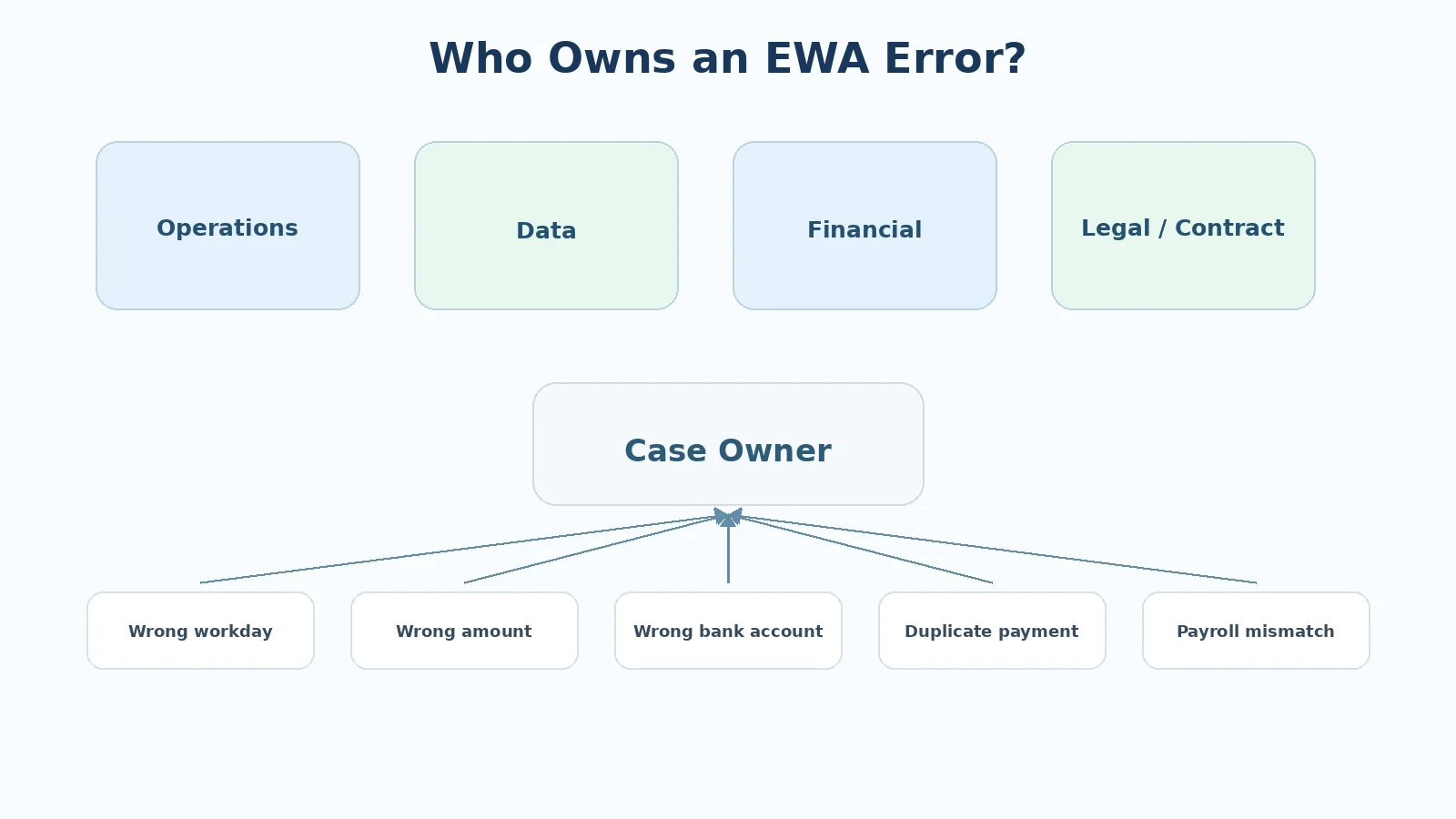
2. Four Types of Responsibility to Distinguish
Operational Responsibility
Who receives, investigates, updates, and closes the case?
Data Responsibility
Who creates, verifies, corrects, and is responsible for the quality of the data source?
Financial Responsibility
Who bears discrepancies, refunds, unrecovered amounts, or incurred costs?
Legal/Contractual Responsibility
Who has obligations to the employee, client, bank, and government agencies?
Customer service personnel may lead operations but cannot independently decide on compensation responsibility.
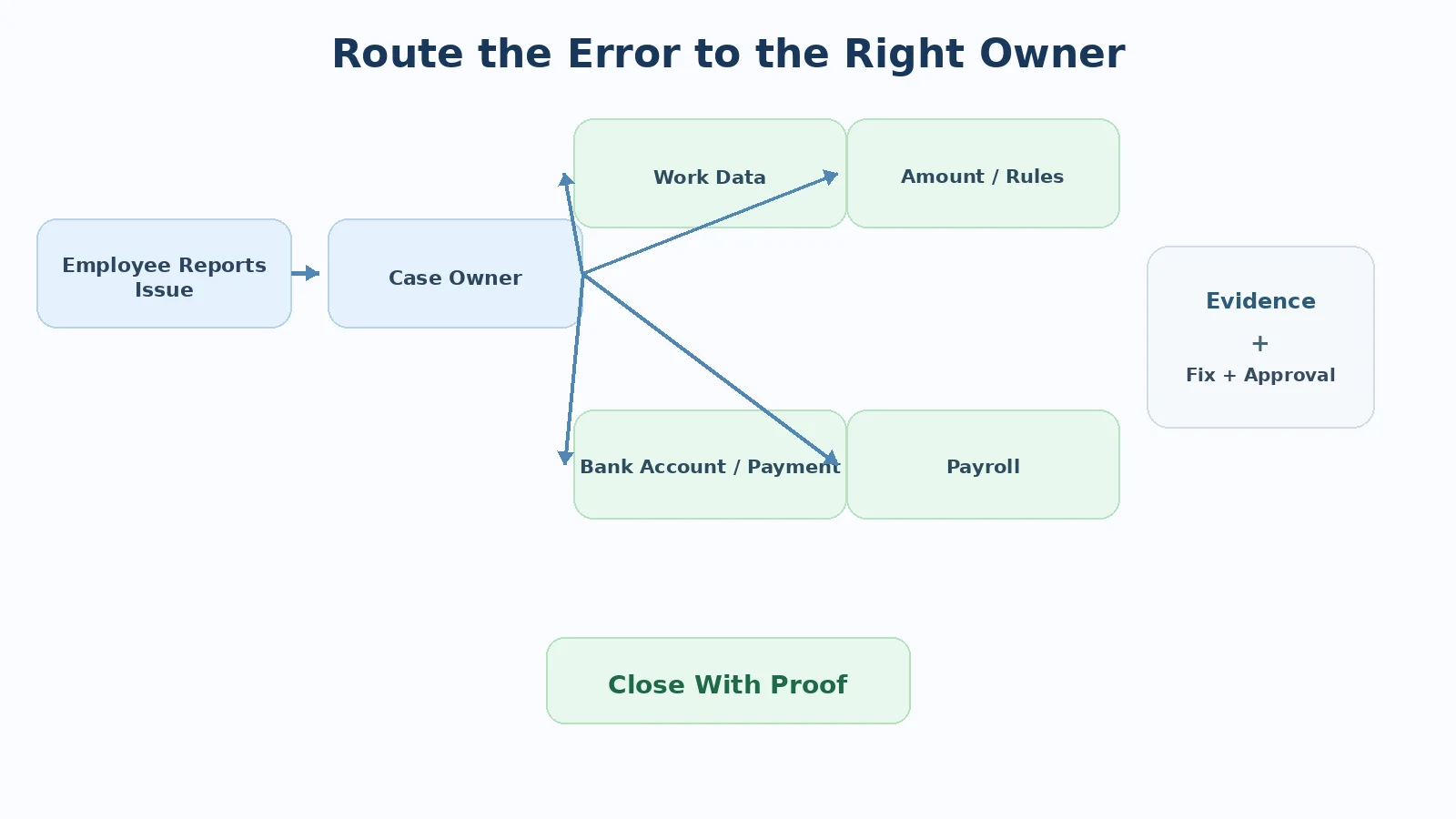
3. "One-Stop, Multi-Team Handling" Principle
Employees should not have to determine whether the error lies with HR, the bank, or the software. The support channel should:
- create a case ID;
- verify the requester's identity safely;
- collect minimal data;
- assign a Case Owner;
- coordinate backend teams;
- update status periodically;
- provide clear results and evidence;
- not close until financial/payroll impacts are resolved.
4. General Responsibility Matrix
4. General Responsibility Matrix
(See also: 20 Clauses to Check in an Earned Wage Access Agreement and Sample Earned Wage Access Policy for Businesses.)
Minh Khang Nguyễn5. Scenario 1 — Incorrect or Missing Employee Records
5. Scenario 1 — Incorrect or Missing Employee Records
Example
Incorrect ID, different name, inactive employee still active, or new employee not synchronized.
Suggested Lead
The unit managing the source HR records. In earned wage access, ERP and ID are crucial connection points, so corrections should start from the authoritative source.
Required Evidence
- source records;
- synchronization history;
- identification key;
- effective time;
- correction log;
- approver.
Do not directly correct in multiple systems without a resynchronization mechanism.
6. Scenario 2 — Time Recorded but Not Visible
Possible Causes
- synchronization job not run;
- incorrect time code;
- record format error;
- overnight shift mapped incorrectly;
- different source chosen as the source of truth;
- employee linked to the wrong client.
Suggested Lead
The owner of the time source or integration depending on the initial check result. The Case Owner remains responsible for updating the employee.
7. Scenario 3 — Unapproved Time
Earned wage access only uses approved time to generate available amounts. If the record is pending, initial responsibility usually lies with the client's/supervisor's approval process, not the bank.
Checks Needed
- when the time was ready for approval;
- who has approval rights;
- whether the approver received notifications;
- if there is a substitute;
- time approval SLA/OLA;
- if it was altered post-approval.
Do not "force approve" just to release funds if data is not ready.
8. Scenario 4 — Approved Time but Incorrect Available Amount
Check Source
Recalculate using the formula:
approved time × daily rate − amount received in period − reserve
Then check rounding and limits.
Suggested Lead
Product/Policy Operations Owner, coordinating with HR and rate manager. If input data is incorrect, redirect correction actions to the correct source but maintain a Case Owner.
9. Scenario 5 — Unverified Bank Account
Causes
Incorrect entry, non-existent account, mismatched name, interrupted lookup service, or incorrect HR records.
Suggested Lead
Account operations team receives; employee checks information; bank supports query status; HR corrects records if the source is wrong.
Do not allow staff to change the receiving account without verification and logging.
10. Scenario 6 — Funds Not Received, Pending Status
(See also: Withdrawing Earned Wage Access but Funds Not Received.)
Pending status does not mean failure. The system may have sent the order but not received a definite result.
Suggested Lead
Bank operations/reconciliation. Keep the transaction ID intact, trace, and do not resend with a new ID.
Closure Evidence
- valid response or query result;
- statement line;
- final status;
- available amount handling;
- notification to the employee.
11. Scenario 7 — System Reports Success but Employee Claims Non-receipt
Steps
- verify the correct account was masked;
- check transaction ID and response;
- reconcile source statement;
- request bank trace through official channel;
- do not ask employees to send entire statements via personal chat;
- update resolution timeline.
Do not close the ticket based solely on a "success" screen.
12. Scenario 8 — Duplicate Payment
This is a serious incident as it can affect funds and payroll.
Suggested Lead
Appointed Incident Commander; coordinate technical, bank, finance, payroll, legal, and customer service.
Actions
- prevent further occurrences;
- preserve logs;
- determine scope;
- reconcile each transaction/amount;
- agree on a legal remedy;
- controlled notification;
- RCA and retest idempotency/locking.
Do not automatically deduct duplicate payments from wages without basis and approved procedure.
13. Scenario 9 — Incorrect Recipient or Account
This may stem from records, account change actions, matching errors, fraud, or access control.
Priority Actions
- halt related flows if necessary;
- preserve verification evidence;
- contact bank through official channel;
- protect involved parties' data;
- identify the error source;
- develop a remedy/compensation plan per contract and law;
- check similar transactions.
14. Scenario 10 — Reduced Time After Payment
(See also: How Businesses Reimburse Earned Wage Access Amounts.)
Earned wage access has a "non-recoverable amount" ledger for identified risk cases. However, who bears the cost and whether it can be offset is not determined by code.
Determine
Minh Khang Nguyễn15. Scenario 11 — Employee Leaves After Receiving Funds
HR must lock new requests, but pending transactions still need resolution. Payroll/finance finalizes received amounts, end income, obligations, and exceptions.
Do not let account locking obscure transactions or hinder reasonable inquiry/complaint rights.
16. Scenario 12 — Statement Mismatch with System
Two Directions to Check
- present in the system but missing on the statement;
- present on the statement but missing in the system.
Suggested Lead
Financial/bank reconciliation team. Technical supports logs; bank verifies lines; accounting decides recognition after evidence.
Do not erase discrepancies to make reports "match."
17. Scenario 13 — Earned Wage Access Amount Miscalculated on Payroll
Causes
Incorrect period, pending transactions included in payroll, double deductions, missed refunds, incorrect person or covered days added back.
Suggested Lead
Payroll, coordinating with EWA and accounting. Bridge reports must trace total income, obligations, received amounts, and remaining payments.
18. Scenario 14 — Personal Data Accessed Beyond Scope
(Security framework: see Data Security and Privacy in Earned Wage Access Deployment.)
InfoSec/data protection and legal lead response; system team preserves logs, revokes access, and identifies affected data/persons.
Do not just handle the violating account and close; assess notification obligations, impact on employees, and preventive measures.
19. Sample RACI for Standard Flow
| Activity | R | A | C | I |
|---|---|---|---|---|
| Record Update | HR | HR Owner | IT | Employee |
| Time Approval | Supervisor/Client | Time Source Owner | HR | Employee |
| Limit Configuration | Operations | Service Owner | Finance/Legal | Customer Service |
| Account Verification | Operations | Service Owner | Bank/InfoSec | Employee |
| Transaction Processing | System/Operations | Service Owner | VPBank | Customer Service |
| Reconciliation | Finance | Chief Accountant | Bank/IT | HR |
| Payroll | Payroll | Payroll Owner | EWA/Accounting | Employee |
| P1 Incident | Incident Team | Incident Commander | Legal/Bank | Leadership/Client |
This is just a sample. "A" must be a clear entity, avoiding multiple people sharing ultimate responsibility.
20. Case File Must Include
- case ID and severity;
- appropriately masked person/client/transaction;
- discovery time;
- impact description;
- source data and evidence;
- resolution timeline;
- decisions and approvers;
- adjusted amounts/documents;
- sent notifications;
- closure confirmation;
- root cause;
- preventive actions and deadlines.
21. Frequently Asked Questions
If funds are not received, is it the bank's or earned wage access's fault?
Cannot conclude from appearance alone. Must check if the order was created/sent, account, response, trace, and statement. The Case Owner is responsible for coordinating to a result.
Is unapproved time a system error?
Not necessarily. It may belong to the approver's process; the system must display the correct status and remind/escalate per OLA.
Can duplicate payments be deducted from wages?
Should not be automatic. Requires legal, contract, consensual/legal process, and specific documentation.
If an employee enters the wrong account number, who is responsible?
Responsibility depends on verification process, displayed information, and contract. The standard earned wage access flow verifies the account holder's name to reduce this risk.
Who is the final point of contact?
Businesses should designate a Service Owner for the program and a Case Owner for each case; employees need only one intake channel.
---
Minh Khang NguyễnAuthor: [Do Huy Le] — General Director, Nhan Kiet Manpower Supply Co., Ltd. Minh Khang NguyễnEarned Wage Access Solutions for Businesses: Hotline 0937.022.655 · Email info@nhankiet.vn · Earned Wage Access for Businesses