
How does the gap between workdays and payday affect people?
Workers may complete many workdays before the corresponding pay reaches their accounts. This gap between earning and receiving money can pressure cash flow, prompt requests for support between paydays, and add work for HR and payroll if the employer lacks a suitable process.
How does the workday–payday gap arise?
Pay is not merely workdays multiplied by a rate. Before wages are paid, records pass through timekeeping, work approval, overtime and adjustments, payroll preparation and payment.
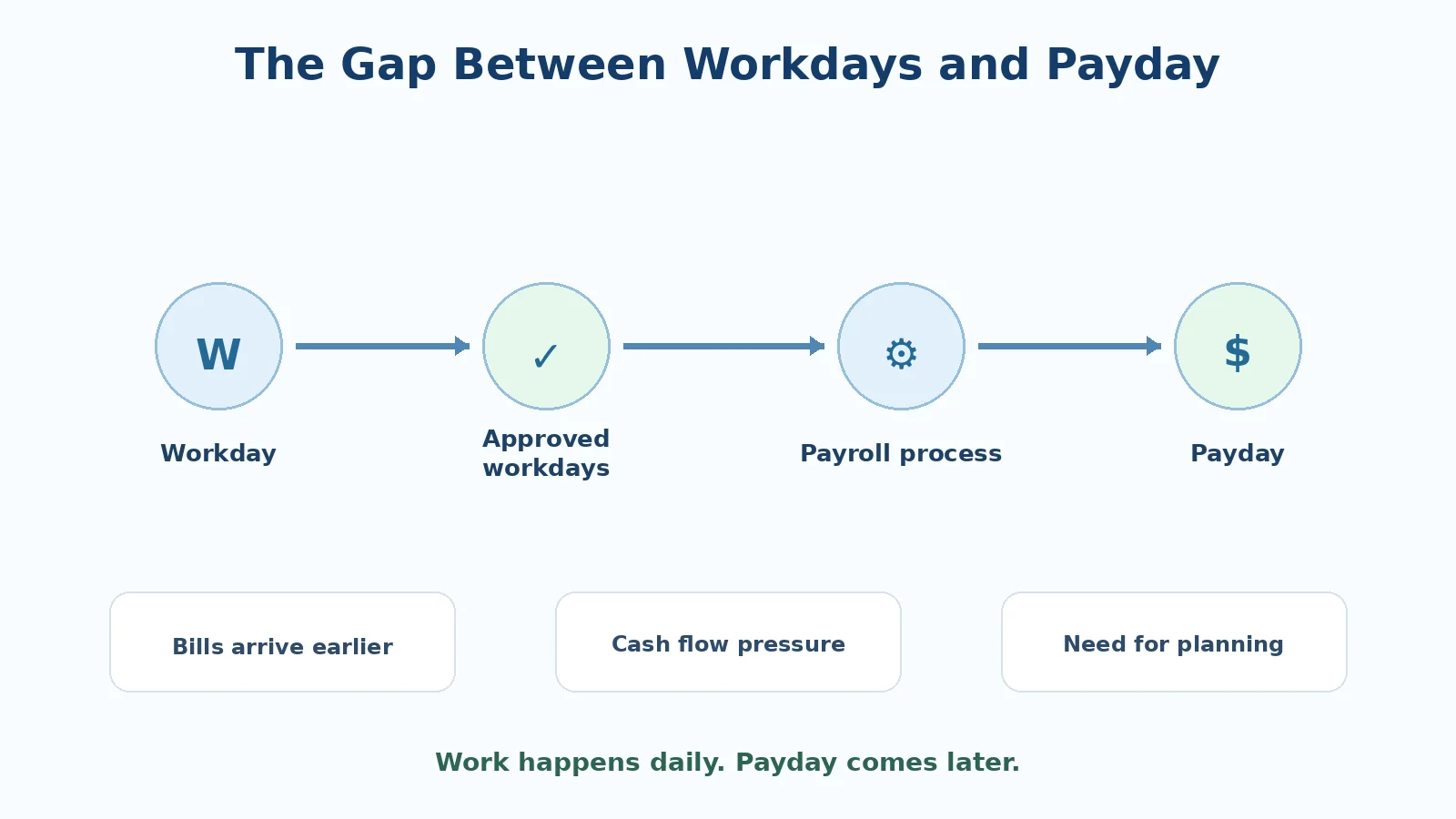
Meanwhile, everyday spending continues. Thus work may be completed while its pay is not yet due. With sufficient savings this may be manageable; when bills fall due sooner, pressure can arise even if monthly earnings are enough.
Effects on workers
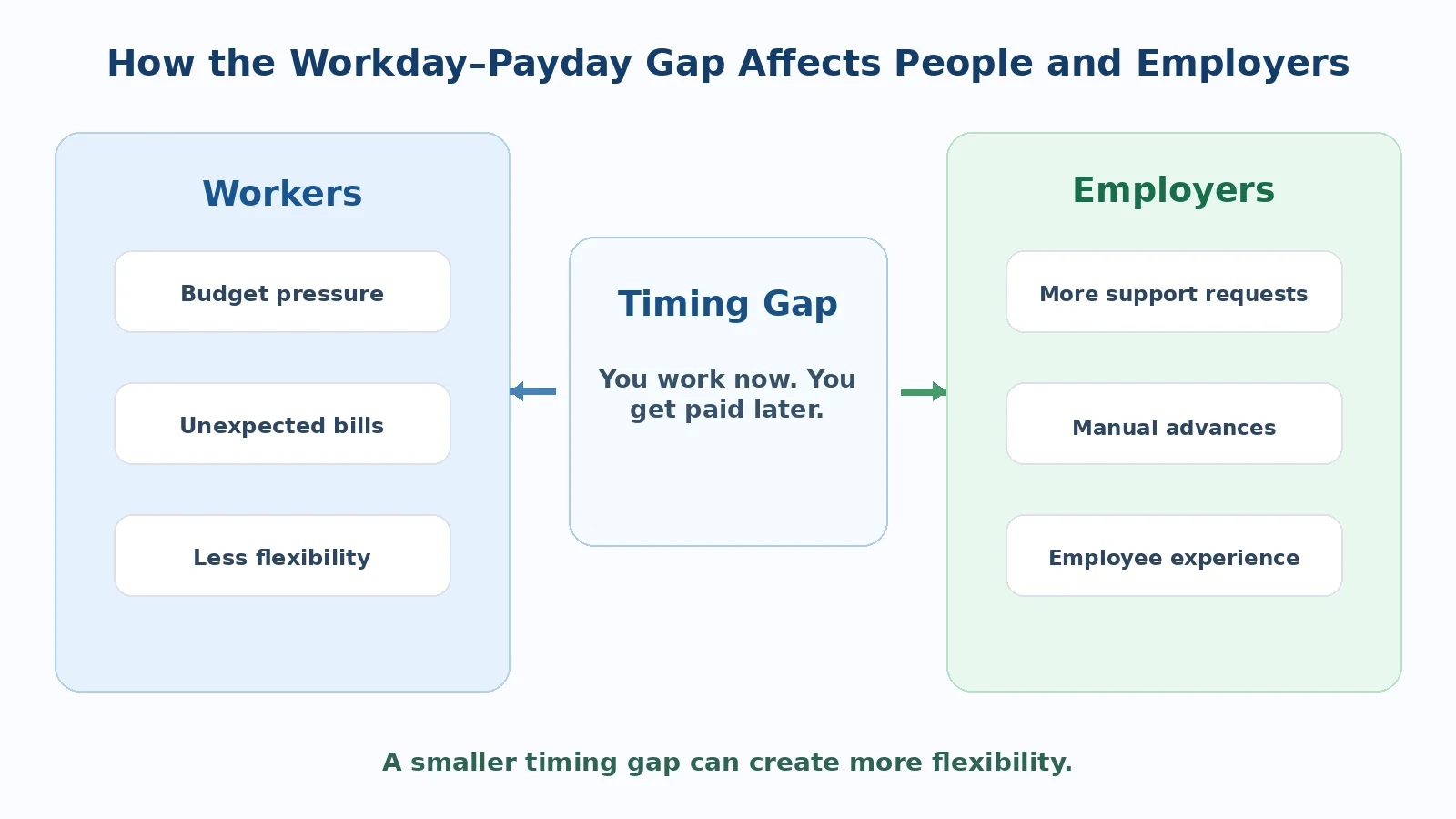
The first effect is pressure from cash flow timing. Rent, transport, school or health costs may come due before wages. This does not always mean income is too low; money in and money out may simply fall on different dates.
A longer interval also makes budgeting more important. A large midperiod cost leaves fewer options. Common effects include:
- difficulty meeting unexpected costs;
- postponing necessary payments;
- more requests for manual advances;
- less control over cash flow;
- mistaking early access for “extra” income without clear information.
A temporary shortage does not justify blaming the worker. Family responsibilities, bill dates and income variability differ.
Effects on employers
The same gap may create operational work.
| Situation | Effect on worker | Effect on employer |
|---|---|---|
| Bill due before payday | Cash flow pressure | Support requests |
| Manual advance request | Earlier money, pending approval | HR and payroll process individual cases |
| Work not approved | No eligible amount yet | Manager reviews records |
| Incorrect work record | Calculated amount may change | More correction and reconciliation |
| Unclear information | Misunderstands an early payment | More questions and complaints |
At scale, separate support requests form a substantial process. Employers need to consider data, workflow and responsibilities as well as benefits.
Why not simply pay earlier?
Shorter pay cycles, such as moving from monthly to weekly wages, require more frequent payroll runs. Employers must consider approval speed, data locking, payroll checks, payment frequency, reconciliation and exceptions.
More frequent scheduled pay is one option. Another is to keep the main pay cycle while allowing eligible workers to access part of already earned pay between dates.
How does earned wage access change the gap?
Earned wage access does not remove the main payday. It adds an opportunity to access earnings after work and before the scheduled payment.
For Nhan Kiet's service, the available amount comes from approved workdays, not projected future work.
Available amount = (approved workdays × daily rate) − amounts already received in the period − the portion retained under employer policy.
Eligible workers can access part before payday, and the earlier amount is reflected in the corresponding payroll. The timing of access changes, not total earnings for the period.
When should employers pay attention to this gap?
Look for frequent midperiod support requests; advances managed through emails, messages or disconnected sheets; HR checking every case by hand; workers unable to understand eligibility; slow work approvals; and complaints about differences between days worked and the available amount.
These signs can point to a problem along the entire path from timekeeping to payroll, not only the pay date.
Where should employers start improving?
Measure the current process before changing the pay cycle. Ask:
- How soon after a shift is work approved?
- When during a pay period do workers ask for support?
- How do HR and payroll handle advances today?
- What errors most often require work records to be corrected?
If work records are unreliable, any flexible pay model risks discrepancies. Better approvals are often the foundation for widening access choices.
Conclusion
The gap between working and receiving wages is a cash flow timing issue, not just an income issue. It can pressure workers and increase employers' manual support workload. Accurate records, clear approvals and transparent access rules are the starting point. Earned wage access can add flexibility without necessarily changing the entire main payroll cycle.
Author: Do Huy Le — General Director, Nhan Kiet Manpower Supply Co., Ltd.
Earned wage access advice for employers: Hotline 0937.022.655 · Email info@nhankiet.vn · Earned wage access for employers
FAQ
Is the workday–payday gap a problem for everyone?
No. The effect depends on each person's cash flow, obligations and financial buffer.
Does weekly pay eliminate the gap?
It can shorten it, but requires more frequent payroll processing. Suitability depends on systems and operations.
Does earned wage access replace the main pay cycle?
Not necessarily. It can add access between paydays while the main payroll keeps its existing schedule.
Does clocking in mean money is immediately available?
No. For Nhan Kiet's service, availability depends on approved workdays and program conditions.