
How to budget remaining pay after receiving part early
After receiving some earned pay during a pay period, workers should revisit the rest of their budget rather than spending as initially planned. Estimate the amount due on payday, reserve housing, food, transport and family costs, and keep a small buffer for surprises.
Why recalculate after each early payment?
Receiving some pay before payday does not raise total earnings; it changes when the money arrives. An early amount paid toward a midperiod expense reduces the corresponding payday payment after actual payroll settlement. An original monthly budget may therefore be out of date. Update the budget each time pay is received early.
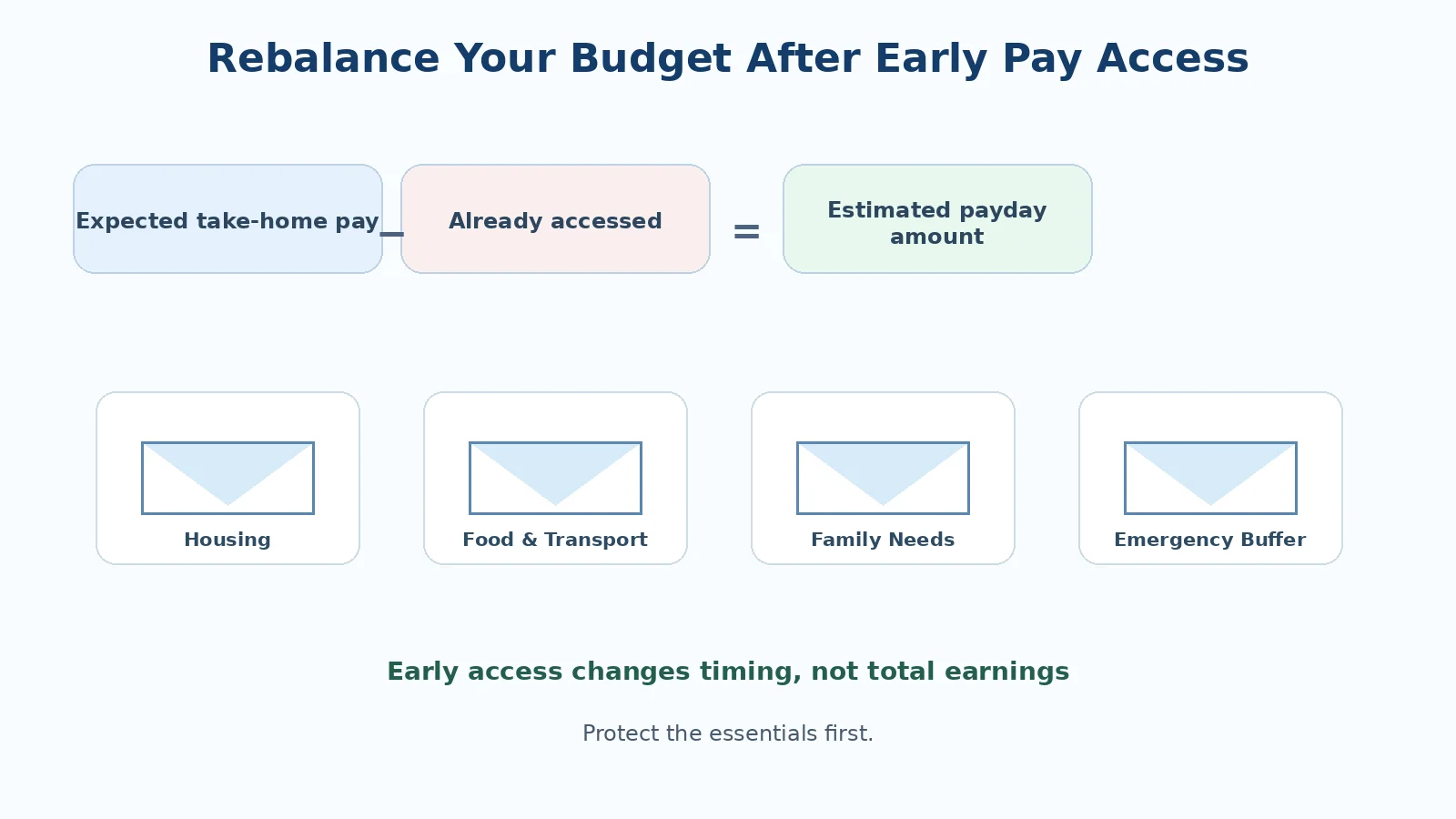
Without an update, payday can reveal that too little remains for mandatory bills.
Step 1: Estimate the payday balance
For planning:
Estimated payday amount = expected take-home pay − total pay received early.
This is not an official payslip. Actual net pay depends on finalized workdays, overtime, allowances, insurance, tax and legitimate adjustments.
Example: expected net pay of 9,000,000 VND minus 1,500,000 VND already received leaves 7,500,000 VND expected on payday. Another 500,000 VND received early would bring it to 7,000,000 VND. The estimate makes the effect visible before deciding.
Step 2: List remaining mandatory expenses
List payments due from payday until the next income date: housing, utilities, food, commuting, children's school fees, family support, medicines and committed bills.
| Amount to reserve | Estimated amount |
|---|---|
| Housing and utilities | 2,500,000 VND |
| Food | 1,800,000 VND |
| Transport | 700,000 VND |
| Family | 1,200,000 VND |
| Health/emergency reserve | 500,000 VND |
| **Total to reserve** | **6,700,000 VND** |
If 7,000,000 VND remains on payday, the buffer is only about 300,000 VND. That is a reason for caution before another early payment.
Step 3: Divide the remainder into three layers
Layer 1: Protected essentials
Keep money for certain obligations: housing, basic food, travel to work and other necessities.
Layer 2: Adjustable costs
These matter, but the amount or date may change: phone charges, family transfers and some needed purchases.
Layer 3: Flexible spending
Leisure, optional shopping and expenses that can wait. When payday funds shrink after early access, adjust layer 3 first rather than cutting basic needs.
Step 4: Keep a small buffer
Do not allocate the whole remaining amount if possible. Even a small reserve can help with transport repairs, medicine, a higher utility bill or unexpected family needs. The aim is to build the habit of not spending the whole payday balance immediately.
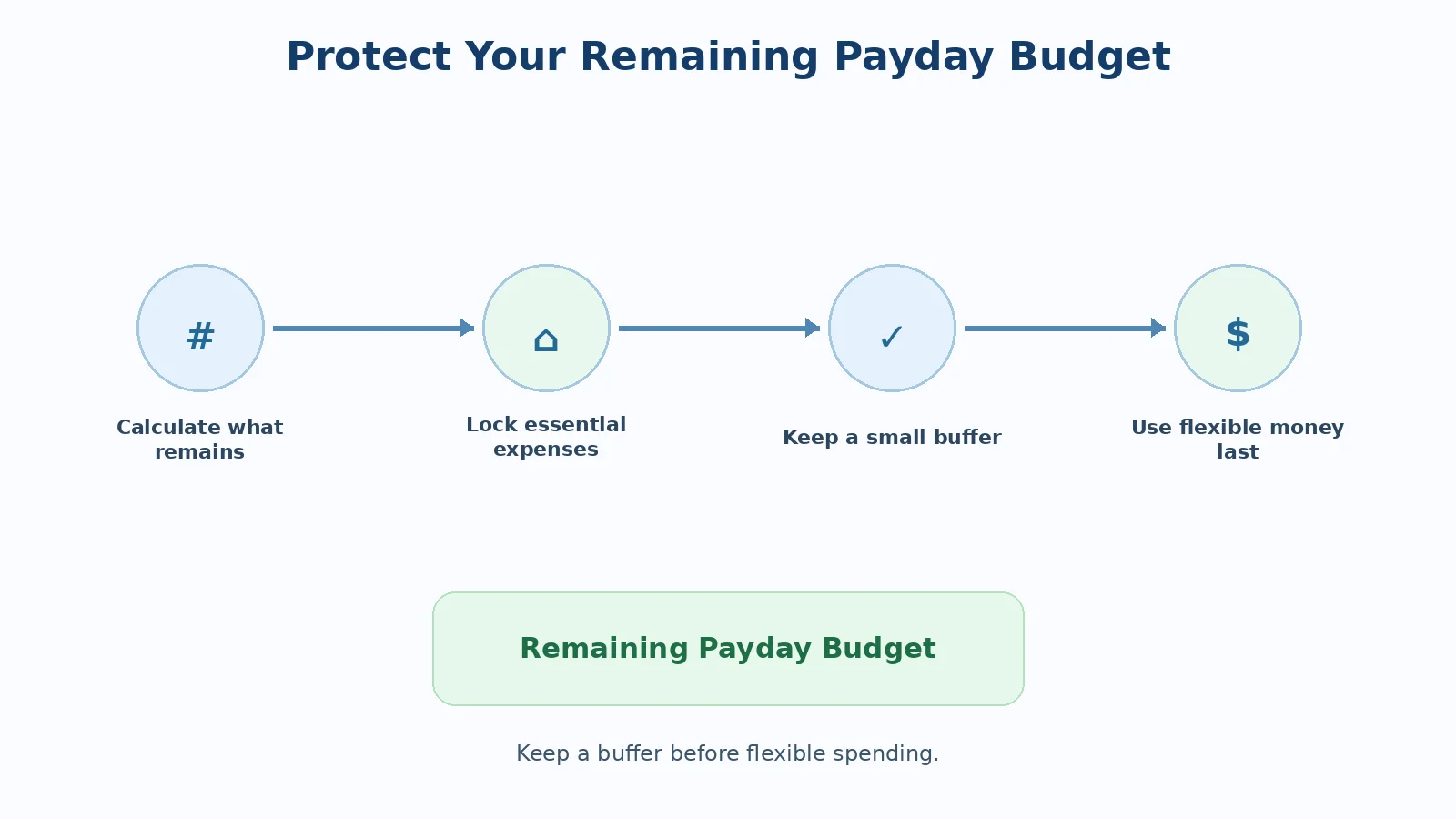
If mandatory payments leave no buffer, consider limiting further early access until the budget has been rebalanced.
Step 5: Track the total received this period
Do not look only at the most recent transaction. Three payments of 300,000, 500,000 and 400,000 VND add up to 1,200,000 VND. The total already received is what matters for the payday budget.
For Nhan Kiet:
Available amount = (approved workdays × daily rate) − amounts already received in the period − the portion retained under employer policy.
The system may show a lower available amount after each payment, but it cannot know all of a worker's personal obligations. Check the household budget separately.
Step 6: Use weekly amounts to avoid a late shortfall
After fixed costs, divide living expenses by the number of weeks until the next pay. If 2,400,000 VND remains for four weeks, a reference budget is 600,000 VND per week. This provides a clear limit and shows an overspend early enough to adjust the next week.
When should usage be reviewed?
Revisit the plan if little remains on payday; another early payment is needed right at the start of the next period; access funds nonessential spending; the available amount is nearly exhausted for several periods; the total received is unknown; the emergency buffer is gone; or another form of support is needed for essentials.
These signs do not imply wrongdoing. Early access may simply have moved beyond its role of bridging a timing gap.
What if early payments have been frequent?
Review the last three pay periods. Record (1) the date, (2) amount, (3) purpose, (4) payday remainder and (5) whether the shortage repeated.
If rent repeatedly falls before payday, options include negotiating its due date, reserving money from the previous period, building a small buffer and adjusting the weekly budget. If total income does not cover essentials, examine the longer-term income and expense balance instead of only shifting payment dates.
Conclusion
After receiving part of earned pay early, rebuild the budget around what remains. Track the period total, protect essentials, plan by week and leave a small buffer. Flexible timing helps only if money needed across the entire period remains protected.
Author: Do Huy Le — General Director, Nhan Kiet Manpower Supply Co., Ltd.
Earned wage access advice for employers: Hotline 0937.022.655 · Email info@nhankiet.vn · Earned wage access for employers
FAQ
Is the early amount “lost” at month-end?
No. It was paid earlier and is reflected in the payroll settlement so it is not paid twice.
How large should the buffer be?
No universal amount applies. Start with a small fixed amount and increase it when possible.
Should remaining pay be divided by week?
It can help reveal weekly spending and show an overspend early.
What if remaining pay cannot cover mandatory costs?
Pause further early access and review obligations, payment dates and the cause of the gap. Taking more early may make the next payday harder.