
When is it better to wait for payday instead of accessing pay early?
Waiting for payday is often the better choice when a purchase is not urgent, can be postponed without significant consequences, the remaining pay needs protecting, or early access has become a repeated habit. An available amount does not mean it should be used immediately.
“Can receive” is different from “should receive”
A system may show an amount available based on completed, approved work. This is a technical possibility, not a recommendation to spend. If every available amount is treated as extra spending money, the remaining payday balance shrinks. Midperiod cash may feel plentiful while money runs short just after payday.
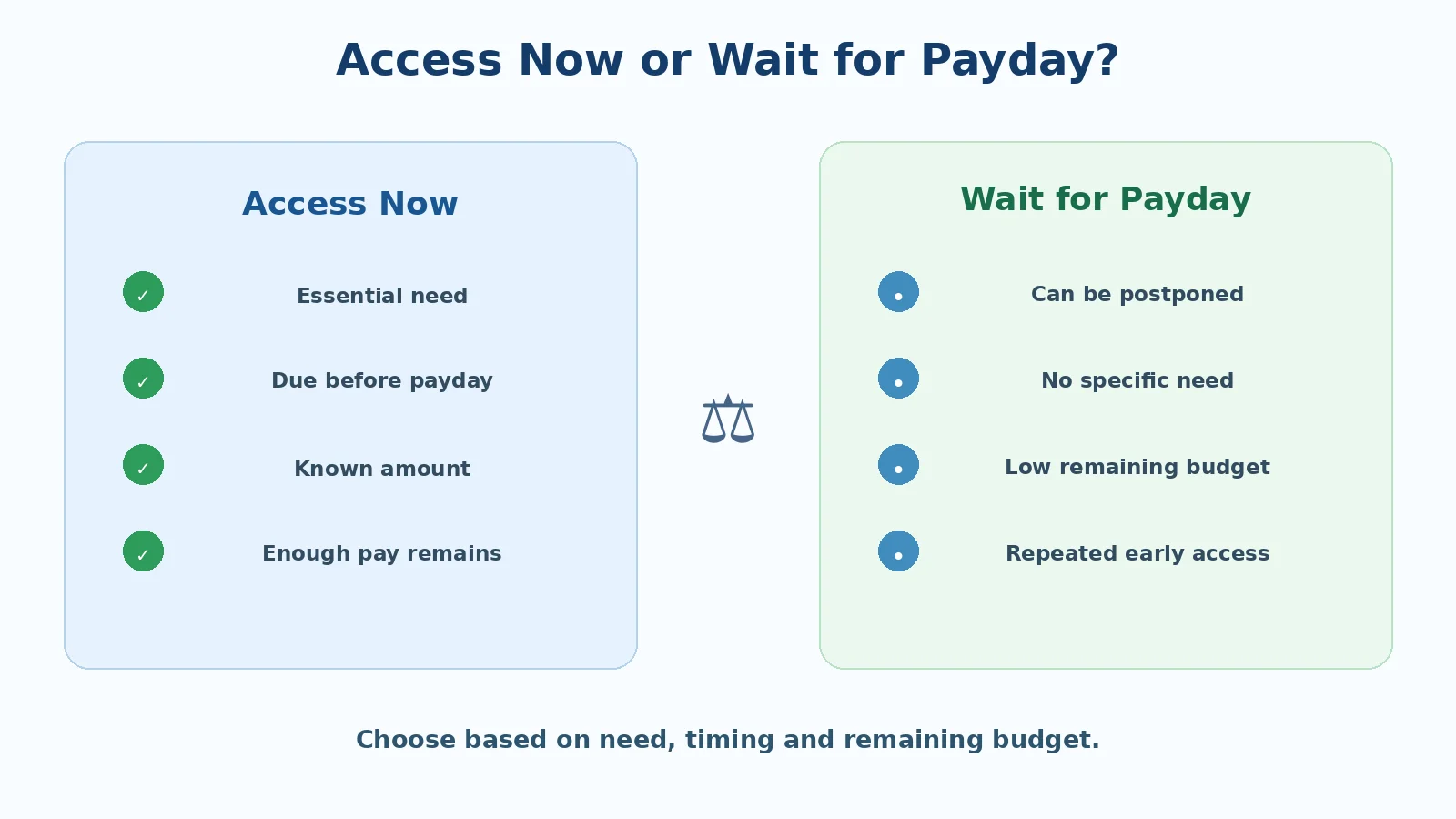
The right question is therefore not “How much does the system allow?” but “Do I actually need this money before payday?”
Six situations where waiting makes sense
1. The purchase is nonessential
Shopping, an upgrade, unplanned dining or a product that can wait is often best funded at the regular payday. A few days can separate a real need from an impulse.
2. There is no specific need
Opening the app only to see “how much is there” and then deciding to withdraw is a sign to pause. A limit does not create a need.
3. The payday balance is already thin
If several early payments have been made or bills remain after payday, another may leave too little. Keeping the available amount preserves a buffer.
4. The bill can be postponed
Some payments can wait without penalties or consequences for health or work. Waiting for payday may then be simpler.
5. Early access repeats each period
If it is used as soon as available every month, examine why. Rent dates may clash with payday, or fixed obligations may be too high. Repeated early access does not resolve either cause by itself.
6. Work or transaction data are unsettled
If work records are being corrected, an account was changed, a device has an issue or a previous transaction's status is unclear, wait for verification before adding another transaction.
What are the benefits of waiting?
Waiting can protect a budget.
| Benefit | Meaning |
|---|---|
| Larger payday balance | More for bills after payday |
| Fewer impulse decisions | Time to reassess the purchase |
| Easier budgeting | Fewer shifts between dates |
| Preserved buffer | Funds for genuinely important surprises |
| Clearer recurring pattern | Easier to detect structural income and expense issues |
For workers with many fixed obligations, keeping more pay until payday can provide greater stability than accessing it repeatedly between dates.
A 24-hour test for a nonurgent purchase
For a cost unrelated to health, housing or the ability to work, pause for 24 hours. Ask:
- What happens if I do not buy it tomorrow?
- Do I need it, or merely want it now?
- How much will remain on payday if I access pay early?
- Are essential bills due after payday?
- How many times have I received pay early this period?
If the need is still clear and the budget works after a day, consider it again.
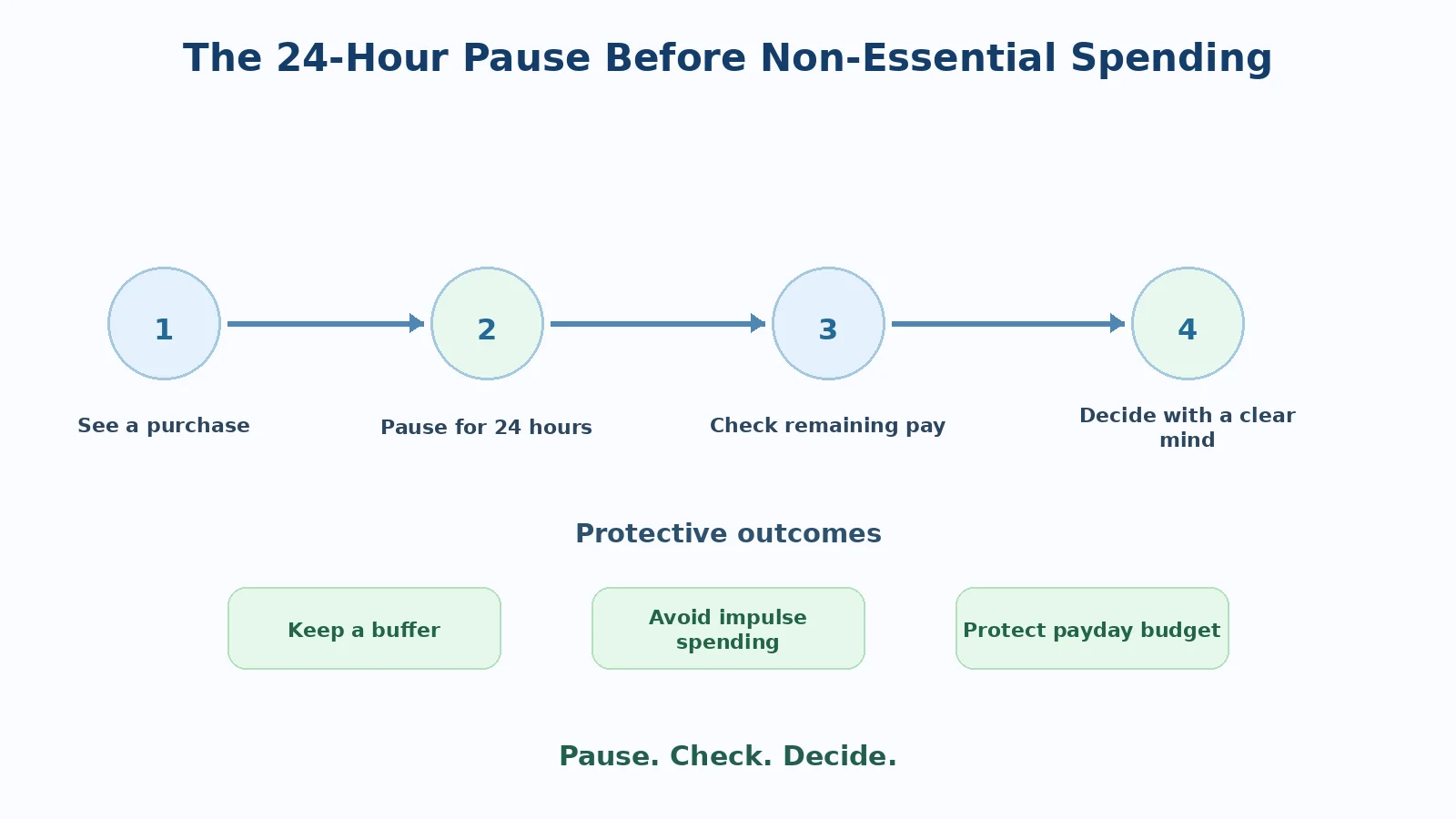
This pause is for nonurgent purchases, not emergencies.
When does waiting matter more than flexibility?
Flexibility helps when it addresses a real need. Repeatedly moving money from payday into the middle of the period can erode that benefit. For example, small early purchases may leave a low payday balance and create another shortage.
A useful default is: if there is no specific essential need, wait. It marks a boundary between money one can receive and money one should preserve.
How to protect the payday balance
Estimate:
Expected remaining pay = expected take-home pay − total received early.
Then list rent, food, transport, schooling or family costs, healthcare, committed payments and a small buffer due after payday. If obligations nearly equal the remainder, waiting is a strong signal.
For Nhan Kiet:
Available amount = (approved workdays × daily rate) − amounts already received in the period − the portion retained under employer policy.
The retained portion helps avoid receiving the entire provisional value before the pay period closes.
When waiting is no longer enough
Do not insist on waiting merely for “discipline” when medicine or necessary care is needed, there is no money to commute, rent is due with significant consequences, an urgent family matter arises, or an alternative is riskier.
In such cases, consider only the needed amount if eligible, after checking what will remain at payday. The aim is the right choice for the situation, not a blanket rule to always wait or always access.
Conclusion
Waiting makes sense when a purchase can be delayed, remaining pay needs protection or early access has become a habit. Flexibility is most useful when workers can also choose “not yet.” A sound decision protects cash flow across the entire pay period.
Author: Do Huy Le — General Director, Nhan Kiet Manpower Supply Co., Ltd.
Earned wage access advice for employers: Hotline 0937.022.655 · Email info@nhankiet.vn · Earned wage access for employers
FAQ
Should I receive early if nothing is urgent?
Waiting generally deserves consideration to preserve the remaining pay and avoid turning the available amount into routine spending.
Does a high available amount mean my budget is healthy?
No. It reflects approved work and system rules, not all your personal obligations.
What if I have already received pay early several times?
Pause and recalculate what will remain before making another request.
Should I wait if work records are being corrected?
Yes. Verify unclear work or transaction status to reduce discrepancies or duplicate transactions.