
When does early access to part of earned pay make sense?
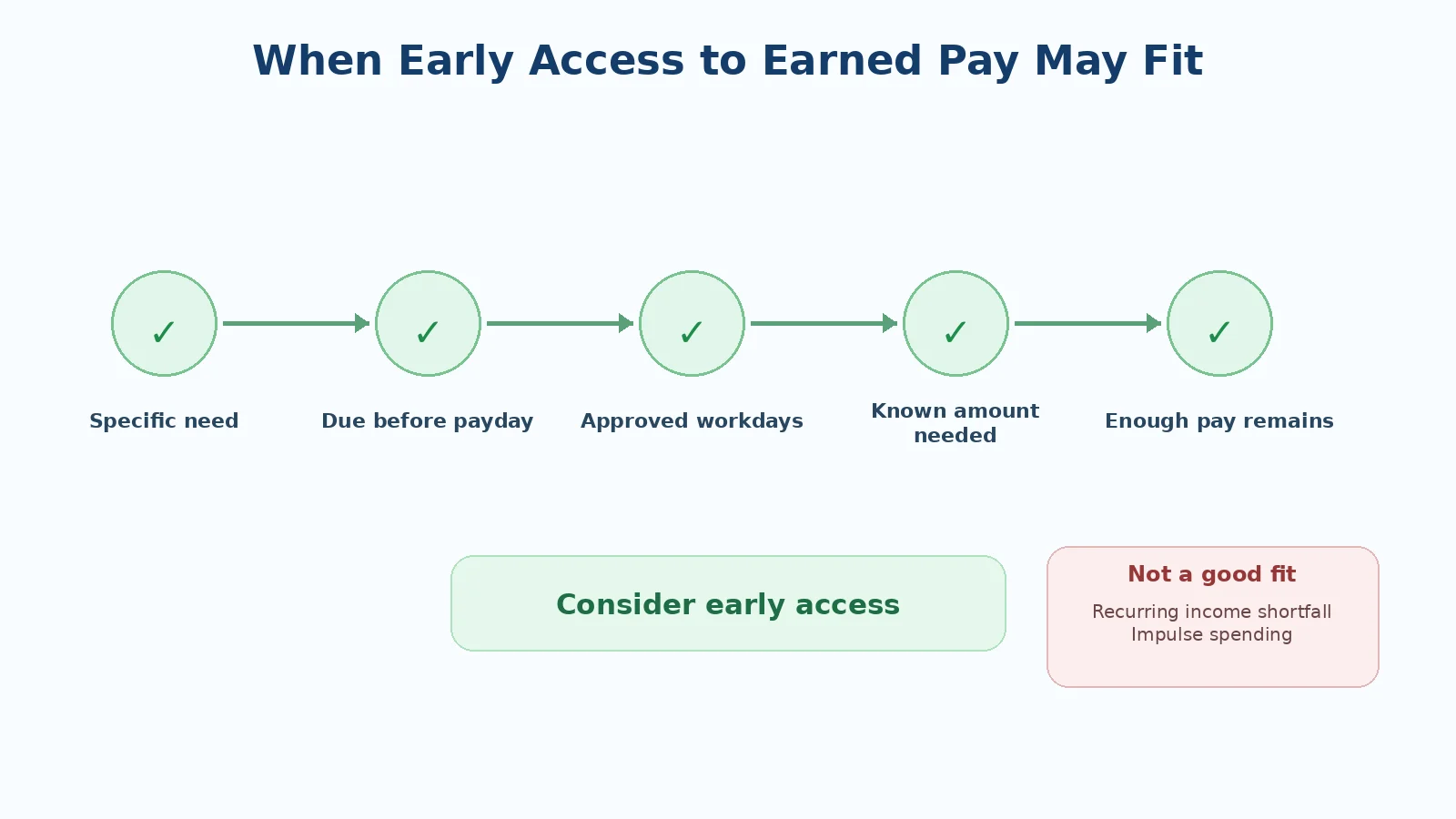
Receiving part of already earned pay may make sense when a specific bill falls due before payday, the needed amount is clear, the relevant workdays have been approved, and the remaining pay can still cover essentials. It is a change in cash flow timing, not a way to create more income.
First sign: a timing shortage, not an income shortfall
Distinguish two cases. Total pay for the period is enough, but a bill is due before payday: a timing mismatch. Or total pay cannot cover recurring obligations: a structural gap. Early access fits the first case more readily. If the same shortage recurs each month, moving the payment date may merely shift the pressure.
Ask yourself: If the bill were due after payday, would I still need early access? If not, timing is likely the main issue.
Five conditions for a more considered decision
No single rule works for everyone, but these five checks help.
1. A specific need exists
A repair needed to keep commuting, medicine, rent due or known school fees are concrete. Having an available balance alone is not a need.
2. The bill really falls before payday
If it can wait several days without material consequences, keeping pay for the scheduled payday may stabilize the budget.
3. The required amount is known
Work out the actual shortage. Needing 400,000 VND does not mean taking 1,500,000 VND merely because the system permits it.
4. Work has been approved
Nhan Kiet's available amount is based on completed and approved workdays. Unapproved or disputed work should not be treated as a certain amount available to receive.
5. Enough pay will remain
After early access, check whether the rest covers rent, food, transport and other upcoming essentials.
Situations that may be a better fit
These examples may fit if the five conditions also hold.
| Situation | Why it may fit | What to check |
|---|---|---|
| Repair transport needed for work | Protects ability to earn | Take only the shortfall |
| Essential medicine or care | Time sensitive health need | Insurance or other support |
| Rent due before payday | Payment date mismatch | Remaining pay after access |
| School fees or child costs | Specific deadline | Can payment be split or delayed? |
| Unexpected family matter | Unplanned need | Avoid taking all that is available |
| Avoid a riskier financial option | May avoid less transparent terms | Read official conditions anyway |
These are prompts for thought, not automatic recommendations.
How much should you receive?
A useful principle is the minimum amount that solves the problem. If a repair costs 600,000 VND and 2,000,000 VND is available, receiving 600,000 VND leaves more for payday. A technical limit is not a spending recommendation.
For Nhan Kiet:
Available amount = (approved workdays × daily rate) − amounts already received in the period − the portion retained under employer policy.
The available amount may therefore be less than all pay earned so far.
How to check what remains
Before confirming, make two estimates:
Expected remaining pay = expected take-home pay − total received early.
Amount after obligations = expected remaining pay − mandatory payments.
If the result is too low, another early payment may make the next payday difficult.
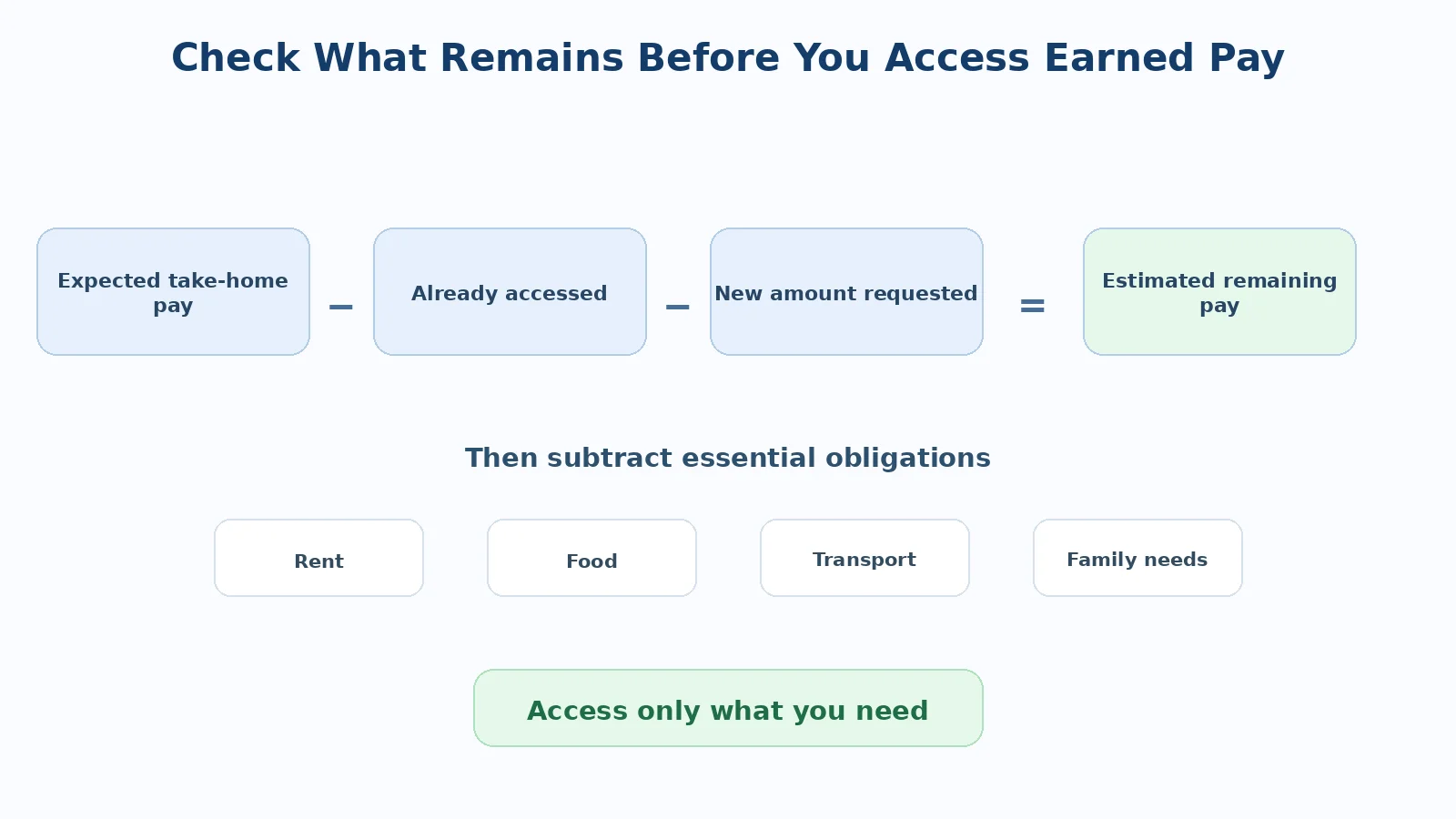
This is an estimate rather than a precise payslip calculation. Its purpose is to avoid choosing without considering what remains.
When should you stop even if the system allows more?
Pause if there is no specific bill; expected payday pay is already low; new access is being used to offset previous early access; the need recurs; work records have been changed or await verification; the account or device seems unusual; or a previous transaction has not resolved.
Keeping the remainder until payday may reduce the chance of another shortage.
The role of Nhan Kiet's earned wage access
The service lets eligible workers receive part of pay for completed, approved work within program conditions. Remember:
- it is not a bonus;
- it does not increase total income;
- the amount received is reflected in the payroll settlement.
The meaningful choice is when to receive, why, and how much, rather than taking money simply because it is available.
Conclusion
Early access to earned pay fits best when it resolves a short-term cash flow mismatch: a clear need before payday, a known amount, approved work and enough left for essentials. The aim is to solve the immediate problem without making the next payday harder.
Author: Do Huy Le — General Director, Nhan Kiet Manpower Supply Co., Ltd.
Earned wage access advice for employers: Hotline 0937.022.655 · Email info@nhankiet.vn · Earned wage access for employers
FAQ
Should I receive the maximum the system permits?
Not necessarily. Start with what is needed and calculate what remains on payday.
Is transport to work a suitable reason?
It may be, because it helps preserve earning ability, but still check the end-of-period budget.
What if I need early access every month?
The issue may go beyond timing. Review recurring expenses, due dates and appropriate support.
Can I receive money immediately after clocking in?
No. The amount depends on approved workdays and program conditions.