
Earned Wage Access for Logistics, Warehousing, and Delivery Companies: How to Calculate Shifts, Trips, and Output?
Earned Wage Access for Logistics, Warehousing, and Delivery Companies: How to Calculate Shifts, Trips, and Output?
To implement Earned Wage Access in logistics, companies must clearly separate approved time-based wages from income based on trips, orders, output, allowances, and bonuses determined only after reconciliation. Data from timekeeping, WMS, TMS, driver/delivery apps, and payroll must use common employee codes, locations, shifts, tasks, payroll periods, and approval statuses. Companies should start with highly certain income, handle late or canceled data separately, and reconcile each transaction before expanding.
> Note: This article serves as a business-technical framework for reference. Salary formulas, allowances, bonuses, penalties/compensations, components included in limits, and settlement methods must be confirmed by the company, Payroll, legal, accounting, and Earned Wage Access provider according to actual contracts and policies.
> Terminology Explanation: Earned Wage Access (access to earned wages) · WMS (Warehouse Management System) · TMS (Transport Management System) · HRIS (Human Resource Information System) · payroll (salary calculation) · COD (Cash on Delivery) · cutoff (period closing) · pilot (trial implementation) · UAT (User Acceptance Testing) · KPI (Key Performance Indicator) · hub (transshipment center) · offline (disconnected).
Why Can't Earned Wage Access in Logistics Rely Solely on "Delivered Orders"?
A warehouse employee may earn wages based on shifts, plus output and night allowances. A delivery employee may incur trips, successful orders, returned orders, cash collections, route allowances, and adjustments. A driver may have a scheduled route, but trips can change, be canceled, or completed after midnight.
If the Earned Wage Access platform considers an unconfirmed operational event as earned wages, limits may be miscalculated. For example:
orders received but not yet successfully delivered;
trips initiated but canceled;
WMS output not excluding test transactions or duplicate scans;
employees transferred between shifts;
route allowances determined only after reconciliation;
cash collections not yet handed over;
offline data synchronized late;
night shifts counted on different days across systems.
Therefore, the key principle is: operational events do not automatically become eligible income. A layer of rules and approval statuses is needed to link operational data with payroll.
1. System Mapping in a Logistics Company
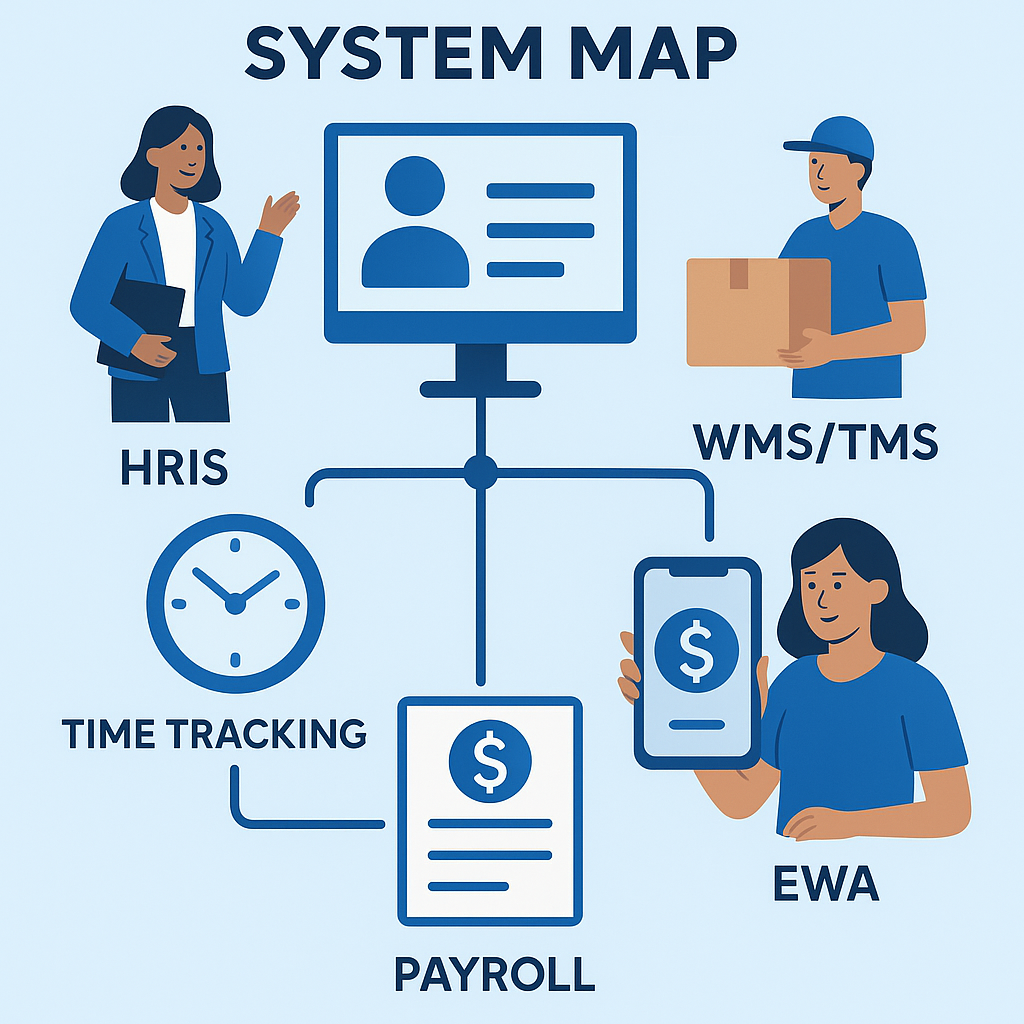
Role of Each System
| System | Data | Should Not Infer |
|---|---|---|
| HRIS | Identity, employment status, unit | Account holders are still employed |
| Timekeeping | In/out events, shifts, exceptions | Every punch is payable time |
| WMS | Warehouse activities, scans, order/output processing | Every task is payable output |
| TMS | Trips, routes, dispatch, status | Every new trip is incurred income |
| Field App | Task acceptance, delivery, proof, location | Every user action is final result |
| Payroll | Period, rules, account codes, approval | Money successfully transferred |
| Earned Wage Access | Limits, requests, transactions | Source data no longer changes |
| Payment | Transfer results | Payroll recorded correctly per period/person |
2. Classifying Workforce Before Designing Earned Wage Access
(For multi-shift factories: see Earned Wage Access for Multi-Shift Manufacturing Companies.)
Shift-Based Warehouse Employees
Income may include time-based wages, overtime, night shift allowances, position allowances, and productivity-based components.
Drivers
May be compensated based on time, trips, routes, distance, vehicle type, waiting time, allowances, or a combination mechanism.
Delivery Employees
Income may relate to the number of orders received, successfully delivered, returned, weight, area, cash collections, and quality bonuses.
Seasonal/Batch Collaborators
Must accurately determine relationships, participation conditions, validity periods, and data sources. Do not lump all work forms under the same Earned Wage Access policy.
Dispatch and Operations Office Employees
Typically have more stable data but different needs and income structures compared to field groups.
Each group needs an eligibilitypolicyid and earningpolicyversion, rather than a single formula for the entire company.
3. Distinguishing Certain Income from Variable Income
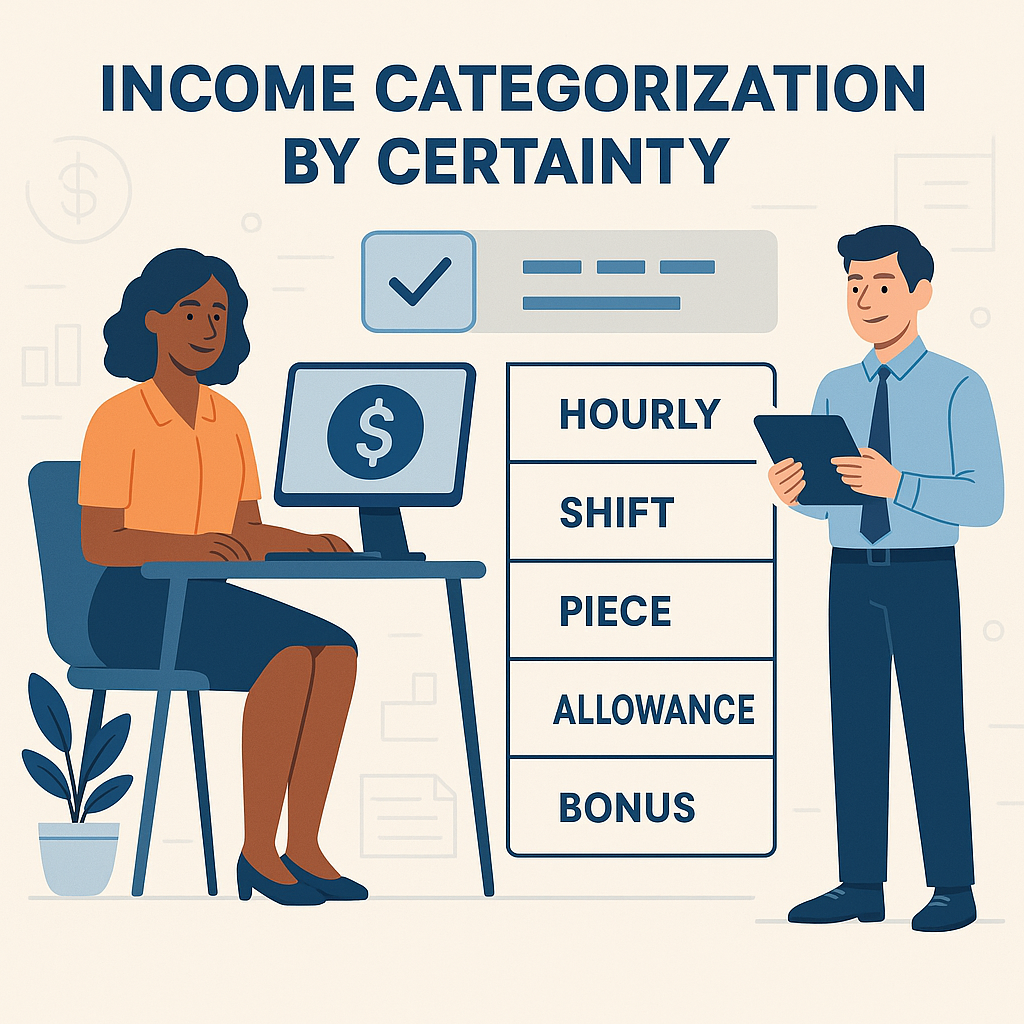
| Income Group | Example | Certainty Level at Early Stage | Consideration for Earned Wage Access |
|---|---|---|---|
| Approved Time-Based Wages | Completed and approved warehouse shift | Higher | Can be initial foundation |
| Approved Overtime | Completed OT, manager confirmed | Relatively high | Depends on policy |
| Reconciled Completed Trips | Trips with sufficient proof, not canceled | Depends on process | Only after eligible status |
| Successfully Delivered Orders | Orders in final status and quality | May change due to returns/adjustments | Need retention or closing rules |
| Route/Night Allowances | Depends on route, time frame, approval | Depends on data | Only count when clearly substantiated |
| Productivity/Attendance Bonuses | Usually determined at period end | Low mid-period | Typically should not be counted early if uncertain |
| Reimbursements/Adjustments | Depends on verification and process | Undetermined | Do not automatically deduct or assume |
Companies should start pilots with the most stable income. After data and reconciliation are solid, consider adding variable components.
4. Minimum Employee Data and Assignment
Employee Profile
employee_id;employeridorlegalentity_id;employment_statusand effective date;payroll_group;role_type: warehouse, driver, delivery, dispatch…;ewa_eligibility;version and update timestamp.
Assignment
assignment_id;siteidorhubid;warehouse_id;route_groupif policy applies;shift_id;vehicle_idif operationally necessary;effectivefrom,effectiveto;assignment status;
approval source.
Minimization Principle
Do not transfer all operational, location, or vehicle data to the Earned Wage Access platform just because it is available. Each field must serve limit calculation, verification, risk, or reconciliation purposes that have been identified.
5. Warehouse Shift and Time-Based Work Data
(Conceptual foundation: see What is Approved Time?.)
Commonly needed fields:
| Field | Purpose |
|---|---|
| work_date | Operational date |
| shift_id | Shift code |
| shiftstart, shiftend | Time with timezone |
| checkin, checkout | Presence events |
| regular_minutes | Confirmed regular time |
| overtime_minutes | Overtime by status |
| break_minutes | Break time by rules |
| attendance_status | Full, partial, absent… |
| approval_status | Pending, approved, rejected, adjusted, locked |
| record_version | Change tracking |
Split Shifts and Multiple Points in a Day
An individual may work two time frames or support two warehouses. The system should record each work segment, then apply anti-duplication rules. Do not simply take the earliest check-in and latest check-out as the total work time, as the gap may not be working hours.
Overnight Shifts
Timekeeping, WMS, and payroll must agree on work_date. If one system uses the start date and another uses the end date, work and output may fall into different periods.
6. What Statuses Are Needed for Trip and Delivery Data?
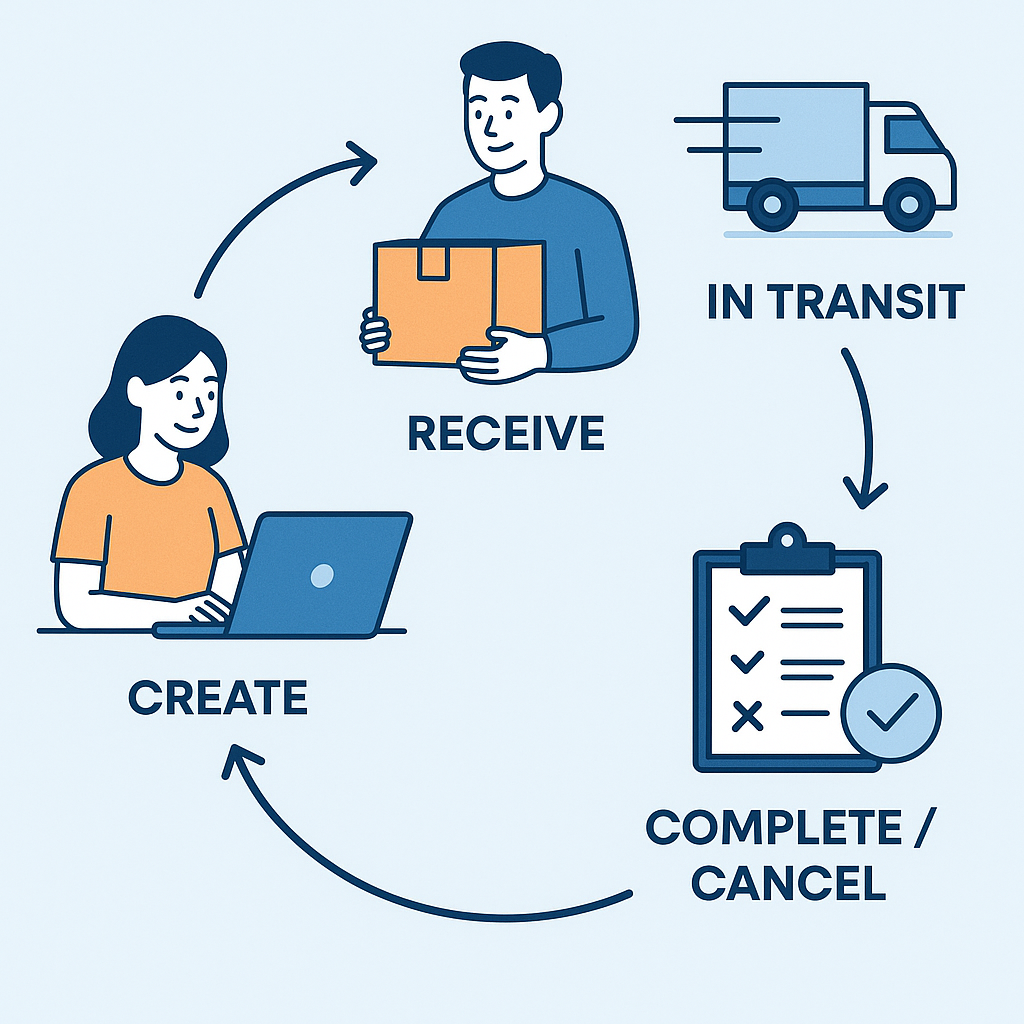
A reference lifecycle:
Actual status names may vary. The important thing is to determine which point is eligible for payroll/Earned Wage Access.
Illustrative Data Fields
taskidortripid;employee_id;assignment_id;siteid/routeid;acceptance, start, completion times;
task type;
valid output;
operational status;
approval status;
reason for cancel/return/adjustment;
approver and approval time;
data version.
Do not transfer end-customer addresses or detailed location data to Earned Wage Access if unnecessary.
7. Are Successfully Delivered Orders Earned Wages?
You cannot conclude solely from the "Delivered" status. Companies must check:
whether the status is final or subject to return/cancellation;
whether delivery proof is valid;
whether the order belongs to the correct employee;
whether output calculation is by order, package, weight, or route;
whether there are quality conditions or COD reconciliation;
which behavior the income is paid for;
whether data is duplicated due to rerouting or reassignment;
which status payroll closes.
Earned Wage Access should only use statuses approved by operations and Payroll as eligible.
8. Handling Returned Orders, Canceled Trips, and Late Data Corrections
Do Not Delete Occurred Events
Returned orders or canceled trips should have a new status, not delete the original record. The system needs to know which Earned Wage Access transactions used previous data.
Processing Flow
receive change event with new version;
check if data is late;
determine affected income portion;
recalculate available limit;
if a transaction exists, create a discrepancy case;
process according to approved policy;
transparently notify if employee benefits are affected;
log before/after values and approver.
Do not automatically consider every return as employee fault or automatically create deductions. Responsibility determination must follow appropriate processes and evidence.
9. Cash on Delivery (COD) Is Not Salary
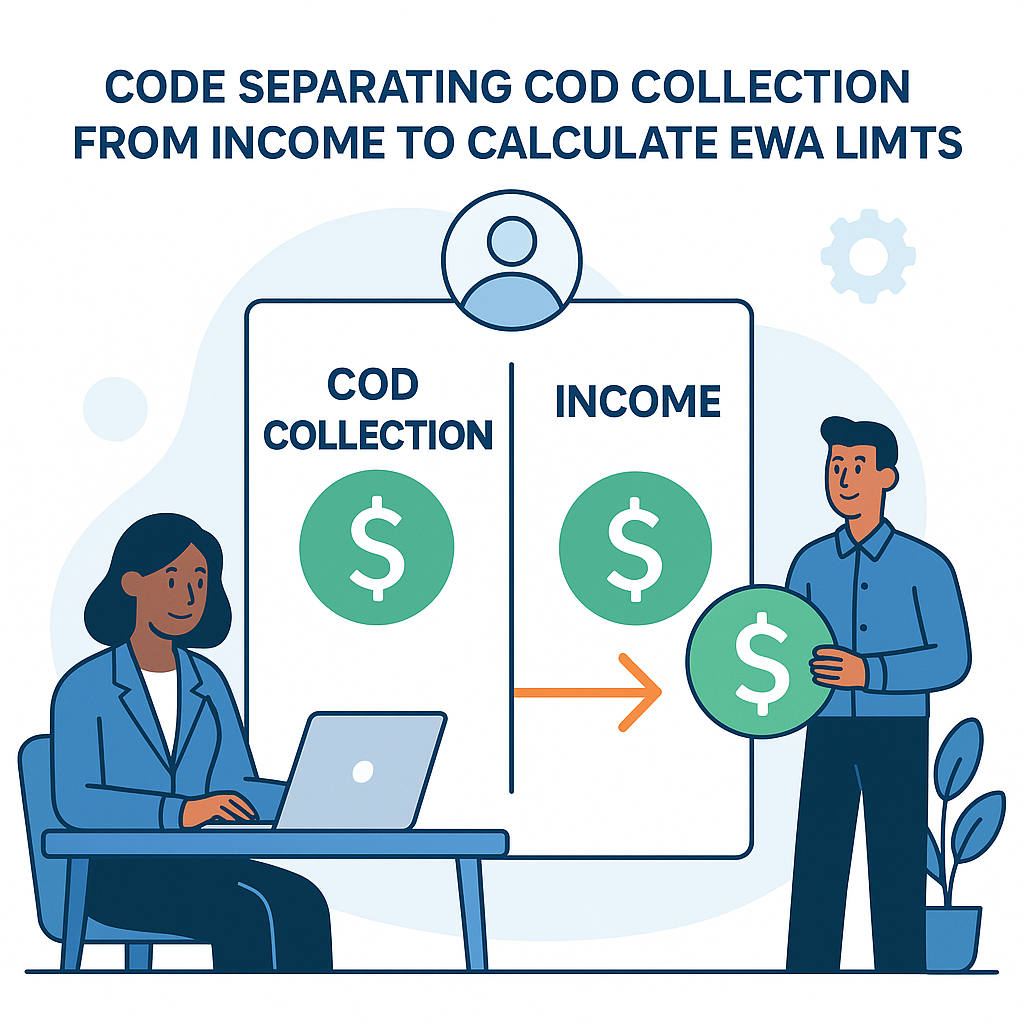
In delivery, employees may hold or remit cash collections. This is a business cash flow distinct from salary.
Data design should separate:
cod_collected;cod_remitted;codreconciliationstatus;eligible income portion;
Earned Wage Access transactions;
payment amount to employees.
Do not use held COD amounts as evidence of employee "income" or automatically offset with Earned Wage Access without substantiated and approved processes.
10. Offline Data and Out-of-Order Events
Drivers or field employees may work in areas with weak networks. Apps syncing later may cause completion events to arrive after adjustment or cancellation events.
Each event should have:
unique
event_id;occurrence time at source;
system receipt time;
version or sequence number;
source/device;
signed/verified status if applicable;
link to
taskid/tripid.
The system should not apply "last record is always correct" if lacking versioning. Conflict resolution rules and exception queues are needed.
11. Calculating Limits for Combined Income
A conceptual model:
Eligible Income = Approved Time-Based Wages + Confirmed Output + Eligible Allowances
Available Limit = Eligible Income x Allowed Rate - Retained Amount - Received/In Process
Each component needs:
account code;
eligible status;
formula;
unit;
rounding rules;
cap;
effective date;
approver;
version.
Do not include projected output or end-of-period bonuses in limits without volatility control mechanisms.
12. Integrating WMS, TMS, and Payroll
(Data and architecture requirements: see Integrating Earned Wage Access with Timekeeping, Payroll, and ERP.)
Do Not Connect by Display Name
Employee names, warehouse names, route names, and shift names may change or duplicate. Stable codes and mapping tables are needed.
Data Standardization Layer
An integration layer should convert different systems to a common model:
people;
assignments;
shifts/time;
tasks/output;
approval statuses;
payroll periods;
income items;
transactions and payments.
API or Batch File?
| Method | Suitable For | Control Points |
|---|---|---|
| Near Real-Time API | Continuously updated task and time data | Authentication, versioning, idempotency, retry |
| Batch File/SFTP | Scheduled output/time closing | Batch code, checksum, deduplication, partial error file |
| Controlled Manual | Small pilot or legacy system | Standard templates, creator/approver, log, reconciliation |
Expansion is only suitable when manual workload is measured and there is a plan to reduce it.
13. Six-Way Reconciliation
(Details: see Reconciling Earned Wage Access Transactions with Payroll and Accounting.)
Depending on the model, logistics companies may need to reconcile:
timekeeping/shift schedule;
WMS/TMS or field app;
approved income item data;
Earned Wage Access transactions;
payment results;
payroll/ERP/accounting.
Discrepancies to Detect
time recorded but missing assignment;
task recorded but wrong person or warehouse;
canceled trip but income not adjusted;
duplicated output recorded;
Earned Wage Access successful but payroll missing;
payment successful but Earned Wage Access not updated;
period error due to overnight shift/trip;
incorrect allowance version;
unresolved return transactions;
total amount matches but individual employee errors.
Each discrepancy must have a case, owner, evidence, and approval to close.
14. Managing Specific Risks and Fraud
(Full framework: see Risk Management and Fraud Prevention in Earned Wage Access.)
Data Signals
same task assigned to multiple people;
multiple tasks completed in unreasonable time;
sudden output spikes;
completion from unusual location/device;
mass adjustments right before cutoff;
same person creating and approving exceptions;
account change followed by immediate transactions;
multiple employees receiving money into the same account.
One signal is not enough to conclude fraud. Combine, verify, and have an appeal mechanism to protect legitimate employees.
Task Separation
Do not allow one person to simultaneously:
adjust output;
approve income items;
change limits;
process transactions;
close discrepancies.
15. Supporting Dispersed Employees Across Multiple Locations
Suitable Channels
FAQ in app;
hotline/ticket;
point of contact at warehouse/hub;
SMS/status notifications;
short shift-based guides;
QR codes at work points.
Ticket Routing
| Issue | Point of Contact |
|---|---|
| Missing/incorrect shift time | Warehouse Manager/HR Operations |
| Incorrect trip/output | Dispatch/WMS/TMS Operations |
| Limit not visible | Earned Wage Access Operations/Payroll |
| Stuck transaction | Earned Wage Access/Payment Support |
| Incorrect payroll settlement | Payroll |
| Suspected account takeover | Security/Risk |
Employees only need one ticket number throughout, not retelling their issue to each department.
16. Protecting Location and Behavioral Data
(Security framework: see Data Security and Privacy in Earned Wage Access Deployment.)
Logistics may use GPS, route history, delivery proof, and devices. This data must be tightly managed.
Companies need to determine:
which location data is truly needed for Earned Wage Access;
detail level and retention time;
who has viewing rights;
whether used for other purposes;
how data is aggregated/obscured;
how to handle employee feedback;
which providers have access;
deletion/return when service ends.
The Personal Data Protection Law No. 91/2025/QH15 and Decree 356/2025/ND-CP take effect from January 1, 2026. Processing must be reviewed according to roles, purposes, and actual data flows; do not transmit all location data to Earned Wage Access just to preemptively address an undefined risk.
17. Pilot KPIs for Logistics
Data and Operations
percentage of employees with valid assignments;
percentage of time/output approved on time;
data freshness;
percentage of duplicate/late data;
percentage of automated processing;
percentage of automated reconciliation;
adjustments after cutoff.
Experience
activation rate;
successful transaction rate;
time to receive money;
abandonment rate;
tickets per 1,000 transactions;
ticket processing time;
understanding of limits and fees.
HR and Finance
manual advance requests;
absenteeism and turnover by cohort;
peak period presence rate;
cost per user/transaction;
confirmed discrepancy and fraud value;
false block rate.
Do not conclude Earned Wage Access causes HR changes solely from pre/post data without controlling for peak seasons, orders, wages, bonuses, routes, and management.
18. Logistics UAT Checklist

Warehouse and Shifts
[ ] Day, night, and split shifts.
[ ] One person supporting two warehouses in a day.
[ ] Missing check-in/check-out.
[ ] Pending and approved overtime.
[ ] Warehouse transfer mid-period.
Trips and Orders
[ ] Trip creation, acceptance, completion, and approval.
[ ] Trip cancellation or reassignment.
[ ] Successfully delivered order later returned.
[ ] Offline data arriving late.
[ ] Duplicate tasks/output.
[ ] Wrong employee or route.
Limits and Transactions
[ ] Only eligible items counted.
[ ] Policy version correct on effective date.
[ ] Duplicate submissions do not create duplicate transactions.
[ ] Timeout creates unclear status.
[ ] Account change verified.
Payroll and Reconciliation
[ ] Overnight shift/trip in correct period.
[ ] Payroll import transactions deduplicated.
[ ] Discrepancies from each source create cases.
[ ] Return transactions processed correctly.
[ ] Traceability from payroll to source data.
19. Pilot Design and Expansion
(Standard roadmap: see 90-Day Pilot Plan for Earned Wage Access.)
Choose Initial Scope
Select a warehouse/hub or delivery group with:
genuine need;
relatively stable data;
clear income rules;
management ready to approve;
sufficient support;
representative process for expansion areas.
Start with Stable Income
The initial phase may only use approved time-based wages. Output, trips, and allowances are added after status and reconciliation prove reliable.
Expand by Wave
Group locations with the same WMS/TMS, payroll, policies, and income models. Each wave needs UAT, permissions, training, dashboard, reconciliation, and rollback.
20. Common Mistakes
Using Generated Orders Instead of Eligible Orders
Orders can still be canceled, returned, or reassigned.
Mixing COD with Income
Two cash flows have different natures and processes.
Using Only Data Arrival Time
Offline events may arrive out of order; need source time and version.
Calculating All Variable Items
Bonuses, allowances, or unconfirmed output make limits highly volatile.
Lack of Assignment Codes
Employees transferring warehouses/routes can be misrecorded or duplicated.
Expanding While Pilot Team Handles Manually
Results do not reflect scalability.
Frequently Asked Questions
Can Successfully Delivered Orders Be Used Immediately for Earned Wage Access Calculation?
Only when it is an eligible status approved by operations and Payroll, with deduplication, return/reassignment handling, and reconciliation possible.
Is COD Counted in Earned Wage Access Limits?
COD should not be considered salary. It is a cash collection flow that needs separate management and reconciliation. Any related mechanism must have substantiated and approved processes.
Is GPS Data Mandatory for Earned Wage Access Implementation?
Not by default. Only use necessary data for defined purposes. In many models, task status and approved time may suffice without transmitting detailed location data to Earned Wage Access.
How to Handle Canceled Trips After Limit Creation?
The system needs to receive a new version, recalculate impact, and create a case if a transaction exists. Do not delete old data or automatically assign blame to employees.
How Are Split Shifts Calculated?
Record each work segment and apply anti-duplication rules, rather than taking the first-last time as a continuous shift. Specific calculation follows payroll policy.
Can a Pilot Be Conducted with Only Timekeeping Data?
Yes, if the initial goal is to calculate only approved time-based wages. Trip/output items should be added after status and reconciliation are reliable.
Is Earned Wage Access Suitable for Logistics Peak Seasons?
It can create value, but peak seasons also increase load, seasonal labor, and exception data. Test beforehand, have capacity plans, support, and do not choose peak seasons for the first go-live if the system is unproven.
Conclusion
Earned Wage Access in logistics is only reliable when companies distinguish operational data from eligible income. Timekeeping, WMS, TMS, and field apps must be standardized by person, assignment, shift, task, payroll period, and data version.
Companies should start with approved time-based wages, separate COD, clearly handle returned orders/canceled trips, and reconcile each transaction. After the pilot proves data and operations stable, add variable income and expand by warehouse/hub. Learn more about Earned Wage Access for businesses to discuss Earned Wage Access models for logistics, warehousing, and delivery workforces.
References
---
Author: Ho Tan Dat — Assistant to the Deputy General Director of Strategy, Nhan Kiet Manpower Supply Co., Ltd.
Earned Wage Access Solutions for Businesses Consultation: Hotline 0937.022.655 · Email info@nhankiet.vn · Earned Wage Access for Businesses