
What data should a business prepare before implementing EWA?
Before EWA implementation, prepare worker, workplace, timekeeping, work, payroll, account and reconciliation data. Every field needs a source of truth, owner and update rule.
Do not begin integration with an arbitrary Excel file
Define and validate identity key, owner, source of truth, effective date and approval. Document exceptions before real-money operation.
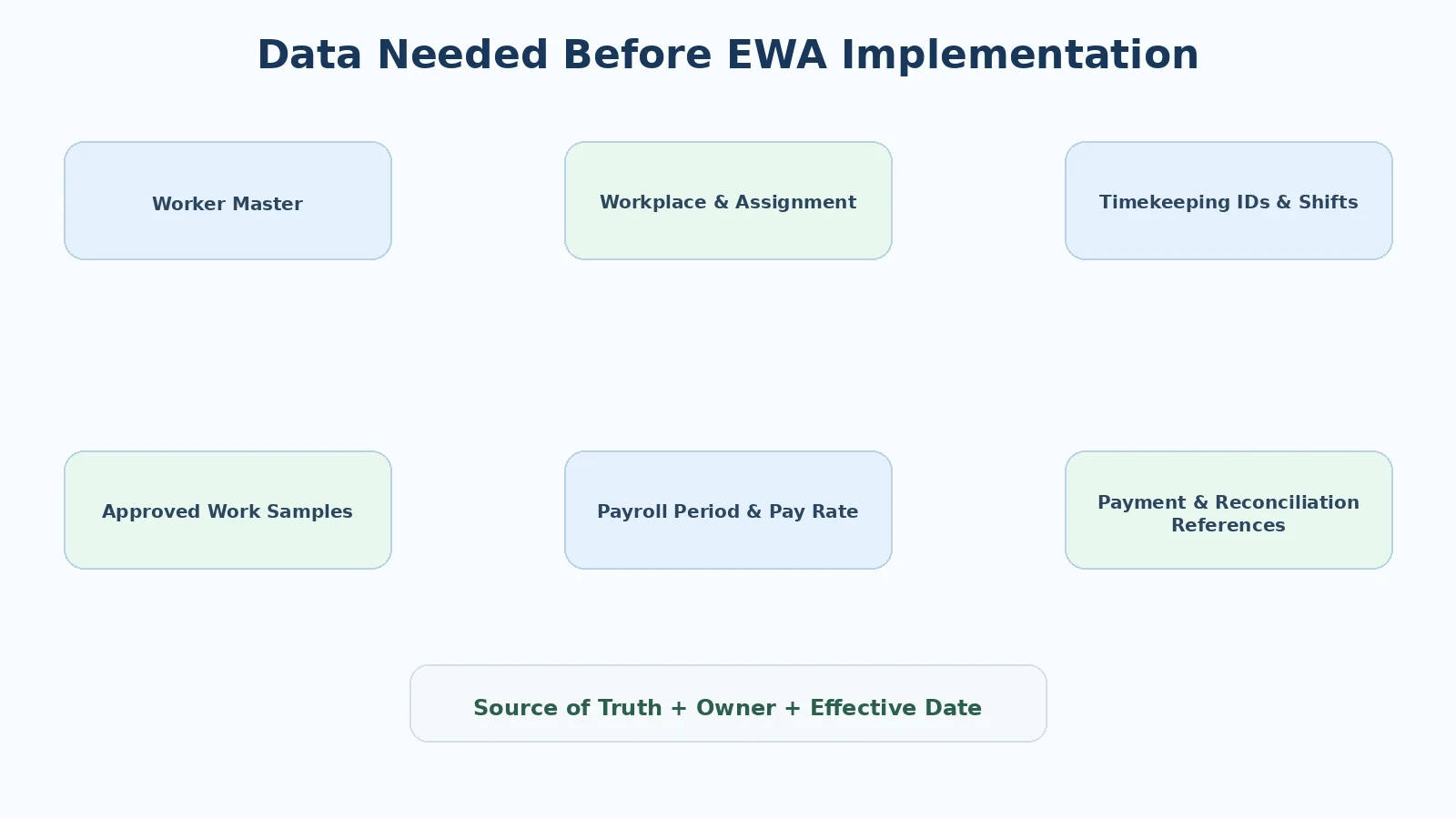
Group 1: Worker master
Define and validate employee ID, name, identity key, work status, join and leave dates. Document exceptions before real-money operation.
Group 2: Organization and workplace structure
Define and validate legal entity, factory, customer, site, department, team and shift codes. Document exceptions before real-money operation.
Group 3: Timekeeping IDs and shifts
Define and validate worker-to-site timekeeping mapping, shifts, midnight rules, overtime and formats. Document exceptions before real-money operation.
Group 4: Sample work data
Define and validate normal, pending, approved, edited, duplicate, invalid, overnight and transfer samples. Document exceptions before real-money operation.
| Data | Source of truth | Owner |
|---|---|---|
| Worker master | HRM/ERP | HR |
| Timekeeping ID | Time system/customer | Operations |
| Approved work | Approval portal | Supervisor/customer |
| Pay rate | Payroll | Payroll |
| Transaction | EWA ledger | Finance/EWA Ops |
| Money status | Bank/reconciliation | Finance |
Group 5: Approval rights and source of truth
Define and validate data owner, winning source and approval authority. Document exceptions before real-money operation.
Group 6: Payroll periods and pay rates
Define and validate payroll period, cut-off, pay date, rate, effective date and mid-cycle changes. Document exceptions before real-money operation.
Group 7: EWA policy configuration
Define and validate eligible users, enabled customers, reserve, limits and status-change rules. Document exceptions before real-money operation.
Group 8: Account and verification data
Define and validate collection, verification, correction, storage and safe account references. Document exceptions before real-money operation.
Group 9: Reconciliation data
Define and validate transaction ID, worker, period, amount, status, bank reference and payroll deduction. Document exceptions before real-money operation.
What columns should a data dictionary contain?
Define and validate field name, description, type, required flag, source, key, format, effective date and error rule. Document exceptions before real-money operation.
| Attribute | Example |
|---|---|
| Field name | employee_id |
| Description | Worker ID |
| Data type | string |
| Required | Yes |
| Source | HRM |
| Key | Primary/Reference |
| Format | No spaces |
| Effective date | If applicable |
| Owner | HR |
| Valid example | EMP001 |
| Error rule | Reject/hold |
How many exception types should the sample contain?
Define and validate profile, assignment, timekeeping, shift, work, approval, rate, period, account and reconciliation exceptions. Document exceptions before real-money operation.
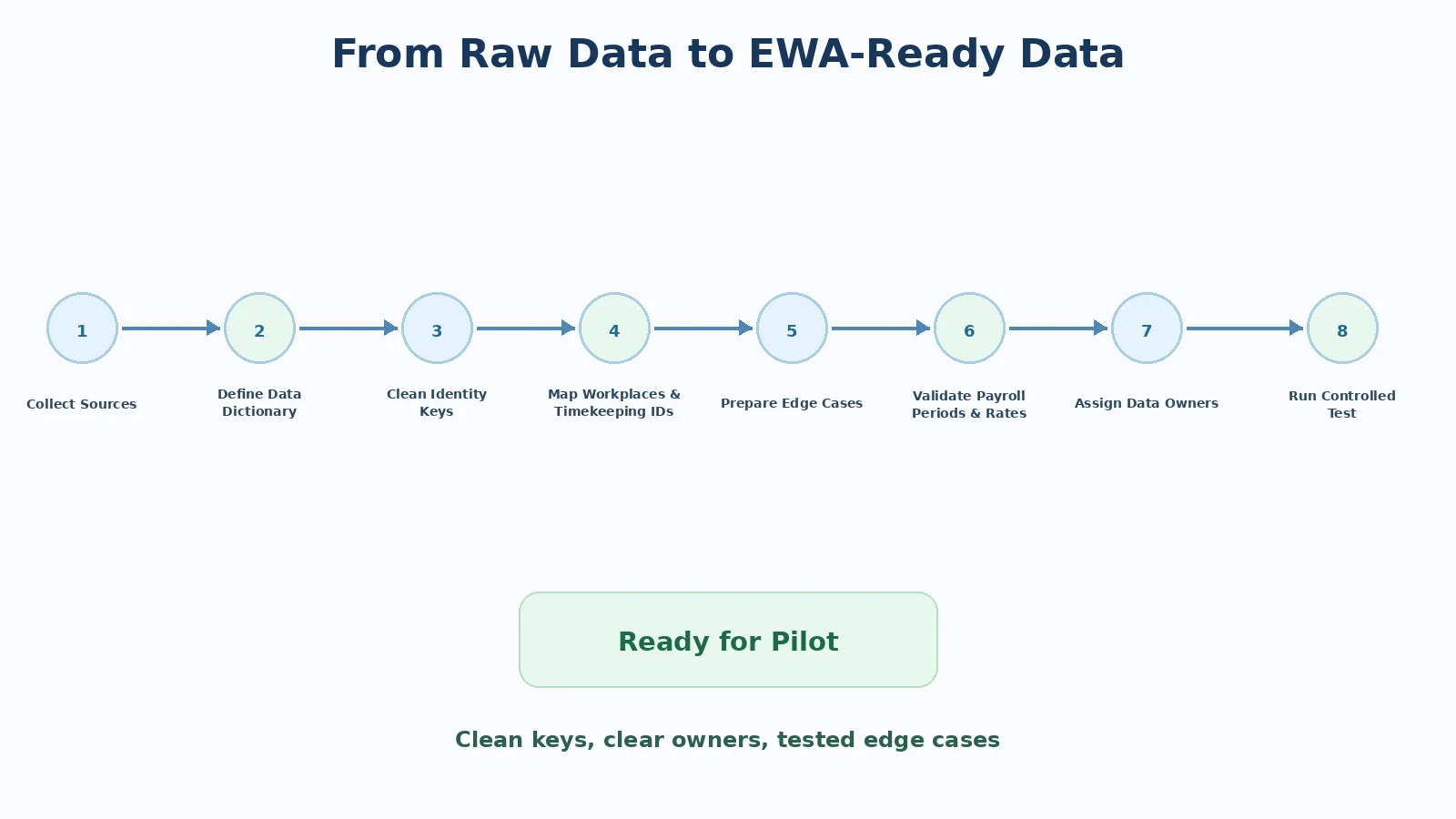
Common data errors that delay projects
Define and validate duplicate identity, lost leading zero, inactive worker, missing date, split night shift and schema drift. Document exceptions before real-money operation.
How File, Google Sheet and API change preparation
Define and validate schema, ownership, access, schedule, versioning, retry, idempotency and monitoring. Document exceptions before real-money operation.
File
Define and validate schema, file name, schedule, duplicate protection, checksum/version and exchange folder. Document exceptions before real-money operation.
Google Sheet
Define and validate sharing rights, data range, owner, column-change rules and edit audit. Document exceptions before real-money operation.
API
Define and validate schema, authentication, versioning, error codes, retry, idempotency and monitoring. Document exceptions before real-money operation.
Who should attend the data workshop?
Define and validate HR, payroll, operations, IT/HRIS, finance/reconciliation and EWA implementation. Document exceptions before real-money operation.
When is data ready?
Define and validate stable keys, dated assignments, mapped timekeeping, defined shifts, approvals, rates, owners and tested exceptions. Document exceptions before real-money operation.
Conclusion
Define and validate clean identity, workplace, timekeeping, shifts, work, payroll, account and reconciliation data. Document exceptions before real-money operation.
Author: Do Huy Le — General Director, Nhan Kiet Manpower Supply Co., Ltd.
EWA consulting for businesses: Hotline 0937.022.655 · Email info@nhankiet.vn · Learn about EWA for businesses
FAQ
Can a business prepare without an API?
Yes. A controlled file or Google Sheet can be the starting channel.
Must all HR data be shared?
No. Share only data required for the agreed implementation scope.
Are many years of history required?
Not by default; provide enough history for relevant testing and operation.
Why include erroneous sample data?
Because the system must handle imperfect real-world inputs.