
EWA Dictionary in Vietnam: 50 Terms HR Professionals Should Know

EWA Dictionary in Vietnam: 50 Terms HR, Payroll, Finance, and Workers Need to Understand
EWA sits at the intersection of HR, timekeeping, payroll, payment, data, and financial benefits. The same word like “limit,” “approved,” or “disbursed” can be understood differently by various departments. This dictionary creates a common language for businesses to design, purchase, operate, and explain EWA more clearly.
> In short: Don't start with “how much can be accessed.” First, agree on what constitutes approved work, earned wages, available amount, successful transaction, reconciliation, and payroll settlement.
> Warning: The definitions below prioritize business understanding. Terms related to law, personal data, credit, wages, and contracts must be legally verified according to specific models. For example, Earned Wage Access only describes functionality, not a substitute for official policy.
Group A — Fundamental Concepts of Wages and EWA
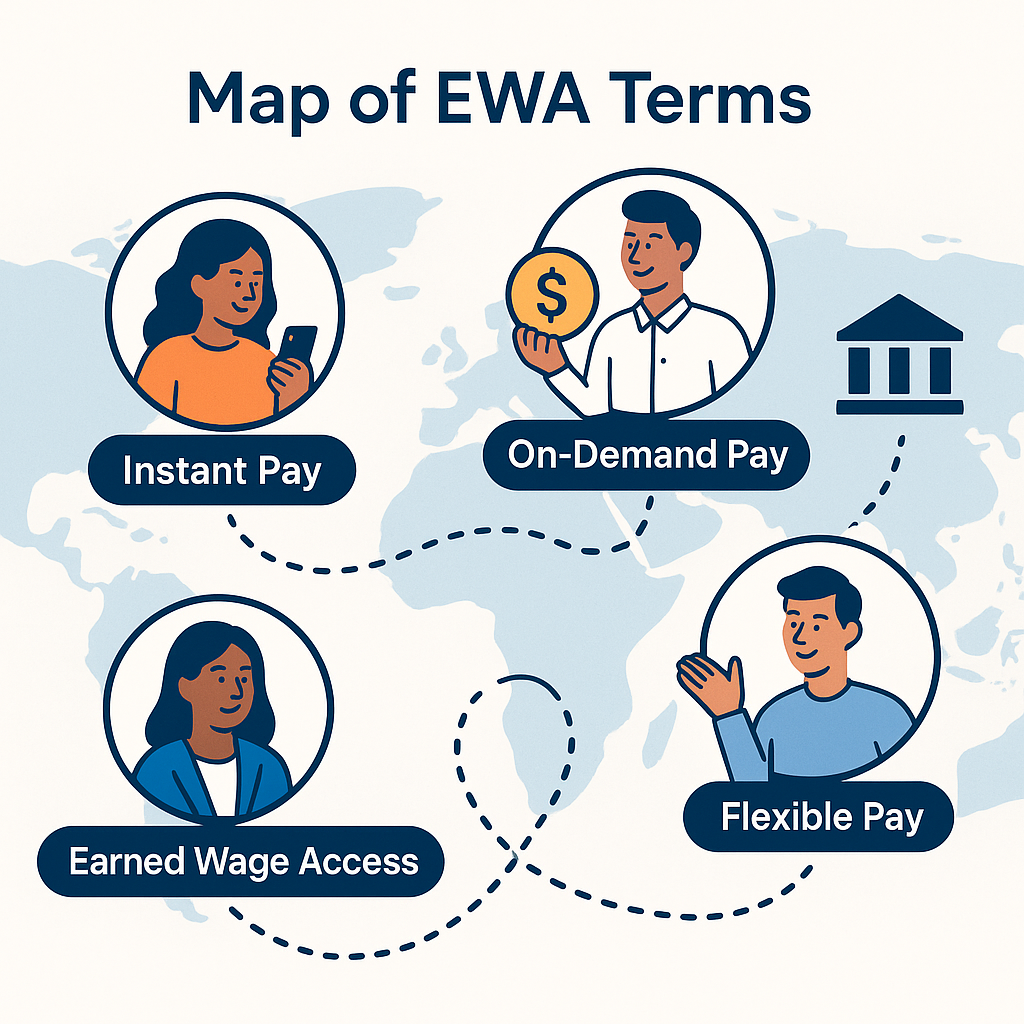
1. Earned Wage Access (EWA)
Simple understanding: the ability to access a portion of income that has accrued from work performed before the regular payday.
Why it matters: this is a business boundary that needs to be distinguished from money based on future work or an independent credit product.
2. Earned Wage Access
Simple understanding: the product name by Nhan Kiet that allows workers to view and proactively receive a portion of money calculated from approved workdays.
In the system: the available amount is calculated on the server; the received amount is deducted during payroll settlement.
3. Daily Wage
Simple understanding: a method of determining wages based on workdays or daily rates.
Don't confuse: “daily wage” is a method of calculating/paying wages; “Earned Wage Access” is also a product name.
4. Flexible Wage Access
Simple understanding: a media term allowing workers to choose when to access eligible wages before the fixed payday.
Note: read the policy to know what “eligible” means.
5. Wage Advance
Simple understanding: the act of an employer or related party allowing workers to receive an amount before the usual payroll settlement/payment time.
Legal note: conditions and handling must comply with labor regulations, contracts, and company policies.
6. Loan
Simple understanding: a relationship where one party provides assets/money and the other has an obligation to repay according to a legal agreement.
Don't assume: the name “EWA” or “0% interest” does not automatically prove a product is not a loan; the actual structure must be examined.
7. Earned Wages
Simple understanding: the portion of income associated with the work performed by the worker, determined according to applicable data and policies.
In Earned Wage Access: only approved work contributes to the available amount calculation.
8. Payroll Period
Simple understanding: the time frame in which a company aggregates work, income, deductions, and payable amounts.
Why it matters: EWA transactions must be correctly linked to the period to avoid incorrect deductions or accumulations.
9. Payday
Simple understanding: the day a company fulfills its obligation to pay wages according to agreements and applicable regulations.
Don't confuse: EWA changes the timing of accessing a portion of income; it does not automatically change the entire payroll period.
10. Payroll
Simple understanding: the process/system of calculating and settling wages, allowances, deductions, and net pay.
Why it matters: EWA does not end when the money arrives; it must align with end-of-period payroll.
Group B — Timekeeping and Entitlements
11. Timekeeping Data
Simple understanding: records of time, shifts, workdays, or presence used as input for work confirmation.
In Earned Wage Access: can come from apps, client timesheets, or ERP.
12. Source of Truth
Simple understanding: the designated source used as the final basis when multiple systems have different data.
Needs regulation: which source prevails when app, Sheet, and payroll data differ.
13. Pending Work
Simple understanding: records exist but have not been confirmed by an authorized person.
In Earned Wage Access: pending work does not generate available money.
14. Approved Work
Simple understanding: work that has passed the confirmation step according to authority and process.
In Earned Wage Access: clients or authorized supervisors can approve; whoever approves first completes it according to current logic.
15. Audit Trail
Simple understanding: traces showing who did what, when, and what changes occurred before and after.
In Earned Wage Access: modifying approved work returns the record to pending and logs changes before/after.
16. Timekeeping Code
Simple understanding: a code used to match a worker with a work record at a client/workplace.
Risk: incorrect code assignment can lead to incorrect work and available amount.
17. Work Shift
Simple understanding: the time frame/rules defining a work session, including regular or overnight shifts.
Why it matters: incorrect shift rules can miscalculate days and work amounts.
18. Geofence
Simple understanding: a virtual geographic area; timekeeping is only valid if the device is within the configured radius.
In Earned Wage Access: default radius in the code is 200 m, but application level must be confirmed with clients.
19. Fake GPS
Simple understanding: behavior or tools that falsify device location.
In Earned Wage Access: mechanisms to detect/block fake locations; should not be described as absolute fraud prevention.
20. Multi-Workplace
Simple understanding: a worker has work at multiple clients or locations.
Why it matters: work, rates, available amounts, and periods must be correctly separated for each place.
Group C — Formulas, Limits, and Responsible Use
(Details: see What is a Reserve? and Minimum and Maximum Transaction Limits.)
21. Available Amount
Simple understanding: the maximum amount the system allows a worker to request at a time.
In Earned Wage Access: approved work × daily rate − received in period − reserve, then rounded down to the nearest 1,000 VND and limits applied.
22. Daily Rate
Simple understanding: the value used to convert a unit workday into money in the formula.
Note: this may be a provisional parameter for EWA, not automatically equal to the entire daily income on the payslip.
23. Amount Received in Period
Simple understanding: the total eligible transactions recorded in the current period.
Why it matters: must be deducted so the same portion of income is not used twice.
24. Reserve
Simple understanding: the portion temporarily held from the available amount to create a safety margin for settlement.
In Earned Wage Access: can be configured to hold the latest N workdays and/or a 10.5% rate when reaching the threshold; actual policy must be confirmed.
25. Minimum Amount per Request
Simple understanding: the lowest level a request is accepted.
In code: default is 50,000 VND; not automatically considered a commercial level applicable to all clients.
26. Cap per Transaction
Simple understanding: the maximum amount in a transaction.
In code: default is 3,000,000 VND and configured by superadmin.
27. Cap per Day
Simple understanding: the total maximum a person can receive in a day.
In code: default is 5,000,000 VND.
28. Rounding
Simple understanding: the rule to bring formula results to an allowable monetary unit.
In Earned Wage Access: available amount is rounded down to the nearest 1,000 VND.
29. Limit by Tenure
Simple understanding: limits change over the time a worker has been employed.
Status: code has a table by tenure group but needs Nhan Kiet confirmation if it is enabled in real operation.
30. Responsible EWA
Simple understanding: design that helps workers access money voluntarily, transparently, with appropriate limits, and not encouraged to overuse.
Practice: display remaining amount, total received, reserve, fees, and end-of-period impact in understandable language.
Group D — Identification, Payment, and Transaction Status
31. eKYC
Simple understanding: the process of identifying customers/users by electronic means.
Note: the scope of eKYC for each party must be accurately described; do not use this term for all identity verification steps.
32. OCR ID Card
Simple understanding: technology to read information from ID card images.
In Earned Wage Access: document images and OCR results are used in verification conditions; sensitive data must be tightly managed.
33. Verified Account
Simple understanding: a bank account in the correct name of the worker receiving money.
In standard flow: the system queries VPBank account names and requires matching with the worker before locking the verified account number.
34. Account Name Query
Simple understanding: querying the bank/payment infrastructure to get the account holder's name before disbursing.
Why it matters: reduces the risk of incorrect entry or transferring to someone else, but does not eliminate all identification risks.
35. Payout
Simple understanding: the command to transfer money from the source account to the recipient's account.
In Earned Wage Access: standard flow uses VPBank's disbursement API from Nhan Kiet's dedicated disbursement account.
36. Stable Transaction Code
Simple understanding: an unchanging code representing a request in submissions/reviews.
Why it matters: banks and systems can recognize duplicate commands.
37. Idempotency
Simple understanding: the same request processed multiple times does not create an additional disbursement.
Example: user clicks again or network timeout does not create a second money transaction.
38. Pending Status
Simple understanding: insufficient evidence to conclude whether a transaction is successful or failed.
Safety principle: do not disburse again just because no immediate response is received.
39. Fail-closed
Simple understanding: when data is lacking or status is unclear, the system stops/holds instead of defaulting to pass.
In Earned Wage Access: unclear status amounts are held for review.
40. Emergency Stop Switch
Simple understanding: a mechanism to temporarily halt disbursement flow in case of incidents or money loss risk.
Management: rights to toggle, usage conditions, and reopening must have logs/approvals.
Group E — Reconciliation, Payroll, Management, and Business Continuity
41. Reconciliation
Simple understanding: comparing independent sources to find missing, excess, or incorrect status transactions.
Chain should match: system transaction log ↔ bank statement ↔ payroll.
42. T+1
Simple understanding: the next working day or calendar day after the transaction day, depending on process definition.
In Earned Wage Access: system reads the previous day's statement file at 08:00; official SLA operation needs confirmation.
43. Non-recoverable Amount
Simple understanding: an amount disbursed but cannot be fully deducted as expected, such as reduced work or worker resignation.
In the system: has a tracking log; risk-bearing policy needs Nhan Kiet confirmation.
44. Advance Covered Days
Simple understanding: marks workdays covered by a wage access amount.
Why it matters: prevents these days from accumulating into the next period's available amount.
45. Bridge Report
Simple understanding: report connecting beginning balance, increase/decrease transactions, exceptions, and end balance between the system and payroll.
Objective: HR, finance, and audit can trace from total to each transaction.
46. RACI
Simple understanding: matrix defining who performs, who is ultimately responsible, who is consulted, and who needs to be informed.
In EWA: RACI is needed for work, limits, disbursement, reconciliation, payroll, data, and incidents.
47. SLA
Simple understanding: service level commitment with measurable criteria, such as response time or incident handling.
Don't confuse: promotional phrases like “almost instant” do not replace SLA in contracts.
48. RTO
Simple understanding: target time to restore service after disruption.
Example: how long the system must return after a major incident.
49. RPO
Simple understanding: maximum data loss measured in time when recovering.
Example: RPO of 15 minutes means the design aims to lose no more than 15 minutes of data, but must be tested.
50. Personal Data Incident
Simple understanding: an event affecting the confidentiality, integrity, or availability of personal data.
In EWA: ID card, location, timekeeping images, bank account, salary data, and transactions all require authorization, logging, and appropriate response procedures.
Six Commonly Confused Term Pairs
(See also: How Many Meanings Does Daily Wage Have? and Is EWA a Loan?.)
| Term 1 | Term 2 | Key Difference |
|---|---|---|
| Daily Wage | Earned Wage Access | One is a calculation/payment method; the other is a product name |
| Recorded Work | Approved Work | Data exists does not mean it has the authority to generate money |
| Earned Wages | Available Amount | Available amount deducts received, reserve, limits, and rounding |
| Command Transfer | Disbursed | Sending a request does not prove the bank has successfully disbursed |
| Reconciliation | Payroll Deduction | One checks alignment; the other is a settlement operation |
| No Interest | Free | No interest can still have other fees |
Minimum Term Sequence for a Transaction
- Worker is identified and correctly assigned to a workplace.
- Timekeeping data moves from pending to approved.
- Formula creates available amount after reserve and limits.
- Worker creates and confirms request.
- System generates stable transaction code and sends payout.
- Status is successful or pending.
- T+1 reconciliation matches statement.
- Received amount enters correct payroll period.
- Advance covered days prevent re-accumulation.
Frequently Asked Questions
Are “earned money” and “received money” the same?
Not necessarily. The received amount may be lower due to amounts received in the period, reserve, limits, and rounding rules.
Can newly recorded work be accessed immediately?
Depends on the model. With Earned Wage Access, only approved work generates available amounts; newly recorded does not mean approved.
Does “pending” status mean failure?
No. “Pending” means the system lacks sufficient evidence to conclude. Immediate re-disbursement may cause duplication.
Is reconciliation the same as viewing transaction history?
No. History is one source; reconciliation must compare with independent sources like statements and payroll.
Is this dictionary a legal definition?
No. This is a business understanding for coordination. Legal must verify terms used in contracts, policies, and communications.
---
Author: Nguyen Minh Tuan — Strategy Team Specialist, Nhan Kiet Manpower Supply Co., Ltd.
Earned Wage Access Solutions for Businesses: Hotline 0937.022.655 · Email info@nhankiet.vn · Earned Wage Access for Businesses