
SLA for EWA Systems: 30 Metrics to Commit To

What Should an SLA for EWA Systems Include? 30 Metrics from Timekeeping to Payroll
A promise of “fast money” is not an SLA. EWA depends on personnel, time, approval, identification, banking, reconciliation, and payroll. If only measuring application uptime, businesses may still face situations where the app opens but time is not updated, transactions are pending without resolution, or payroll does not reconcile at the end of the period.
> In short: An EWA SLA must measure according to the user journey and final outcomes: timely updated records, approved time counted, transaction orders with status, pending items resolved, reconciled statements, and correct payroll data received.
> Warning: Nguyen Minh Tuan — Strategy Team Specialist, not official SLAs of Nhan Kiet or VPBank. Each commitment must have a measurement formula, data source, service schedule, exceptions, responsibilities, and approved penalties.
1. How is SLA Different from SLO, KPI, and OLA?
SLA: service level agreement between parties, often tied to contracts.
SLO: internal operational target for a metric.
KPI: broader performance indicator, not always a service commitment.
OLA: operational agreement between internal teams to achieve SLA together.
Example: An SLA with a customer requires processing pending transactions within a timeframe; OLA allocates time for customer service, banking, and technical teams.
2. Six Mandatory Components of Each SLA Metric
Name and purpose.
Calculation formula.
Data source.
Measurement window and service schedule.
Target/threshold.
Exclusions, responsibilities, and reporting mechanism.
Avoid using terms like “fast,” “timely,” “almost instant” without defining start and end points.
3. Define Start–End Clock
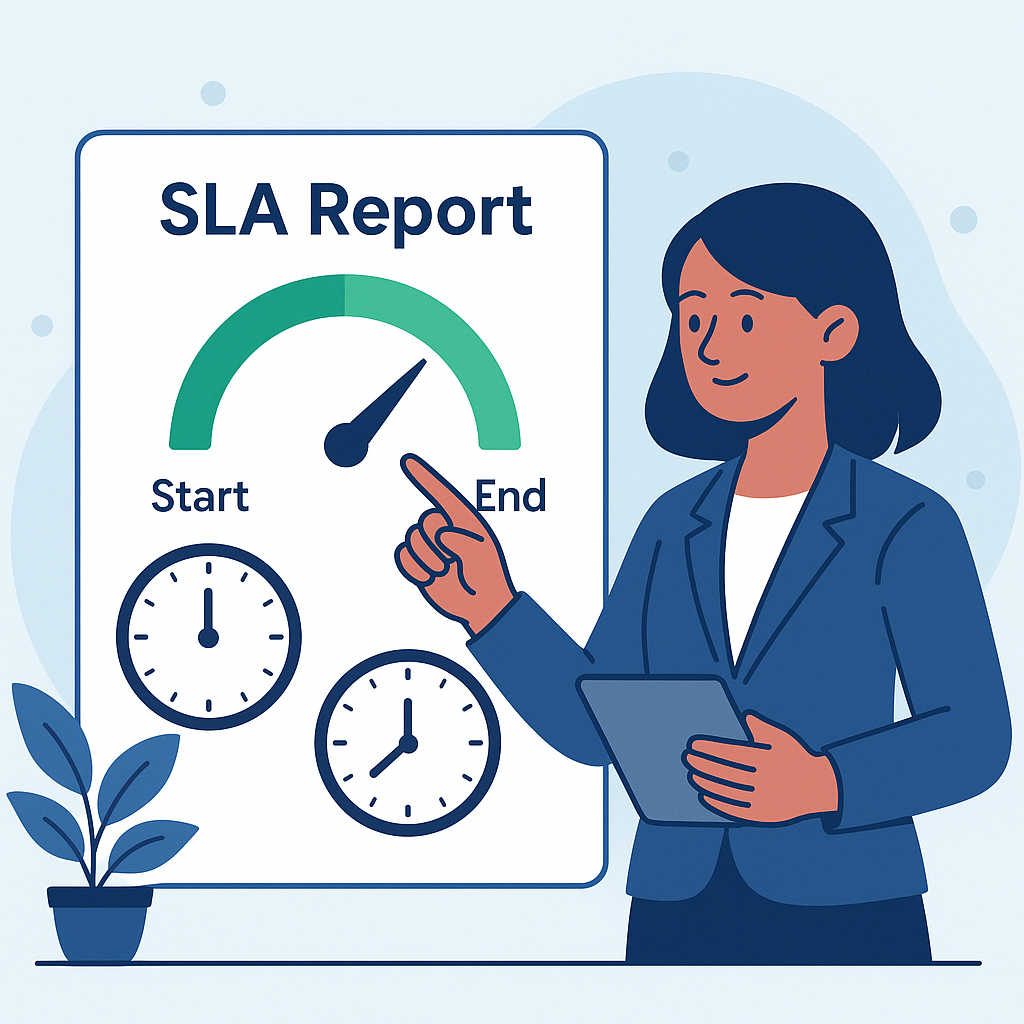
For example, “money arrival time” can start from:
when the worker presses confirm;
when the server accepts the request;
when the order is sent to the bank.
And ends when:
API reports success;
worker's account is credited;
transaction appears on the statement;
worker confirms receipt of money.
Without a defined agreement, both parties may report two correct but different results.
4. Group A — Availability and Performance (SLA 1–5)
1. Availability Rate of Worker Application
Measures the ability to log in, view available balance, and create requests within the service window.
2. Availability Rate of Customer Portal
Measures the ability to view, approve, reject, and edit time records.
3. Response Time of Core Screens/API
Should measure percentiles like P95/P99, not just average as the average can hide very slow instances.
4. Server Error Rate
Separate system errors, input data errors, user errors, and third-party errors.
5. Maintenance Window
Defines schedule, advance notice time, emergency maintenance, and affected functions.
5. Group B — Personnel and Timekeeping (6–10)
6. Delay in Syncing Personnel Records
From the time a change occurs in the source to when EWA reflects it, especially for resignations/transfers.
7. Delay in Syncing Time Records
Earned wage access currently has a Google Sheet schedule every 30 minutes and an immediate sync button; SLA must specify measurement if the job is delayed or file errors occur.
8. App Time Record Delay
Timekeeping in the app is designed to be recorded in real-time; still needs a target for reflection on the screen/approval source.
9. Successful Time Record Merge Rate
Number of records correctly merged with person, customer, date/shift divided by total valid records.
10. Time to Process Error Time Records
Separate system errors from source data; specify who fixes and response time.
6. Group C — Time Approval and Available Balance (11–14)
11. Time Approval Duration
This is usually the customer's/supervisor's OLA, not entirely controlled by the platform. Measure from when time is ready to when it is approved.
12. Delay in Updating Available Balance After Approval
Measure from valid approval event to when the server calculates/displays the new balance.
13. Correct Available Balance Calculation Rate
Check with recalculated samples from time, unit price, received, reserve, limit, and rounding.
14. Time to Apply Policy Changes
Unit price/limit/reserve must have an effective date, approval, and post-change verification.
7. Group D — Identification and Accounts (15–17)
15. OCR/CCCD Verification Response Time
Distinguish between automatic processing and exceptions requiring human review.
16. Account Name Lookup Time
Measure system and bank parts; define status when lookup service is interrupted.
17. Device/Account Change Processing Time
Must balance experience with anti-takeover, have verification and approval.
8. Group E — Banking Transactions (18–22)
18. Successful Request Processing Rate
Must separate failures due to system, bank, account, data, or policy.
19. Time to Send Order After Confirmation
Measure from when the server accepts to when the disbursement service receives the order.
20. Result Confirmation Time
Not synonymous with “money in account.” Need to define confirmation source.
21. Pending Transaction Rate
Monitor rate and cause; unusually low may also indicate premature system conclusions.
22. Pending Transaction Age
Measure time from entering pending to final conclusion; report longest pending and group ages.
In earned wage access, pending item reconciliation runs on a five-minute technical schedule. SLA must account for bank/related party response time.
9. Group F — Reconciliation and Payroll (23–26)
(Details: see Reconciliation of EWA Transactions with Payroll and Accounting.)
23. T+1 Reconciliation Completion
Earned wage access has a statement file reading schedule at 08:00. Commitment must specify file readiness time, merge rate, and exception closer.
24. Automatic Statement Transaction Merge Rate
Number of uniquely merged lines, correct code/amount/account divided by total eligible lines.
25. Time to Close Reconciliation Discrepancies
Classify by value, number of people, and risk of duplicate/wrong person disbursement.
26. Timely Payroll Data Delivery
Measure checked file/API, correct cut-off, correct person/customer/period; not just “email sent.”
10. Group G — Support and Issues (27–30)
(See also: When Earned Wage Access Encounters Issues and EWA Complaint Handling Playbook.)
27. First Response Time
From when a valid ticket is recorded to when the user receives a response with a case number.
28. Restoration/Resolution Time
Distinguish between service restoration and thorough resolution and RCA.
29. Incident Notification Time
Define recognition, confirmation, initial notification, and periodic update milestones.
30. RCA Provision Time
RCA must have a timeline, root cause, impact, remediation, and preventive actions.
11. Reference Incident Severity Matrix
Level | Example | Handling |
|---|---|---|
P1 | Wide-scale duplicate/wrong person disbursement, loss of control over locks, core service outage | Incident command, appropriate halt, continuous updates |
P2 | Many unable to transact, significant available balance/reconciliation errors | High priority, cross-functional team |
P3 | Small group affected, alternative available | Handle according to standard SLA |
P4 | Information request/presentation error | Backlog/regular support |
Official levels must have thresholds for money, people, data, and time; not classified solely by perception.
12. Illustrative SLA Target Table
Metric | Example Target | Note |
|---|---|---|
Core Service Uptime | 99.9%/month | Illustrative only, need exclusion definition |
P95 API Response | ≤ 2 seconds | Separate bank API |
Sheet Sync | 30-minute cycle | From when source data is valid |
P1 Ticket Response | ≤ 15 minutes | Requires 24/7 on-call schedule if committed |
P2 Ticket Response | ≤ 30 minutes | Does not mean resolved |
T+1 Reconciliation | Complete by cut-off time | Depends on bank file |
Payroll Delivery | Before approved cut-off | With checksum/receipt |
All numbers in the table are illustrative of how to write. Not to be used as commitments of Earned Wage Access.
13. How to Calculate Uptime Correctly
A common formula:
Uptime = (total service window minutes − SLA downtime minutes) ÷ total service window minutes × 100%
Contracts need to specify:
which functions are measured;
measured externally or internal logs;
how partial downtime is counted;
whether maintenance is excluded;
internet/bank dependencies;
rounding and time zone;
how data disputes are handled.
14. Avoid Overly Broad Exclusions
Clauses like “all third-party errors” can render SLA meaningless as banks and infrastructure are essential parts of EWA.
Should separate:
end-to-end SLA where the provider is responsible for coordination;
metrics dependent on banks/customers;
OLA between parties;
notification obligations and contingency plans regardless of cause.
15. RTO and RPO
RTO: target time to restore service after disruption.
RPO: maximum data loss acceptable over time.
EWA requires specific RTO/RPO for:
records/time;
available balance;
transactions;
audit log;
reconciliation/payroll.
Financial transactions require stricter requirements than communication content. Goals are meaningful only if rehearsed and evidence of recovery without duplicate disbursement exists.
16. SLA for Data and Security
(Full framework: see Data Security and Privacy in EWA Deployment.)
Beyond uptime, agreements should include:
time to lock suspected compromised accounts;
revoke rights of resigned individuals;
patch vulnerabilities by severity;
data breach notifications;
provide logs/evidence;
handle data subject requests;
backup and recovery testing;
periodic rights review;
delete/return data upon termination.
Official deadlines must comply with laws and risk assessments, not mechanically copied from international templates.
17. Is Service Credit Sufficient?
Service credit can encourage compliance but does not replace:
correcting financial errors;
data protection obligations;
complaint handling;
contractual/legal compensation;
right to suspend/expand;
recurrence prevention plans.
For serious financial errors, specific blocking conditions and responsibilities are more important than a small fee reduction.
18. Monthly SLA Report Should Include
results of 30 applied metrics;
three–six month trends;
number of violations and duration;
analysis by customer/source;
pending transactions and age;
reconciliation/payroll discrepancies;
P1–P4 and RCA;
major maintenance/changes;
complaints and reopenings;
corrective actions, owners, deadlines;
anticipated risks for the next period.
A summary dashboard should not obscure a serious error with a nice average number.
19. Six-Step SLA Building Process
Map journey and dependencies.
Select critical outcomes for workers/businesses.
Identify metric, source, and measurement clock.
Measure baseline before committing.
Negotiate targets, exclusions, OLA, and penalties.
Pilot, review, and adjust before scaling.
Do not commit to high levels just because the market typically records them if the system lacks a baseline.
20. SLA Due Diligence Checklist
(Documentation: see Earned Wage Access Due Diligence File.)
Has a service window definition.
Has start/end points for processing time.
Independent and traceable measurement data source.
Has percentile for performance.
Third-party errors not excluded indefinitely.
Has pending transaction SLA.
Has reconciliation and payroll commitments.
Has P1–P4 with objective thresholds.
Has incident update schedule.
Has RTO/RPO and rehearsals.
Has data/security SLA.
Has periodic reports and reviews.
Has audit/data dispute rights.
Has appropriate service credit/responsibility.
Has SLA amendment mechanism when scale changes.
21. Frequently Asked Questions
Is money arriving in 30 seconds an SLA?
Only if the contract defines start point, end point, transaction success rate, account/bank conditions, and exceptions. Otherwise, it's just an experience message.
Is 99.9% uptime sufficient for EWA?
Not enough. The application may be online but time not updated or bank not processing. Need end-to-end SLA.
Are pending transactions counted as SLA violations?
Must have separate metrics for pending transaction rate and age. Some pending states are safety controls, but cannot exist indefinitely.
Is customer delay in approving time a provider error?
Usually a customer dependency/OLA. SLA needs to separate time before and after valid time approval.
Should SLA be publicly disclosed on the website?
Can disclose framework or approved service status. Detailed contract targets may differ by customer; do not disclose numbers without evidence.
---
Author: Nguyen Minh Tuan — Strategy Team Specialist, Nhan Kiet Manpower Supply Co., Ltd.
Earned Wage Access Solutions for Businesses: Hotline 0937.022.655 · Email info@nhankiet.vn · Earned Wage Access for Businesses