
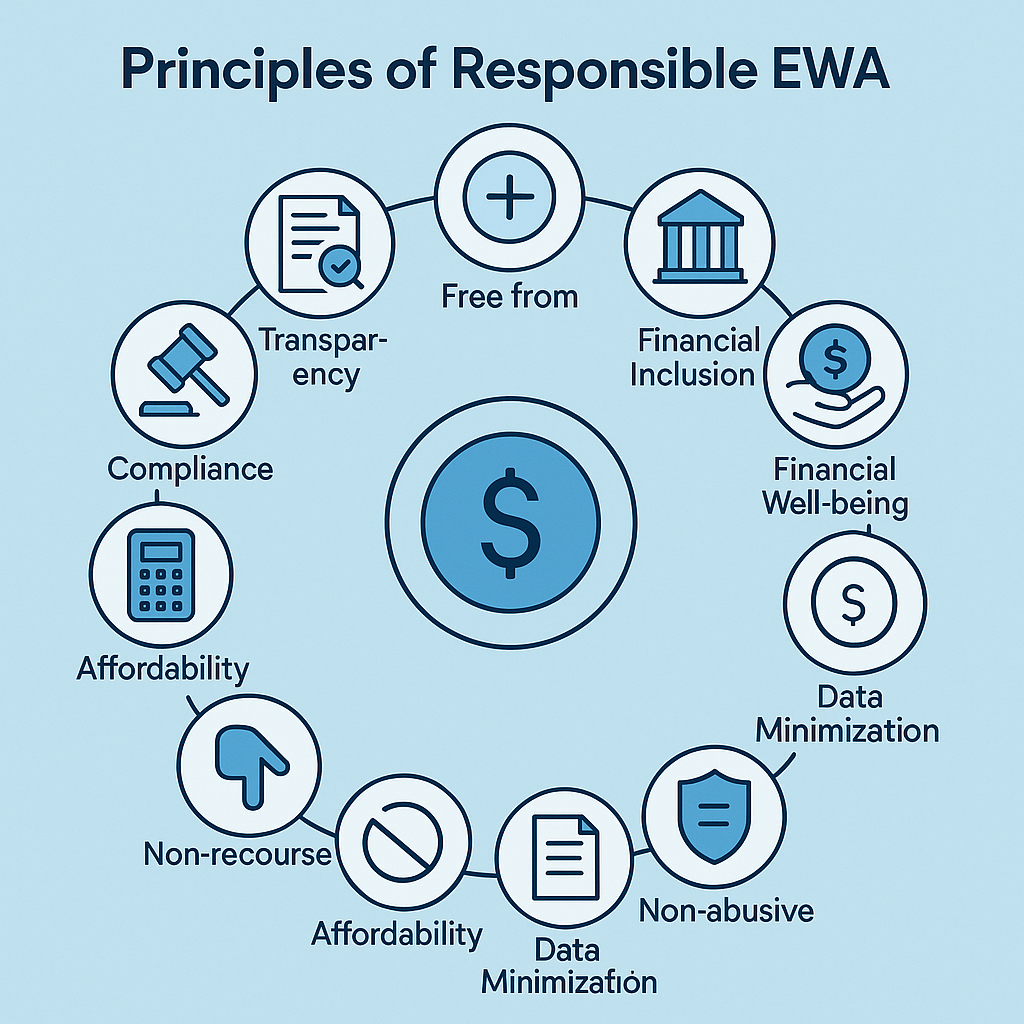
12 Principles for Responsible Earned Wage Access in Vietnam

12 Principles for Responsible Earned Wage Access in Vietnam: Proposed Standards for Businesses
Earned wage access is truly valuable when it empowers workers without creating new risks. The speed of money transfer is visible; the harder part is ensuring the money is tied to work done, fees are transparent, workers participate voluntarily, data is protected, transactions are not duplicated, and end-of-period reconciliation is accurate.
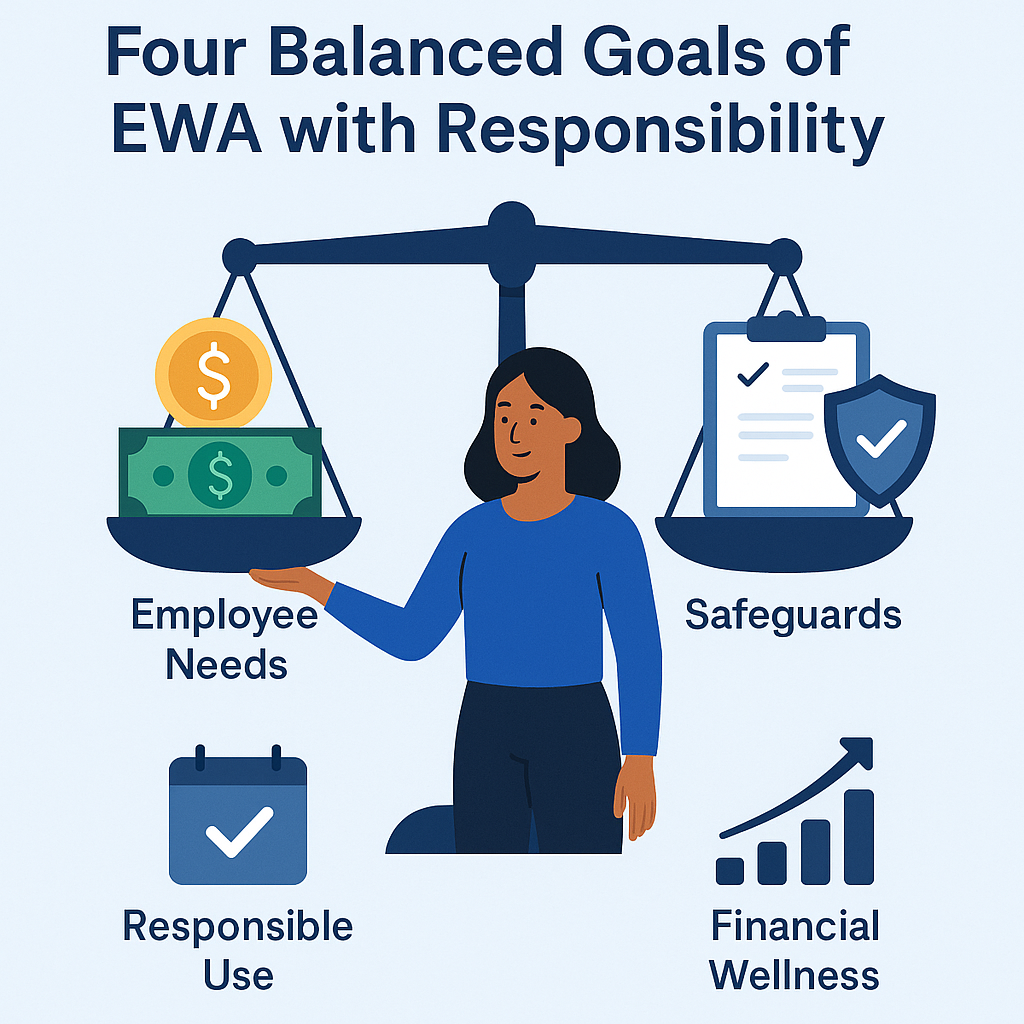
> In short: A responsible earned wage access program must achieve four simultaneous goals: true to its nature – fair to workers – safe for money/data – controllable for businesses.
> Warning: These are proposed principles, not national standards, certifications, or legal conclusions. The name earned wage access does not inherently define the nature of a product; contracts, data, fees, funding sources, and actual recourse rights must be examined.
1. Why is a separate set of principles needed for earned wage access?
If a program only optimizes transaction numbers, it may inadvertently:
encourage workers to access money too frequently;
use unverified work;
obscure fees;
create confusion with loans;
collect excessive data;
transfer money quickly but make error handling difficult;
pressure payroll and accounting;
turn voluntary benefits into mandatory KPIs.
The principles help leaders evaluate the overall design, avoiding being swayed by features or slogans.
Principle 1 — Based only on earned income
(See also: Is earned wage access a loan?.)
Available amounts must be linked to work already performed by the worker and reliable data, not based on future unearned income.
Verification methods
source of work is identified;
eligibility status is defined;
current/future dates are controlled;
a transaction can be recalculated from original data.
In earned wage access, only approved work generates available amounts, with a logical barrier against unconfirmed/future work.
Principle 2 — Transparency of nature, fees, and end-of-period impact
(See also: Is earned wage access truly free?.)
Workers must know what they are receiving, who provides it, any fees involved, and how they will receive the remainder at the end of the period.
Information must be displayed before confirmation
requested amount;
total received in the period;
remaining available amount;
reserve if applicable;
all fees;
how received amounts are reflected in wages;
complaint channels.
“0% interest” is insufficient if other fees exist. If free, the scope and conditions must be clearly stated.
Principle 3 — Voluntary and non-detrimental
(See also: Responsible earned wage access: when to use and not to use?.)
Workers have the right not to register, not to transact, or to stop using the service without being coerced or negatively evaluated for that choice.
What not to do
assign withdrawal targets to supervisors;
require trial transactions with real money if unnecessary;
use transaction frequency as a disciplinary/recruitment criterion;
automatically enable services without appropriate information.
KPIs should measure eligibility rates, quality of work approval, and transaction accuracy—not promote consumption.
Principle 4 — Prudent limits with a buffer
Access to the entire provisional amount should not be allowed if work, obligations, or cut-offs are still fluctuating. Limits should align with data, pay periods, and risks.
Possible layers
minimum per transaction;
cap per order;
cap per day/period;
percentage of earned income;
reserve by day/percentage;
frequency limits;
limits based on history/tenure if reasonable and explained.
Limits should not be designed to maximize fee revenue.
Principle 5 — Workers understand and control decisions
Interfaces must use simple language, allow workers to view information before confirming, and avoid pressure-inducing designs.
Responsible design
do not pre-select maximum amounts;
do not create fake countdowns;
do not continuously prompt withdrawals;
require clear confirmation;
allow viewing of history and pay slips;
warn against sharing OTP/passwords;
include budget management content.
Principle 6 — Correct person, correct account
Money must be transferred to the correct worker's account.
Minimum controls
identification with stable keys;
check ID/documents per process;
verify account names;
control account/device changes;
mask information on screens and logs;
exception processes with approval.
Standard earned wage access flow uses a primary VPBank account, verifies names, and locks account numbers post-authentication.
Principle 7 — Transaction safety and fail-closed
(See also: Protection layers for an earned wage access transaction.)
When status is unclear, the system must prioritize non-duplication.
Must have
immutable transaction codes;
idempotency;
concurrency locks;
server-side checks;
response verification;
pending status;
reconciliation;
emergency stop switch;
separate bank keys from business applications.
Fast but indeterminate outcomes do not provide a good experience.
Principle 8 — Minimal data and purpose alignment
(Full framework: see Data security and privacy in earned wage access deployment.)
Only collect data necessary for identity, work, entitlement, payment, and defined obligations. Do not use location, wage, or transaction frequency data for new purposes without assessment/legal compliance.
Check questions
is original image storage necessary;
are precise coordinates needed or just regional results;
who can view ID/wage/account;
how long is data stored;
which third parties receive data;
how do workers exercise their rights.
Principle 9 — Fairness and accessibility
Programs should not only serve those with new phones, high digital skills, or day shifts, neglecting vulnerable groups.
Practices
guide with images/videos;
support during shifts;
optimize app/network;
OCR processes, device/account exceptions;
simple language;
channels for disabled or hard-to-reach individuals;
do not let ambassadors hold OTPs or transact on behalf.
If a group cannot use the service, businesses need to know the rate and reasons instead of assuming “no demand.”
Principle 10 — End-to-end reconciliation and understandable pay slips
(Details: see Reconciliation of earned wage access transactions with payroll and accounting.)
Programs must match three sources: the earned wage access system, bank statements, and payroll. Workers must trace each transaction to the final amount payable at the end of the period.
Evidence chain
approved work → formula → request → successful disbursement → statement → received amount → pay slip
Pending, refunded, corrected work, and unrecoverable amounts must be in exception processes, not hidden in totals.
Principle 11 — Timely support, complaint handling, and remediation
(See also: Complaint handling playbook for HR and customer service in earned wage access.)
When money is delayed or wages are incorrect, workers need a clear point of contact and case ID. Do not send them in circles between HR, banks, and providers.
A good playbook needs
error categorization;
SLA and escalation;
minimal data collection;
ID/bank statement protection;
end-to-end ownership;
status updates;
compensation/remediation policies;
root cause analysis.
Principle 12 — Impact measurement, auditing, and continuous improvement
(See also: Measuring earned wage access effectiveness with KPIs.)
Do not only measure transaction numbers. Businesses need to monitor positive impacts and unforeseen risks.
Four indicator groups
Group | Example |
|---|---|
Access | Valid profiles, approved work, verified accounts |
Quality | Success, processing time, pending transactions, complaints |
Safety | Duplicate payments, wrong accounts, data incidents, exceptions |
Impact | Financial stress, turnover, manual advances, worker feedback |
Any claims of reduced turnover or financial improvement must have data, methodology, and appropriate comparison groups.
13. 100-Point Scorecard for Responsible Earned Wage Access
Pillar | Maximum Points |
|---|---|
Earned income and formula | 10 |
Fee/impact transparency | 10 |
Voluntariness | 10 |
Prudent limits | 10 |
Worker control rights | 8 |
Identification/account | 8 |
Transaction safety | 10 |
Data protection | 10 |
Accessibility | 6 |
Reconciliation/payroll | 8 |
Support/complaints | 5 |
Measurement/auditing | 5 |
Total | 100 |
The scorecard is a proposed internal tool, not a certification. Businesses must set their own blocking conditions: one duplicate payment or wrong person error cannot be offset by high communication scores.
14. Five Blocking Conditions Despite High Scores
Access to money from uncontrolled future work.
Non-transparent fees or obligations.
Risk of duplicate payments/wrong person not addressed.
Inability to reconcile with statements and payroll.
Serious data violations or worker coercion.
15. What Does Earned Wage Access Offer in Terms of Technical Design?
System capabilities include:
only approved work generates available amounts;
formula deducts received amounts and reserves;
multi-layer limits;
ID and primary VPBank account verification;
anti-location spoofing/one person–one device in related flows;
stable transaction codes, locks, and fail-closed;
pending transaction reconciliation, T+1 reconciliation;
covered workdays are not cumulative;
customers control work approval/modification;
audit trail of changes.
These are technical capabilities, not self-evidence that all principles are effectively operating for every customer. Production evidence, policies, training, and audits are needed.
16. Unverified Claims Earned Wage Access Should Not Make
permanently free;
absolute legal conclusion “not a loan” for all structures;
no CIC impact in all situations;
precise percentage reduction in turnover;
user/transaction/total amount figures without official reports;
fully automated for all customers;
risk-free;
better than all competitors.
A trustworthy brand is built with clear limits and verifiable evidence.
17. Roadmap for Applying the Principles
Step 1 — Self-assessment
Score each principle with documentation and data, not perception.
Step 2 — Identify blocking conditions
Close all money, rights, data, and reconciliation errors before expansion.
Step 3 — Limited pilot
Limit customers, users, amounts, and time; reconcile daily.
Step 4 — Gather worker feedback
Interview users and non-users; find misunderstandings, barriers, unexpected pressures.
Step 5 — Transparent disclosure
Disclose definitions, fees, conditions, limits, complaints, and data handling.
Step 6 — Regular audits
Monitor indicators, sample transactions, review rights, test incidents, and update principles.
18. Sample Commitment for Businesses
> Our earned wage access program is designed for workers to voluntarily access eligible earned income. We clearly disclose fees, limits, and impact on pay periods; protect data; control transactions; reconcile with banks and payroll; provide complaint channels; and regularly evaluate impact and improve.
Commitments should only be disclosed when businesses have corresponding evidence and accountability mechanisms.
19. Checklist for Leadership
Has the earned wage access definition been legally reviewed?
Can the formula be recalculated?
Are workers coerced into using it?
Are all fees transparent?
Are limits based on confirmed work?
Who funds and bears unrecoverable amounts?
What data is collected, shared, and stored?
Can timeouts cause duplicate payments?
Do the three ledgers—bank, earned wage access, payroll—match?
Do workers know where to file complaints?
Are there impact figures beyond transaction numbers?
Who is ultimately responsible for the entire program?
20. Frequently Asked Questions
Does responsible earned wage access mean completely free?
Not necessarily, but all costs must be reasonable, transparent, and not misleading to workers. A free policy is a design choice that must be disclosed within its scope.
Is allowing access to 100% of earned wages better?
It cannot be concluded solely by a high percentage. Businesses need to maintain a suitable margin for work fluctuations, end-of-period obligations, and protect workers from excessively low net amounts.
Does more withdrawals prove program success?
No. It may indicate good access, but it could also reflect financial stress or design encouraging excessive use. It must be read alongside quality and impact indicators.
Can the 12 principles be used to evaluate providers?
They can be used as an initial assessment framework, but contracts, systems, data, and operational evidence must be checked. This is not an independent certification.
Has earned wage access achieved 100 points?
It cannot be concluded from the source code. The system has many appropriate controls, but policy confirmation, production operations, impact data, and audits per customer are needed.
---
Author: Nguyen Minh Tuan — Strategy Team Specialist, Nhan Kiet Manpower Supply Co., Ltd.
Earned Wage Access Solutions for Businesses: Hotline 0937.022.655 · Email info@nhankiet.vn · Earned Wage Access for Businesses