
EWA Vendor Selection Checklist for Enterprises
To select an EWA (Earned Wage Access) vendor, enterprises must evaluate at least eight criteria groups: legal and contract; product nature and funding source; fees and cash flow; time-tracking–payroll; integration technology; data security; employee experience; and operational SLA and support capabilities. Before comparing scores, knock-out conditions must be verified, such as inability to explain fund flows, hidden fees, lack of duplicate payment prevention mechanisms, or failure to meet data protection requirements.
EWA — Earned Wage Access — is commonly understood as a solution that allows employees to access a portion of accrued wages from completed work prior to the scheduled pay cycle. However, under the same label of “EWA” or “automated wage advance,” various product structures can exist. Therefore, enterprises should not select a provider based merely on application UI, transfer speed, or an advertised fee rate.
Define Enterprise Objectives Before Seeking Vendors
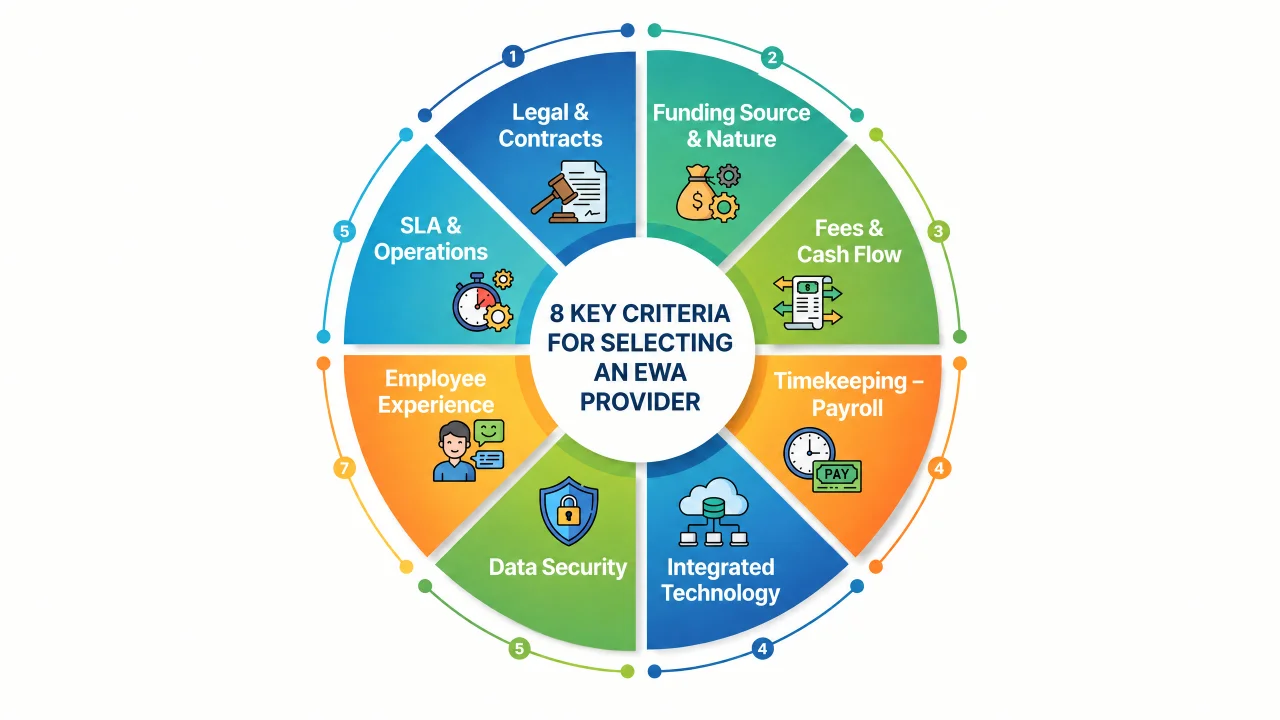
An assessment will lack benchmarks if the enterprise has not clearly defined the core problem it aims to solve.
Objective | Pre- and Post-Metric to Measure | Priority Criteria Group |
|---|---|---|
Reduce manual advance processing | Number of requests, processing turnaround, approval steps | Payroll, integration, reconciliation |
Enhance recruitment appeal | Offer acceptance rate, candidate decision factors | Experience, communication, coverage |
Improve employee retention | Early turnover rate, attrition across user groups | Metric data, responsible usage |
Provide emergency financial support | Access rate, disbursement time, complaints | Fees, speed, transparency |
Standardize time-tracking & payroll data | Pending approvals, payroll discrepancies, reconciliation time | Time-tracking, data, workflow |
Large-scale benefit rollout | Eligible employee headcount, activation rate, SLA | Scalability, support, security |
"Maximizing transaction volume" should not be the sole objective. EWA is an earned wage timing management tool; responsible usage without generating discrepancies takes precedence over maximizing withdrawal frequency.
Step 1. Establish Knock-Out Criteria
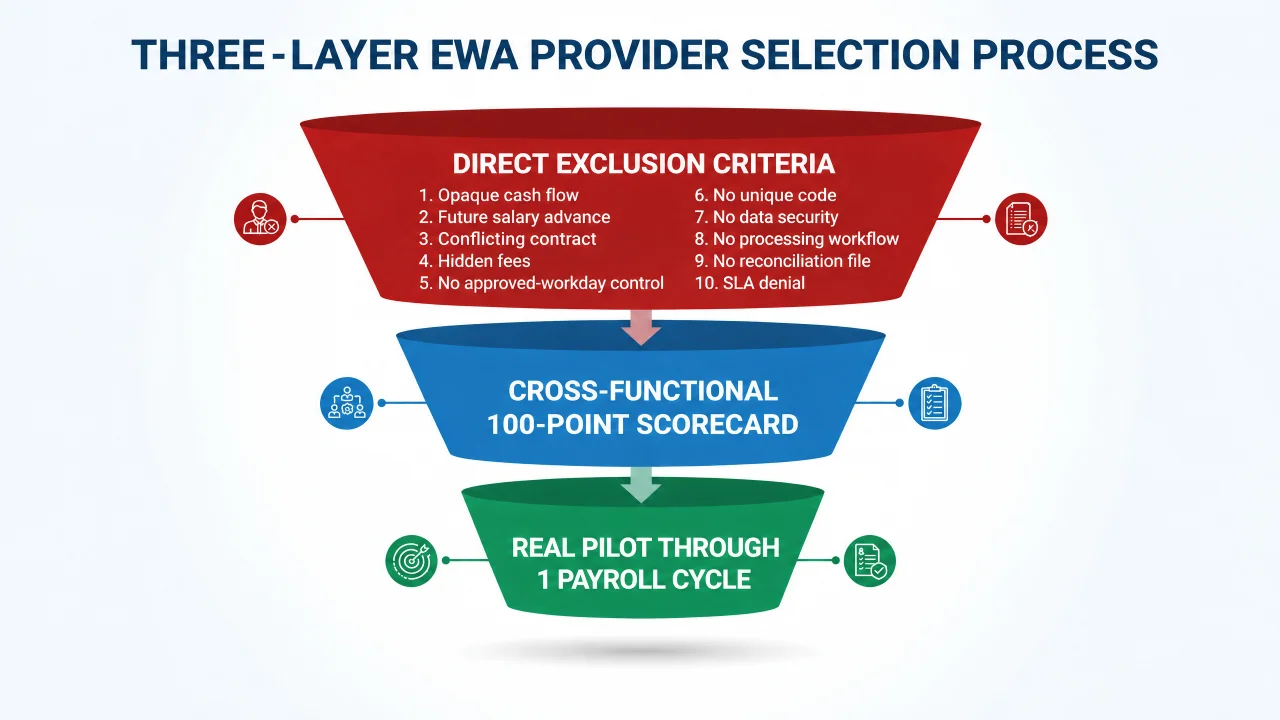
Knock-out criteria are prerequisites a vendor must satisfy before moving to the scoring phase. If failed, a high aggregate score in other categories cannot offset fundamental platform and regulatory risks.
Ten Red Flags Requiring Immediate Halt or Clarification
Inability to clearly delineate the funding source and fund flows among parties.
Inability to explain whether transactions are backed by accrued earned wages or projected future income.
Contradictions among contracts, operational practices, and marketing claims.
Failure to fully disclose fee structures before employee confirmation.
Absence of a mechanism ensuring limits are calculated strictly against approved work hours.
Lack of unique transaction identifiers or duplicate disbursement prevention measures.
Inability to prove safeguards for salary, attendance, and recipient account data.
Absence of standard operating procedures (SOPs) for resignations, attendance discrepancies, failed transactions, and dispute investigations.
Inability for the enterprise to export raw reconciliation logs, or reliance solely on aggregate summary reports.
Unwillingness to commit to SLAs, incident liability, or enterprise audit rights in the contract.
Possessing certificates or claiming a broad client base does not substitute for addressing these points with concrete documentation and verifiable evidence.
Step 2. Evaluate Legal and Contractual Terms
Vendors must consistently define the true nature of their product. The enterprise must determine:
Whether the accessed funds derive from work already performed.
Which entity directly provides the capital.
What terms and agreements the employee must execute.
Whether transactions are reconciled via the payroll ledger or create independent repayment obligations.
Whether interest, fees, penalties, recourse, or credit bureau (CIC) reporting apply.
Liability allocation when final payroll is insufficient for reconciliation.
Operational handling mechanisms when an employee departs mid-cycle.
Governing law, dispute resolution venues, and indemnification caps.
Documentation to Request
Master Service Agreement (MSA) template between enterprise and vendor.
End-User License Agreement (EULA) and terms confirmed by employees.
Operating regulations or standard procedural manuals.
Legal architecture and fund flow schematics.
Policies on fees, complaints, refunds, and dispute investigation.
Legal opinions or formal structural whitepapers.
List of sub-processors and designated roles of each party.
In Vietnam, classifying EWA depends on actual model architecture. A study published in the Banking Review (June 2026 issue) analyzed the fundamental distinction between models strictly tied to accrued earned wages and those sharing characteristics with credit-granting activities. Consequently, enterprises should never accept absolute assertions based purely on commercial branding (see Is EWA Considered a Loan?).
Step 3. Verify Funding Sources, Fees, and Financial Liabilities
Funding Source
Enterprises need absolute clarity on:
Does the enterprise fund the float directly, or does the vendor/third-party advance the capital?
How is the liquidity pool sustained?
Are there aggregate caps by day, cycle, or enterprise?
When demand spikes, which party injects supplementary liquidity?
If funds are disbursed but final payroll cannot clear the balance, who absorbs the shortfall?
What are the settlement timelines and protocols between parties?
Fees
The fee schedule must separate and itemize:
Setup/onboarding fees.
Integration fees.
Platform subscription/software fees.
Per-active-user fees.
Per-transaction fees.
Payment transfer fees.
Custom reporting or premium support fees.
Dispute investigation, chargeback, or exception processing fees (if any).
Price review conditions and over-quota thresholds.
Comparing Costs Correctly
Never evaluate two vendors solely on "per-transaction fee." Normalize calculations using Total Cost of Ownership (TCO):
Total Cost of Ownership = Vendor Fees + Payment Processing Fees + Capital Financing Costs + Integration Costs + Internal Operational Overhead + Exception Handling Costs
Simulate at least three operational scenarios: low usage, baseline, and peak period (refer to How Are EWA Service Fees Calculated?).
Step 4. Audit Time-Tracking, Payroll, and Reconciliation
EWA is only dependable when seamlessly bridged from approved work hours to payroll slips and general accounting ledgers, conforming to a structured Daily Wage Earned Workflow.
Time-Tracking Questions
How does the system classify logged, pending, approved, rejected, and adjusted shifts?
Who holds authorization to approve and modify attendance?
Upon attendance modification, how quickly does the available withdrawal balance update?
Are there alerts for incomplete hours, overlapping shifts, shift mismatches, or unapproved overtime?
If the source data stream lags, does the platform halt withdrawals or continue on stale data?
Limit Calculation Questions
What variables constitute the calculation formula?
Are safety margins and reserve buffers retained?
How are individual, unit, daily, and program-wide caps established?
Is the available limit recalculated immediately prior to disbursement?
When an employee has drawn in excess of a reduced limit caused by retroactive attendance cuts, how is the balance resolved?
Reconciliation Questions
Are transactions reconciled against banking/payment gateway settlement logs?
Are granular itemized files provided down to individual employee and transaction IDs?
How does the system prevent duplicate deductions in payroll?
What transaction lifecycle status qualifies an entry for payroll deduction?
How are pending dispute transactions handled during period close/cutoff?
Can each payroll slip line item be traced back to a specific transaction ID?
Step 5. Assess Technology and Integration Capabilities
A vendor does not necessarily need a single rigid integration method. An enterprise may start with controlled batch files during a pilot before transitioning to APIs for full-scale rollout. What matters is that data maintains unique identifiers, versioning, explicit status flags, and comprehensive auditability.
Technical Criteria to Audit
Clearly documented APIs, batch file specs, or connection protocols.
Availability of sandbox/staging environments and mock test datasets.
Support for consistent employee IDs or governed mapping tables.
Unique identifier for every individual transaction.
Idempotency mechanisms to prevent duplicate processing on API retries.
Data acknowledgment handshakes, error handling statuses, and retry logic.
Period cutoff milestones and dataset versioning controls.
Webhooks/notifications or pollable endpoints for final transaction status.
Comprehensive technical audit logs.
Full data export capabilities upon contract termination.
Transition, rollback, and offline fallback procedures for integration outages.
Red Flags to Avoid
"API-ready" claims without technical documentation or staging environments.
"Real-time" claims without defined latency thresholds and SLA metrics.
"Seamless integration with any system" without defined data schemas and RACI matrix.
"AI-driven automated approval" without transparent decision rules, data sources, and override controls.
Step 6. Audit Data Security and Personal Data Protection
EWA processes sensitive personal identity data, employment details, time-tracking logs, salary figures, bank account information, and transaction histories. An enterprise cannot offload statutory data protection duties to a third party through generic liability waivers.
In Vietnam, the Personal Data Protection Law No. 91/2025/QH15 and Decree 356/2025/ND-CP took effect on January 1, 2026. When vetting vendors, enterprises must map the roles, obligations, and boundaries of each party across the entire data processing lifecycle.
Security Documentation to Request
Architectural schematics and data flow diagrams (DFD).
Detailed data collection inventory.
Purpose specification, retention policies, and deletion/return protocols.
Role-Based Access Control (RBAC) matrix.
Authentication frameworks and privileged access management (PAM).
Encryption standards in transit and at rest.
Access, mutation, and transaction audit logs.
Vulnerability management framework and patch deployment schedules.
Recent independent penetration test reports with defined assessment scope.
Backup, Disaster Recovery (DR), and Business Continuity Plans (BCP).
Security incident response, notification, and escalation protocols.
Inventory of sub-processors, physical hosting locations, and cross-border data transfer flows (if any).
Critical Security Questions
Can vendor platform administrators view employee salaries and transaction details?
Who is authorized to export employee directories?
How is access revoked when vendor personnel terminate employment?
Under what policy are data backups secured and purged?
Does the enterprise retain rights to access audit logs and participate in incident investigations?
Information security certifications are valuable evidence when the scope aligns, but they never substitute for auditing real-world architecture, contractual commitments, operational processes, and actual system execution.
Step 7. Evaluate Employee User Experience
A solution with robust back-office workflows will still fail if employees struggle to understand and use it.
Pre-Transaction: What Employees Must See Clearly
Approved work hours and the data synchronization timestamp.
Available withdrawal limit.
Requested advance amount.
Applicable service fees and transfer fees.
Net payout amount.
Cumulative withdrawals within the current cycle.
Estimated remaining cycle salary.
Designated receiving bank account.
Expected processing and disbursement window.
Post-Transaction: What Employees Must Receive
Unique transaction ID and real-time status.
Granular transaction history.
Instant status updates (success, failure, or under review).
Dedicated support channels for attendance discrepancies and transaction errors.
Security reminders on safeguarding credentials and OTPs.
Non-judgmental financial wellness educational content.
The vendor must demonstrate that the application performs reliably on entry-level smartphones, in low-bandwidth network environments, and for digital novices — especially when serving large manufacturing workforces.
Step 8. Evaluate SLA, Support, and Operational Capabilities
Product demos invariably take place under ideal conditions. Real vendor capability surfaces when data is flawed, transactions hang in pending status, or employees need assistance outside standard business hours.
Service Level Agreements (SLAs) Requiring Exact Metrics
Incident acknowledgment and resolution response times.
Standard transaction processing turnaround.
Turnaround time for investigating indeterminate transaction states.
Data correction and balance recalculation response windows.
Dispute resolution and fee refund processing SLAs.
System availability/uptime commitment and measurement methodology.
Recovery Time Objective (RTO) and Recovery Point Objective (RPO) during incidents.
Incident reporting cadence, escalation paths, and regular operational reviews.
Operational Capabilities Requiring Verification
Dedicated implementation, operations, IT engineering, and tier-1/tier-2 support teams.
Proven track record serving client workforces of comparable scale.
Contingency protocols for volume spikes before holidays, Tet, or cutoff dates.
Redundancy plans for banking and payment gateway downtimes.
Referenceable, verifiable enterprise deployments.
Standard operational reporting templates and reconciliation sign-off forms.
Change management framework and release note notification procedures.
EWA Vendor Scorecard — 100-Point Scale
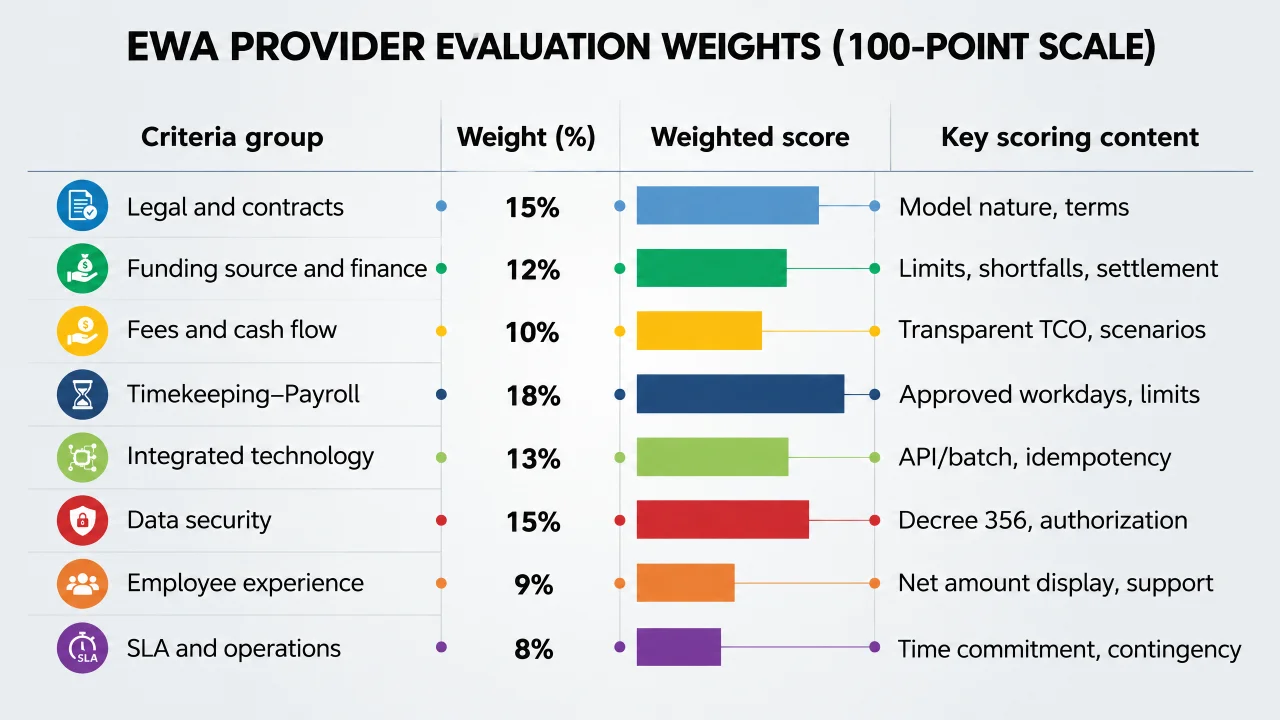
Score vendors only after they have successfully cleared all knock-out criteria.
Criteria Group | Weight | Core Evaluation Scope |
|---|---|---|
Legal & Contractual | 15 | Model structure, liabilities, employee terms, dispute resolution |
Funding Source & Financials | 12 | Capital origin, caps, shortfall absorption, settlement |
Fees & Total Cost of Ownership | 10 | Transparency, scenario-based costs, price escalations |
Time-Tracking, Limits & Payroll | 18 | Approved work, limit formulas, reconciliation, exceptions |
Technology & Integration | 13 | API/files, unique IDs, idempotency, logs, migration |
Security & Data Protection | 15 | RBAC, encryption, retention, incident response, sub-processors |
Employee Experience | 9 | Transparency, usability, history, support channels |
SLA & Operational Capacity | 8 | Commitments, support coverage, scalability, failovers |
**Total** | **100** |
Scoring Methodology
Use a 0–5 rating scale:
0: Non-existent or vendor refuses to provide information.
1: Verbal claim only; no supporting documentation.
2: Basic process documented, but significant gaps remain.
3: Meets baseline requirements with supporting evidence.
4: Performs well; verified in relevant pilots or validated case studies.
5: Fully comprehensive; features measurement frameworks, audits, and continuous improvement.
Weighted Score = (0–5 Score ÷ 5) × Criteria Weight.
For example, if a vendor scores 4/5 in the Payroll group (weight 18), the weighted score is:
4 ÷ 5 × 18 = 14.4 points.
Score Interpretation & Recommended Action
Total Score | Assessment | Recommended Action |
|---|---|---|
Below 60 | Significant gaps or weak documentation | Do not proceed to pilot; require remediation |
60–74 | Worth consideration, but holds noticeable risks | Proceed only with limited-scope pilot and strict conditions |
75–84 | Meets requirements solidly | Proceed to in-depth technical audit and live pilot |
85–100 | Strong overall capability based on evaluation | Proceed to UAT, pilot, and empirical verification |
These thresholds serve as a guideline. A vendor scoring 90 overall must still be disqualified if they fail non-negotiable requirements in legal structure, data privacy, or duplicate payment controls.
20 Critical Questions to Ask During an EWA Demo
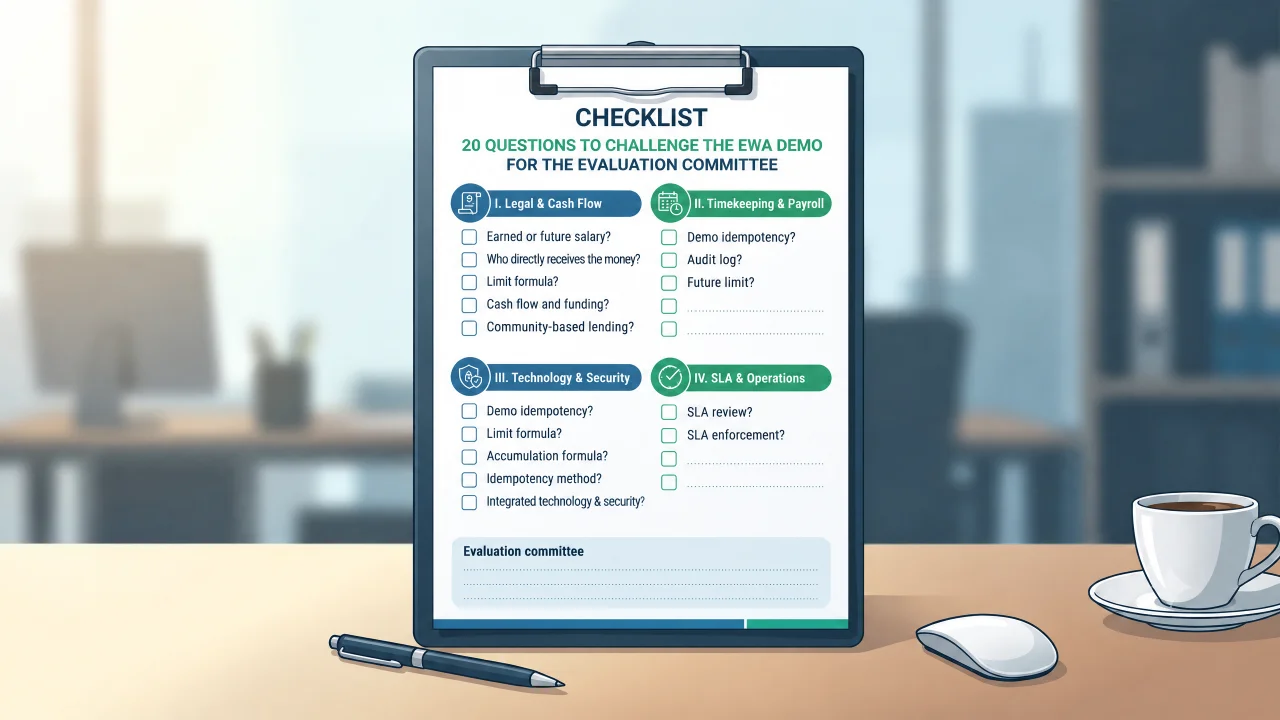
Does the solution strictly grant access to accrued earned wages, or can it advance beyond completed work?
Which entity directly disburses capital to the employee?
What agreements do employees sign/confirm, and does an independent repayment obligation arise?
What is the comprehensive fee structure, and who bears each specific cost?
Can you demonstrate the employee screen displaying fees, net payout, and remaining wages prior to final withdrawal confirmation?
How does your platform validate and determine "approved work hours"?
What mathematical formula calculates the withdrawal limit, and what safety reserve buffer is maintained?
If an employee's recorded hours are retroactively reduced post-disbursement, how does the system recover the difference?
What is the protocol if an employee resigns mid-cycle?
Can you demonstrate how the system prevents a single withdrawal request from being disbursed twice?
When a banking gateway lags or times out, how is the definitive success/failure state determined?
How are the three tiers of reconciliation (transaction–payroll–accounting) executed?
Can each payroll deduction item be directly audited back to a specific transaction ID?
Does integration occur via API, batch files, or alternate methods, and do you provide a functional staging sandbox?
Exactly what personal data is captured, where is it hosted, for how long is it retained, and with whom is it shared?
Which vendor personnel have authorization to view employee compensation and transaction records?
In the event of a security or data incident, what is the guaranteed notification and incident response window?
How are SLAs measured for transaction throughput, dispute resolution, attendance adjustments, and employee support?
Can you share anonymized sample operational reports, system logs, and payroll deduction files?
Upon contract termination, what is the established procedure for returning and permanently purging enterprise data?
A competent vendor will not merely provide verbal answers; they will demonstrate workflows directly, supply formal technical documentation, and agree to enshrine critical commitments into the contract.
Common Pitfalls in EWA Vendor Selection
Selecting Solely on the Lowest Stated Fee
Low transaction fees frequently conceal elevated integration, internal administration, or exception resolution expenses. Always evaluate Total Cost of Ownership across identical operational scenarios.
Prioritizing Payout Speed Over Control
Instant payouts executed against unapproved attendance or without idempotency protections exponentially elevate exposure to fraud and payroll shortfalls. Speed must remain secondary to calculation precision and end-to-end auditability.
Relying Blindly on Client Logos
Marketing slide decks featuring prominent brand logos do not reveal deployment scope, workforce scale, duration, or operational health. Insist on referenceable accounts or detailed, anonymized case studies.
Neglecting Mid-Cycle Terminations and Time Adjustments
Demos typically showcase flawless "happy path" scenarios. Demand live demonstrations of edge cases: employee resignations, retroactive timesheet edits, pending settlement transactions, duplicate disbursement traps, and payroll freeze cutoffs.
Letting HR Decide in Isolation
EWA impacts treasury, payroll, general ledger accounting, data security, and payment infrastructure. The evaluation committee must comprise HR, Finance, Accounting, IT/InfoSec, Legal, Procurement, and Operations.
Enterprise-Wide Rollout Without a Controlled Pilot
Compelling documentation does not guarantee real-world payroll reconciliation will balance. Run a pilot with limited headcount, complete at least one full monthly payroll cycle, and resolve all material discrepancies before expanding.
Proposed Vendor Selection Process
Define business objectives and measurable KPIs.
Draft technical, operational, and legal functional specifications.
Establish non-negotiable knock-out criteria.
Issue RFP and evaluation questionnaire to prospective vendors.
Conduct standardized live demos covering standard and exception workflows.
Score vendors independently across participating departments.
Perform reference checks and audit evidentiary documentation.
Negotiate contract terms, SLAs, and data protection liabilities.
Execute a capped pilot with defined Go–Adjust–Stop gates.
Evaluate post-pilot payroll reconciliation before authorizing full-scale rollout.
Executive Summary Checklist for the C-Suite
Prior to contract sign-off, executive leadership should receive a one-page briefing addressing these 10 core questions:
[ ] What are the specific business objectives and defined success metrics?
[ ] What is the legal classification of the transaction and what is the capital funding source?
[ ] What is the Total Cost of Ownership across low, base, and peak operational models?
[ ] Who bears financial liability for mid-cycle shortfalls or unrecoverable disbursements?
[ ] How are approved work hours verified and withdrawal limits enforced?
[ ] What structural mechanisms govern payroll and general accounting reconciliation?
[ ] How is employee personal and financial data secured and segregated?
[ ] Under technical or banking system failures, who holds authority to initiate a kill-switch?
[ ] What are the exact scope, duration, and financial liquidity caps of the pilot?
[ ] What are the objective Go–Adjust–Stop decision criteria following the pilot payroll cycle?
Conclusion
The ideal EWA vendor does not merely disburse funds swiftly. They must verify that the entire operational chain — approved work hours → available limit → transaction → disbursement → payroll → accounting ledger → data governance — operates accurately, securely, and with complete auditability.
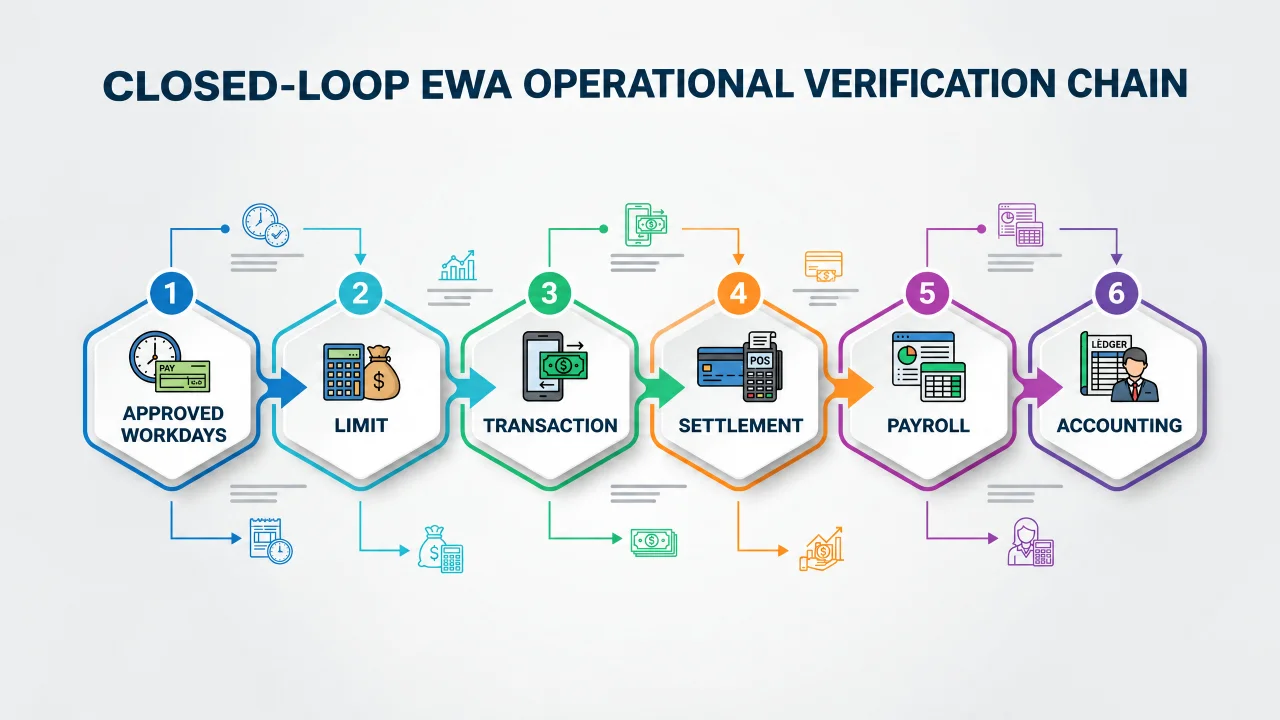
Enterprises should apply a three-tier decision framework:
Knock-out criteria to eliminate foundational platform risks.
100-point scorecard for objective, cross-departmental comparison.
Live pilot through a full payroll cycle to validate vendor claims against real production data.
Enterprises can submit this 20-question audit to Nhan Kiet or schedule an EWA demo and advisory session at Earned Wage Access for Enterprises.
> Disclaimer: This guide provides general operational frameworks and does not replace formal procurement policies, security audits, or tailored legal and financial counsel for specific corporate environments.
References
---
Author: Nguyen Minh Tuan — Strategy Team Specialist, Nhan Kiet Manpower Supply Co., Ltd.
Earned Wage Access Consultation for Enterprises: Hotline 0937.022.655 · Email info@nhankiet.vn · Earned Wage Access for Enterprises
FAQ
Should enterprises select the cheapest EWA vendor?
No. Headline per-transaction fees represent only a fraction of expenses. Enterprises must account for Total Cost of Ownership, platform risk, reconciliation capabilities, data security, SLAs, and the operational overhead of exception management.
Is an ISO or security certification sufficient proof of safety?
No. A certificate alone does not validate the underlying architecture, data isolation, role-based access, audit logging, penetration test results, sub-processor security, or contractual incident liability.
Is direct API integration mandatory from day one?
Not necessarily. A controlled pilot can operate effectively using secure, validated batch files, provided identity mapping, data versioning, approval gating, idempotency, and reconciliation controls are maintained. API integration becomes vital when scaling across large workforces requiring dynamic balance updates.
What is the recommended headcount for a pilot?
There is no universal figure. Select a business unit with stable time-tracking workflows that is small enough to control closely yet sufficiently sizable to surface real operational friction, while enforcing clear transactional and capital caps.
Why is demonstrating system edge cases critical?
Happy-path demonstrations fail to reveal operational resilience. Mid-cycle departures, timesheet corrections, delayed payment gateway responses, updated banking details, and duplicate disbursements reveal whether a solution can safeguard enterprise payroll.
Who should sit on the vendor selection committee?
At a minimum: HR, Payroll, Finance/Accounting, IT/Information Security, Legal, Procurement, and Operations, spearheaded by a dedicated project owner.
Does achieving a high evaluation score guarantee immediate contract award?
No. Scoring provides structured comparative analysis, but the leading vendor must still satisfy all mandatory knock-out criteria, contract negotiations, UAT sign-off, and a live payroll pilot.