
How Does EWA Help With Recruitment and Employee Retention?
EWA can support recruitment and retention by helping employees access a portion of wages they have already earned before the regular pay date, easing short-term cash-flow pressure and increasing the sense that the company supports them. However, EWA does not guarantee that a candidate will accept a job offer or that an employee will stay. Its effectiveness still depends on pay levels, management quality, the work environment, fees, user experience, and how the program is implemented.
EWA — Earned Wage Access — often referred to as flexible pay or access to wages already earned. What sets EWA apart is not paying extra wages, but giving employees more control over when they receive a portion of income they have already earned.
> Glossary: EWA (access to wages for days already worked) · pilot (trial rollout) · KPI (key performance indicator) · onboarding (new-employee orientation) · landing page (recruitment landing page) · ATS/CRM (recruitment/customer management software) · HRIS (human resources information system) · eKYC (electronic identity verification) · ROI (return on investment) · Go–Adjust–Stop (Continue – Adjust – Stop).
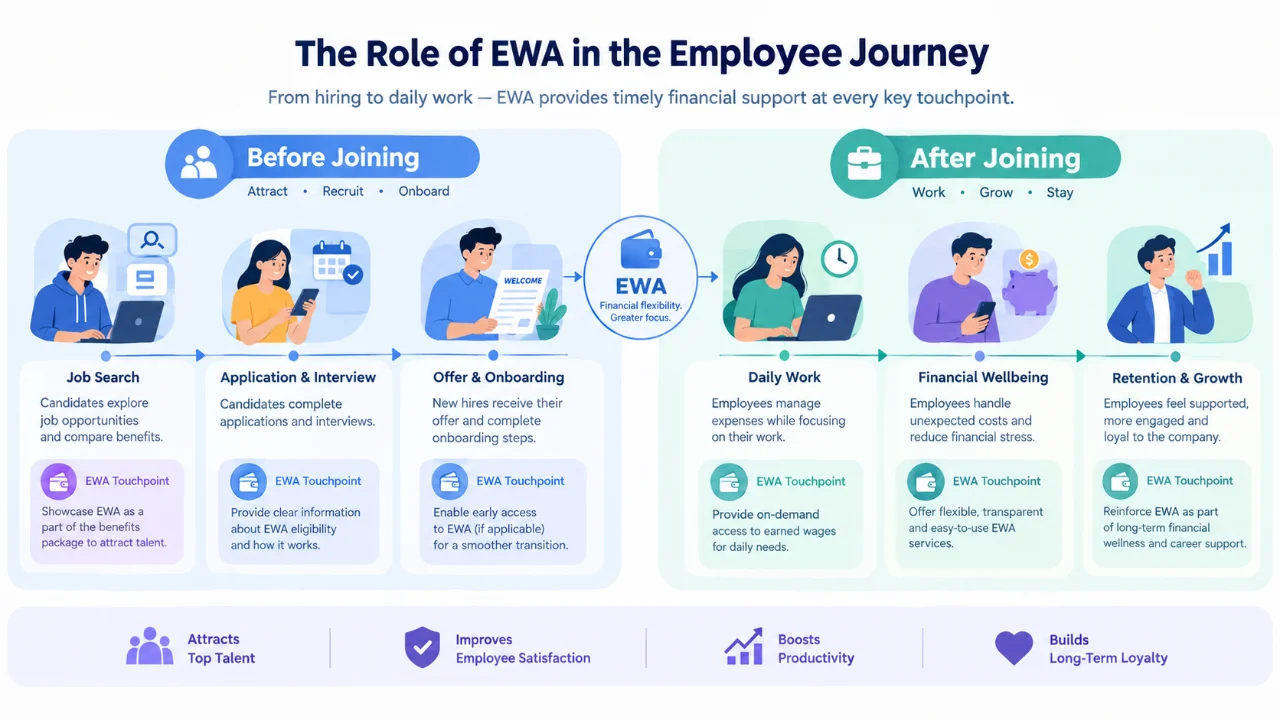
For businesses that employ large numbers of workers, the value of EWA can appear at two stages:
Before joining: it gives candidates one more concrete reason to be interested, accept the offer, and complete their first day.
After joining: it helps employees manage the timing gap between income and expenses, which may improve the experience and reduce some of the reasons employees leave that are related to cash-flow difficulties.
Why might employees run short of money between pay periods?
A person can have income and still run short of money at a specific point in time because the day they earn and the day they spend don't line up. For example:
Rent is due before payday.
They need money for transportation to keep going to work.
An unexpected medical or family expense comes up.
A new employee has to wait for the first pay period.
Holidays shift the timing of spending.
Income varies with attendance, shifts, or overtime.
EWA does not solve the problem of total income being lower than total living expenses. It can only help with the timing of cash flow when an employee has already earned part of their wages but the pay date hasn't arrived yet.
This is an important limitation. If a company markets EWA as a cure for every financial difficulty, the program is likely to create the wrong expectations.
How the EWA mechanism can affect the employee experience
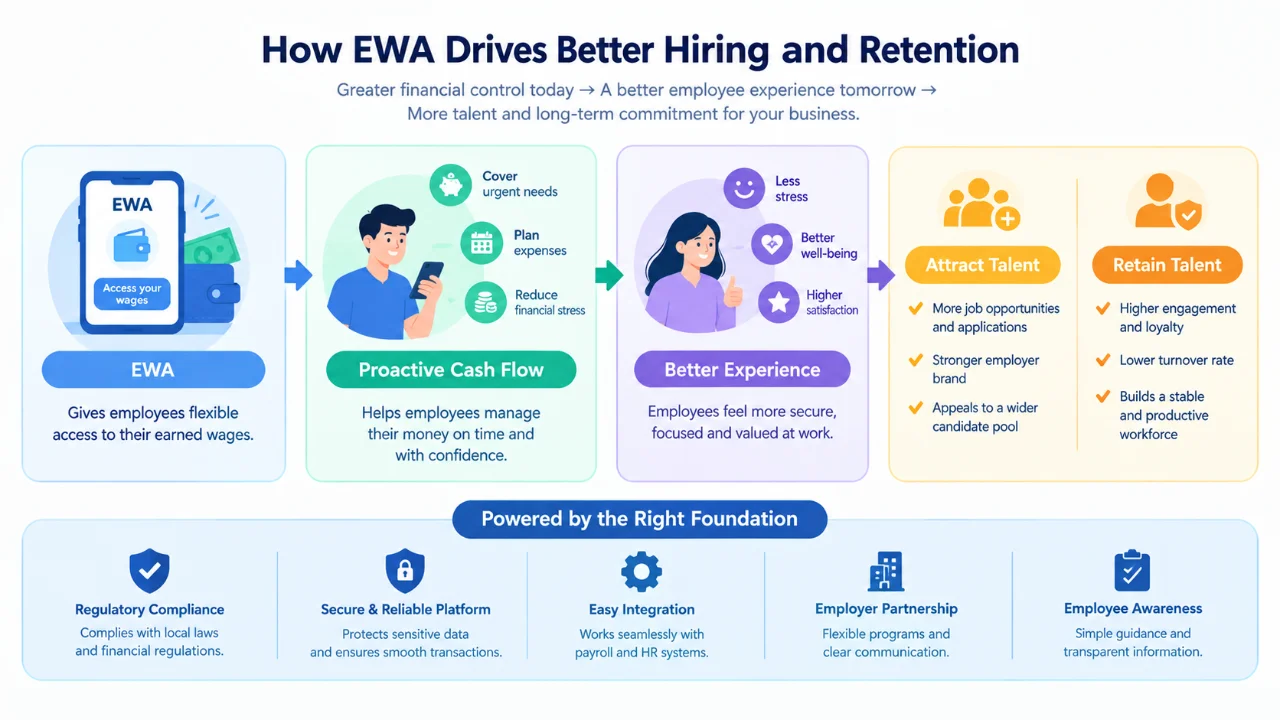
Mechanism | Employee experience | Related HR outcome |
|---|---|---|
Control over when money is received | Less dependence on a fixed payday in short-term situations | A stronger sense that the benefit is useful |
Access to wages already earned | Sees the connection between approved work and entitlement | Greater clarity about timekeeping and pay |
Digitized process | Less need to request manual approval or explain personal circumstances | A more private, more consistent experience |
Visibility of remaining pay | Employee knows the impact of a transaction on the rest of the pay period | Encourages planned use |
Support when needed | A sense that the company cares about real difficulties | May increase engagement and trust |
These mechanisms only work when work hours are approved on time, fees are transparent, transactions are accurate, and employees understand that receiving pay early does not increase total income.
How can EWA support recruitment?
1. Create a point of difference in job postings
Many job postings describe similar benefits. An easy-to-understand benefit such as "can access a portion of wages from work already completed, according to policy" can give candidates one more reason to learn more.
The message should reflect the reality accurately:
> "Eligible employees can proactively access a portion of wages already earned for confirmed work hours, ahead of the regular pay period."
Avoid vague language such as "get paid every day," "advance as much as you want," or "get money instantly with no conditions" if that is not how the system actually works.
2. Ease concerns about waiting for the first pay period
New employees may have to wait until the regular pay date. If the policy allows it and hours have already been approved, EWA can help them access part of the wages they've earned during this early period.
This impact should be measured using:
The rate of candidates accepting job offers.
The rate of candidates showing up on their first day.
The turnover rate at 7, 30, and 60 days.
Reasons for early departure.
The share of new employees who are eligible for and actually use EWA.
3. Make the job offer more concrete
EWA is a benefit that can be described through a clear process: when someone becomes eligible, which hours count, what the limits are, what the fees are, and how the remaining pay is calculated. This clarity helps candidates evaluate the real benefit better than a generic slogan can.
4. Support high-volume recruitment
For factories, logistics, retail, or service businesses with ongoing hiring needs, EWA can be incorporated into:
Recruitment landing pages.
Official job postings.
Candidate advisory content.
Pre-employment orientation sessions.
Employee referral programs.
First-day onboarding.
Companies need to control the messaging across every channel to prevent recruiters from promising benefits that go beyond the actual policy.
How can EWA support employee retention?
1. Ease some short-term cash-flow pressure
When employees need money for transportation, daily living, or an unexpected situation, accessing a portion of wages already earned can be a more suitable option than waiting for payday or turning to an expensive alternative — after fully comparing the terms and costs involved.
If cash-flow pressure is one reason employees skip shifts or look for jobs that pay sooner, EWA may help reduce that cause. However, companies must measure this with real data rather than assume it.
2. Create a sense that the company supports its employees
A benefit has value when employees see that it solves a real problem. Giving them a choice about when to receive their pay can create a sense that the company understands their day-to-day life.
This sense of support can easily be undermined if:
Hours are worked but approved slowly.
Fees are not clearly displayed.
Transactions fail and support is slow to respond.
End-of-month pay is lower than expected without explanation.
The company advertises "no fees" or "not a loan" in ways that don't match the actual model (see Is EWA a Loan? and How Are EWA Service Fees Calculated?).
3. Reduce reliance on the traditional ask-and-approve advance process
A traditional salary advance process may require employees to explain their circumstances to multiple levels of approval. A system based on work-hour data and consistent rules can make the experience more private and fairer.
4. Improve transparency of hours and pay
If the app shows approved hours, wages already earned, the amount already withdrawn, and the remaining balance, employees have more ability to check things for themselves. This benefit doesn't come from EWA alone — it comes from the company standardizing the underlying data and processes.
What does existing research say?
A preliminary 2022 study by researchers from Harvard College, Harvard Business School, and Yale used data from a fintech company in Mexico. The study found that EWA usage was associated with a higher likelihood that employees stayed in their jobs within the observed sample, after controlling for certain characteristics. The study itself also noted the need for further experimental design to establish a clearer causal relationship.
The takeaway isn't to copy a percentage and promise it in Vietnam, but rather:
There is a basis for hypothesizing that EWA may be related to retention.
The impact can vary between groups of workers.
A measurement design is needed to separate the effect of EWA from other factors.
How fees, limits, and responsible-use design are structured can influence the outcome.
Financial Health Network also views EWA as a relatively new product and continues to study its impact on financial health. The organization recommends that companies minimize fees, clearly explain the mechanism, and combine EWA with supplementary financial resources.
What can't EWA solve on its own?
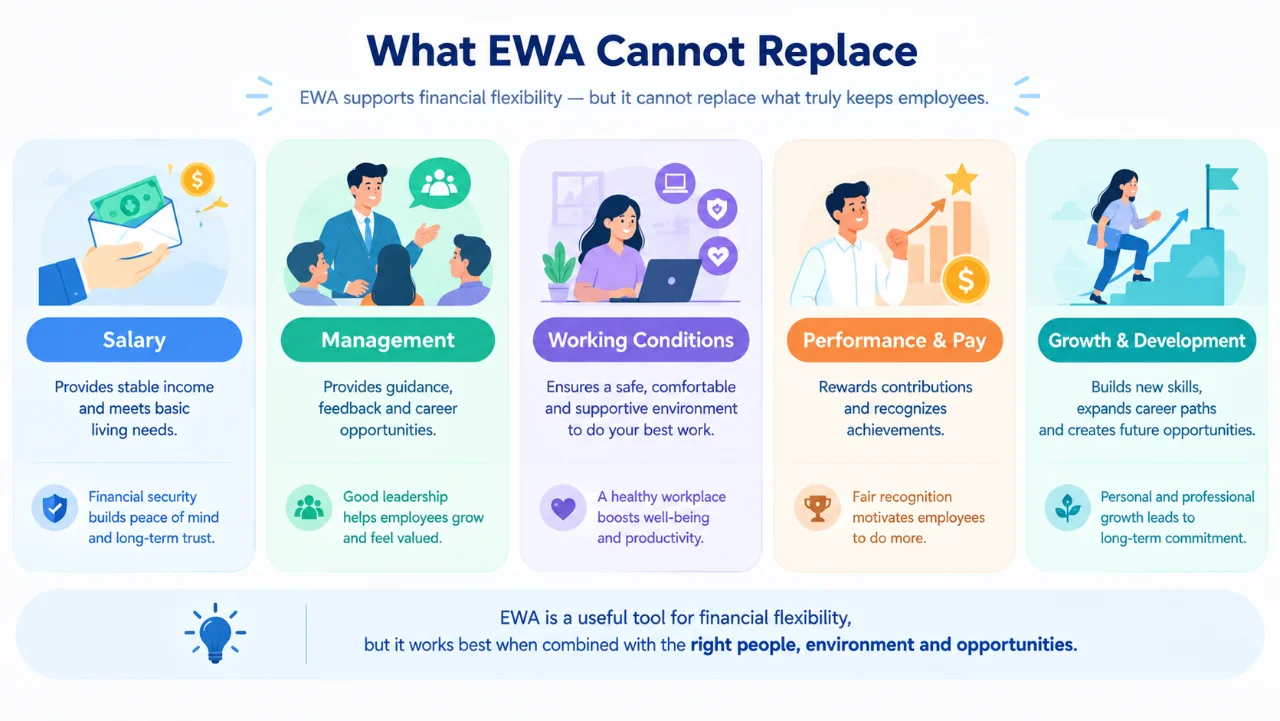
Uncompetitive pay
EWA changes when pay is received, not the total amount earned. If pay doesn't meet market rates or match the workload, employees still have a reason to look elsewhere.
Weak direct management
A lack of respect, unclear task assignment, slow approval of hours, favoritism, or unresolved complaints can undermine the effect of any benefit.
Unsuitable working conditions
Safety, shift patterns, housing, transportation, meals, and the work environment remain foundational factors.
Persistent errors in hours or pay
An early-wage-access app cannot make up for an inaccurate timekeeping/payroll system — this is tied to standardizing approved work hours. If anything, it can make such errors surface sooner and more clearly.
Lack of growth opportunities or unfair treatment
Employees also care about training, promotion, fairness, and the quality of their relationship with management.
Structural financial hardship
If regular expenses consistently exceed income, receiving pay early only shifts the date money is received. Employees may need budgeting help, counseling, and other forms of support.
When does EWA risk making the experience worse?
Employees don't know their total fees for the month.
The system shows only the available limit, not the remaining pay.
Transactions are too easy to make without responsible-use limits.
Hours worked aren't approved on time.
Recruitment messaging doesn't match the actual terms.
An employee leaves the company but transactions/reconciliation haven't been clearly resolved.
Pay data or transaction history is accessed without necessity.
The company uses EWA data to judge, stigmatize, or pressure employees.
For EWA to become a genuine retention benefit, companies must protect employees' freedom of choice, transparency, and privacy.
How to roll out EWA in recruitment
Stage 1. Standardize the messaging
Build one shared piece of content for recruitment, HR, and management covering:
What EWA is.
Who is eligible.
When hours are counted.
How the limit is determined.
Whether there are fees.
How early access affects end-of-period pay.
The official support channel.
Stage 2. Train recruiters
Recruiters need to know how to answer correctly without over-promising. A set of frequently asked questions and illustrative examples should be prepared.
Stage 3. Place it at the right touchpoints
Job postings.
Landing pages.
Advisory calls.
Offer letters.
Onboarding.
Payslips and the employee app.
Stage 4. Measure conversion
Tag the recruitment source and messaging version to know whether EWA is actually contributing to application, acceptance, and first-day attendance rates.
How to measure the real impact on recruitment and retention
Step 1. Establish a baseline
Measure at least the following metrics before the pilot:
Number of eligible candidates.
Offer-acceptance rate.
First-day attendance rate.
Turnover rate at 7/30/60/90 days.
Monthly voluntary turnover rate.
Cost to recruit one employee who starts working.
Absenteeism/shift-abandonment rate.
Number and processing time of manual advance requests.
Step 2. Choose a comparison group
You can select two factories, departments, or time periods with similar characteristics. One group rolls out EWA; the other does not, during the same period.
Step 3. Clearly define users
Distinguish between:
Eligible.
Informed about the program.
Activated.
Used at least once.
Repeat users.
Non-users.
If everyone is grouped together, it becomes hard to know whether the impact comes from "being offered the benefit" or from actually using it.
Step 4. Control for confounding factors
Record any changes that happen during the same period:
Adjustments to pay or allowances.
Recruitment bonuses or sign-on bonuses.
Changes in management.
Changes in orders, overtime, or shift patterns.
Improvements to housing, shuttle transportation, or meals.
Hiring season and market fluctuations.
Step 5. Combine quantitative and qualitative evaluation
Pair the numbers with interviews/surveys:
Why did candidates accept or decline the offer?
Why did employees leave?
Was EWA a contributing factor?
How well do users understand fees and remaining pay?
What difficulties has EWA not yet solved?
Sample 90-day KPI plan
Objective | KPI | How to measure | Warning signs to watch |
|---|---|---|---|
Access to the benefit | Share of eligible employees | Eligible records / total pilot | Unapproved hours, incomplete records |
Correct understanding | Share answering 3 core questions correctly | Short survey | Mistaking EWA for a pay raise or a loan |
Activation | Account activation rate | Activated accounts / eligible | eKYC errors, weak communication |
Usage | User rate and transactions per user | System logs | Unusually repeated withdrawals |
Recruitment | Offer-acceptance and first-day attendance rate | Recruitment ATS/CRM | Multiple policies changing at once |
Early retention | Turnover at 7/30/60/90 days | HRIS | Sample composition bias |
Overall retention | Voluntary turnover rate | HRIS, monthly | Seasonality, order volume changes |
Attendance | Absenteeism and shift abandonment | Timekeeping | Inaccurate hours data |
Experience | Satisfaction, complaints, resolution time | Survey/tickets | Complaints about fees, hours, transactions |
Financial | Cost, net benefit, ROI | Finance + HR Analytics | Double-counting benefits |
Evaluation milestones
Day 0: Finalize the baseline, pilot group, KPIs, and hypotheses.
Day 30: Assess access levels, correct understanding, hour approvals, and operational errors.
Day 60: Review trends in usage, recruitment, early departures, and complaints.
Day 90: Conduct an overall assessment, compare groups, calculate preliminary ROI, and make a Go–Adjust–Stop decision.
Ninety days can offer an initial signal, but it isn't always enough to confirm long-term retention impact.
An illustrative example of the evaluation method — not a real case
Suppose a company rolls out EWA at Factory A and selects Factory B — with a relatively similar size, type of work, and production season — as the comparison group.
Metric | Factory A before | Factory A after | Factory B before | Factory B after |
|---|---|---|---|---|
90-day turnover rate | 12% | 10% | 11% | 10.5% |
First-day attendance rate | 82% | 86% | 83% | 84% |
If you look only at Factory A, the turnover rate dropped by 2 percentage points. But Factory B also dropped by 0.5 percentage points over the same period. The difference-in-differences to carry forward for further analysis is:
(10% − 12%) − (10.5% − 11%) = −1.5 percentage points.
This is a simple "difference-in-differences" calculation. The result isn't enough on its own to prove causation if the two factories differ in many ways, but it's more reliable than comparing before-and-after for a single group alone.
> Note: The figures above are entirely hypothetical, used only to illustrate the method.
How to calculate the financial value of a retention impact
If a company has reasonable evidence of the number of departures avoided:
Retention benefit = Number of departures avoided × Verified average cost of replacement hiring
Replacement hiring cost can include advertising, recruitment, paperwork, training, uniforms, management time, and lost productivity. Don't use one generic market rate for every position.
Then calculate ROI (details in How to Calculate ROI When Implementing EWA):
EWA ROI = (Total converted benefit − Total EWA cost) ÷ Total EWA cost × 100%
Don't double-count the benefit of reduced turnover together with recruitment costs and production shortfalls if those components are already included in the same replacement-hiring unit cost.
Six principles for EWA to support retention responsibly
Base it only on eligible hours worked: Don't encourage employees to access income that hasn't been earned yet.
Show the total cost: Fees, the amount actually received, and total fees for the period must be clear.
Show the remaining pay: Employees should know the impact on the rest of the pay period before confirming.
Set reasonable limits: Have a safe ratio and control frequency according to the model.
Protect privacy: Don't let managers use EWA history to stigmatize or pressure employees.
Combine it with financial education: Provide budgeting guidance, alerts, and support channels.
Conclusion
EWA can support recruitment and retention through three main mechanisms: creating an easy-to-understand benefit, easing some short-term cash-flow pressure, and increasing the sense that the company supports its employees. But EWA is only one part of the employee experience ecosystem.
Companies must still ensure competitive pay, good management, accurate hours-to-pay tracking, safe working conditions, and growth opportunities. To know whether EWA is actually working, establish a baseline, a comparison group, 90-day KPIs, and disclose the limitations of the data as well.
Companies that want to assess their turnover challenge, design an EWA pilot, and build a KPI framework to measure impact based on real data can learn more at Earned Wage Access for Businesses.
> Note: This article provides general information; it is not a commitment that EWA will improve any specific rate of recruitment, turnover, productivity, or financial outcome.
References
Harvard Business School: Fintech to the (Worker) Rescue — Earned Wage Access and Employee Retention
ILO: Earned Wage Access – A Global Study on Benefits and Risks
Financial Health Network: Earned Wage Access — research and insights
---
Author: Nguyen Minh Khang — Strategy Team Specialist, Nhan Kiet Manpower Supply Co., Ltd.
Business consultation for Earned Wage Access solutions: Hotline 0937.022.655 · Email info@nhankiet.vn · Earned Wage Access for Businesses
FAQ
Does EWA definitely reduce turnover?
No. EWA can help address some causes related to cash flow and experience, but turnover still depends on pay, management, the job itself, working conditions, and the labor market. Companies must measure the actual impact.
Should EWA be included in job postings?
It can be, if the benefit is ready and the content states the terms accurately. Job postings should describe it as access to a portion of wages already earned according to policy, not as additional income.
Does EWA replace a pay raise?
No. EWA changes when pay is accessed; it does not increase total income. Competitive pay remains a foundational factor.
Are employees who don't use EWA affected?
They shouldn't be adversely affected. The program should be optional, and companies shouldn't use whether or not someone uses it to judge attitude, competence, or loyalty.
Does a high usage rate mean it's working well?
Not necessarily. You need to look at the purpose, frequency, fees, remaining pay, complaints, and signs of dependency. The goal is responsible use.
How long does it take to measure the retention impact?
A 90-day pilot can give an early signal about early departures and experience. Assessing long-term retention usually takes longer and should involve a comparison group or period.
Can international data be used for advertising in Vietnam?
It should only be used as a reference, with context, sample, and limitations clearly stated. Research results from one country or one provider should never be turned into a commitment made by EWA in Vietnam.
What happens if approved hours are delayed?
Employees may not see their available limit despite having worked, which reduces trust in the benefit. The rate and timeliness of hour approvals should be a critical operational KPI.