
How Are EWA Service Fees Calculated and Who Pays Them?
EWA service fees may be paid entirely by the employer, paid by the worker on each transaction, shared between both parties, or included in a recurring subscription package. Beyond the platform fee, there may also be transfer, integration and operating fees. So to know how much EWA really costs, you need to look at the total cost across the whole period, who bears each item, and the final amount the worker actually receives.
EWA stands for Earned Wage Access, commonly understood as a solution that lets workers access part of the wages they have already earned from days worked, before the regular payday.
EWA fees are an area that must be presented with particular transparency. The phrase "no interest" does not mean "no cost of any kind"; conversely, the mere existence of a service fee is not enough to automatically conclude that the transaction is a loan. Its true nature must be assessed from the entire transaction structure, the source of funds, the contract, the obligations of each party and the way the fee is calculated.
Distinguishing interest, service fees and payment fees
These three concepts are often used interchangeably, but they are not the same.
Cost item | Typically charged for | How it should be presented |
|---|---|---|
Interest | The cost of using a sum of money in a credit-type relationship | Rate, accrual period, interest amount and total obligation |
EWA service fee | The platform, request processing, operation and provision of the utility | Fee level, calculation method, party responsible and timing of the charge |
Payment/transfer fee | The bank, payment intermediary or disbursement channel | Per-transaction fee or waiver/refund policy |
Integration fee | Connecting timekeeping, payroll, ERP, API or initial deployment | One-time fee, by scope or by workload |
Subscription fee | The right to use the platform per month/year | Service tier, number of users and included features |
Internal operating cost | Staff approving attendance, reconciliation, support and handling discrepancies | The business's estimated resources and time |
The name of a charge is not the only factor that determines its legal nature. For example, calling a charge a "platform fee" while the amount grows with the time left unpaid, together with late penalties and an independent obligation to repay, may raise different questions than a fixed fee for a technological operation.
When conducting due diligence, a business should ask all of the following at once:
Have the funds the worker receives already been earned from days worked?
Who provides the money?
Is the fee charged per transaction, by the value of money, or by time?
Does the worker have an independent obligation to repay a debt?
Are there interest, late penalties, recovery fees or extension fees?
Is the fee shown upfront, or does it only appear after the transaction is completed?
What can an EWA fee include?
Depending on the model, the total cost may include one or more components:
Setup fee: survey, process configuration, business setup and training.
Integration fee: connecting HR, timekeeping, payroll, accounting and payment data.
Recurring platform fee: paid per month, per year, per eligible person or per active account.
Transaction fee: incurred each time a worker receives money early.
Transfer fee: the cost of the payment channel or bank.
Cost of funds: the cost to the business or provider of having money available before payday.
Premium support fee: a dedicated SLA, a dedicated point of contact, custom reporting or after-hours operation.
Internal cost: the time of HR, payroll, accounting, IT and line managers.
Not every program has all eight cost types. A good quote must let the business clearly distinguish which items are mandatory, which are optional and which arise only in specific situations.
Four common EWA fee models
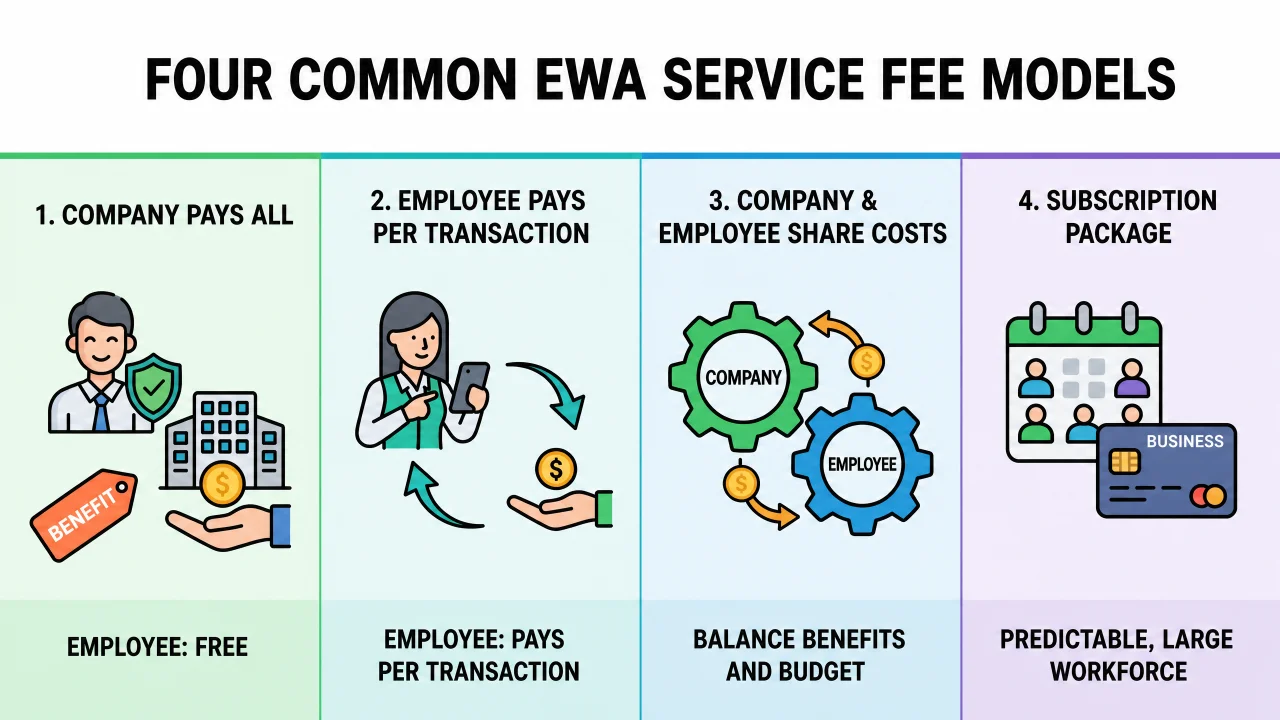
1. The employer pays in full
The business buys EWA as a benefit for workers and pays the fees agreed with the provider. Workers receive money without paying a direct transaction fee, unless the policy announces another charge.
Advantages:
A simple experience that is easy to communicate.
Workers do not have to weigh a cost every time they use it.
Reduces the risk of confusing service fees with interest.
Suitable when the business wants to use EWA as a recruitment and retention benefit.
Points to consider:
The business must budget for the entire program.
Costs may rise as the number of users and transactions grows.
If it is entirely free with no suitable limits, workers may transact too frequently.
2. The worker pays a per-transaction fee
Each time they request an early wage payment, the worker pays a fee that is displayed before confirmation.
Advantages:
The business reduces its direct cost.
Costs are tied to actual usage demand.
Those who do not use it bear no transaction fee.
Points to consider:
A small fee can add up considerably if the worker transacts many times.
If only "0% interest" is promoted without emphasizing the fee, users may misunderstand the total cost.
A fixed fee can represent a large proportion of a small-value transaction.
3. The employer and worker share the cost
The business subsidizes part — for example the platform fee or a certain number of transactions; the worker pays the rest if usage exceeds the supported scope.
Advantages:
Balances benefit and budget.
The business can subsidize a basic number of uses or emergency situations.
Creates an incentive for considered use.
Points to consider:
The policy can become hard to understand if there are many fee tiers.
It must clearly show the portion the business subsidizes and the portion the worker pays.
Payroll and accounting must classify each portion of the cost correctly.
4. Subscription or scale-based fee
The business pays a fee per month/year, per eligible worker, per active account or for a feature package. The package may already include a certain volume of transactions.
Advantages:
Easy to budget if scale and scope are stable.
Suitable for large programs with frequent use.
Can bundle multiple administration, reporting and support features.
Points to consider:
The business may pay for unused accounts if it chooses the wrong unit of measure.
It must clarify how over-package transactions are charged.
The definitions of "user", "active account" and "successful transaction" must be agreed upon.
Comparison of the advantages and disadvantages of each model
Model | Main payer | Ease of budgeting | Worker experience | Risks to manage | Suitable when |
|---|---|---|---|---|---|
Employer pays in full | Employer | Medium–high depending on method | Very simple | Budget grows with usage; overly frequent transactions | EWA is seen as a strategic benefit |
Worker pays per transaction | Worker | High for the business | Requires weighing each time | Fees accumulate; relatively high fees on small transactions | The business wants cost based on actual users |
Cost sharing | Both parties | Medium | Depends on how it is displayed | Complex policy; hard to reconcile | You want to subsidize a basic level and cap the budget |
Subscription/by scale | Employer | High if scale is stable | Usually simple | Paying for inactive accounts; over-package | Wide deployment with stable demand |
No single model is best for every business. The right option depends on the benefit objective, workforce size, budget, expected usage frequency, data stability and how the business wants to allocate costs.
Who should pay the EWA fee?
You can decide based on three questions:
What is the program's objective?
If the main objective is benefits, recruitment and retention, the business can subsidize the full cost or the basic portion.
If the objective is to provide an optional utility, a per-transaction or cost-sharing model can be considered.
If EWA replaces a manual advance process that consumes many resources, the business should factor in the operating cost saved before shifting the entire fee to workers.
Who receives the economic benefit?
Workers gain flexibility over the timing of their cash flow. The business can reduce the volume of manual advance processing, increase the appeal of its benefits and gain an additional tool to support its workforce. Because both parties can benefit, cost sharing is an option that should be evaluated rather than defaulting to one party bearing the entire cost.
Is the cost fair to small transactions?
If the fee is fixed per transaction, the same fee level will represent a higher proportion of a small withdrawal. The business needs to evaluate both the absolute amount and the ratio of cost to the amount actually received.
For example, a fee of VND 10,000 on a VND 200,000 transaction equals 5%; but the same VND 10,000 on a VND 1,000,000 transaction equals 1%. This is only an illustrative calculation, not the fee schedule of earned wage access.
Formula for calculating total monthly EWA cost
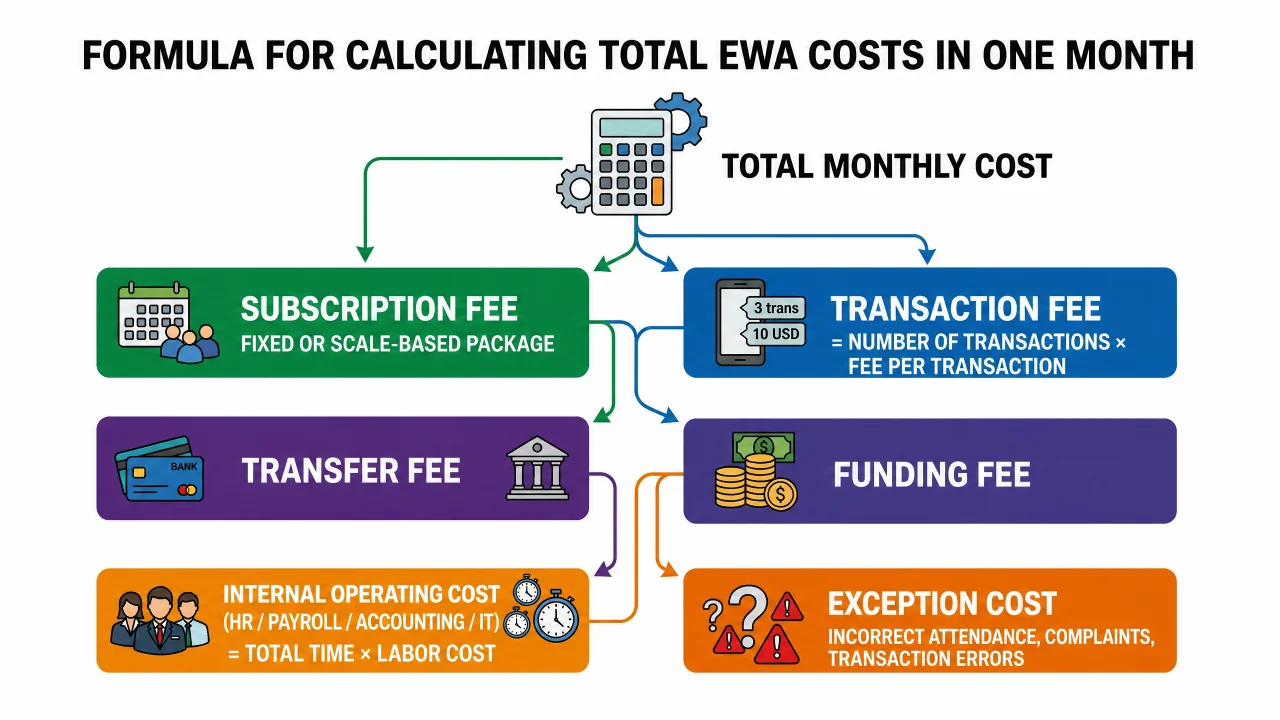
To compare options, you can use the formula:
Total monthly cost = Allocated subscription fee + Transaction fees + Transfer fees + Cost of funds + Internal operating cost + Exception costs
Where:
Transaction fees = number of successful transactions × fee per transaction.
Transfer fees = number of chargeable transactions × payment-channel fee.
Internal operating cost = total time of HR/payroll/accounting/IT × the corresponding labor cost.
Exception costs include handling attendance errors, refunds, tracing, failed transactions and complaint support.
For workers, the formula is simpler:
Total individual cost = Total transaction fees + Total transfer fees + Any other announced fees
Example of calculating cost in one month
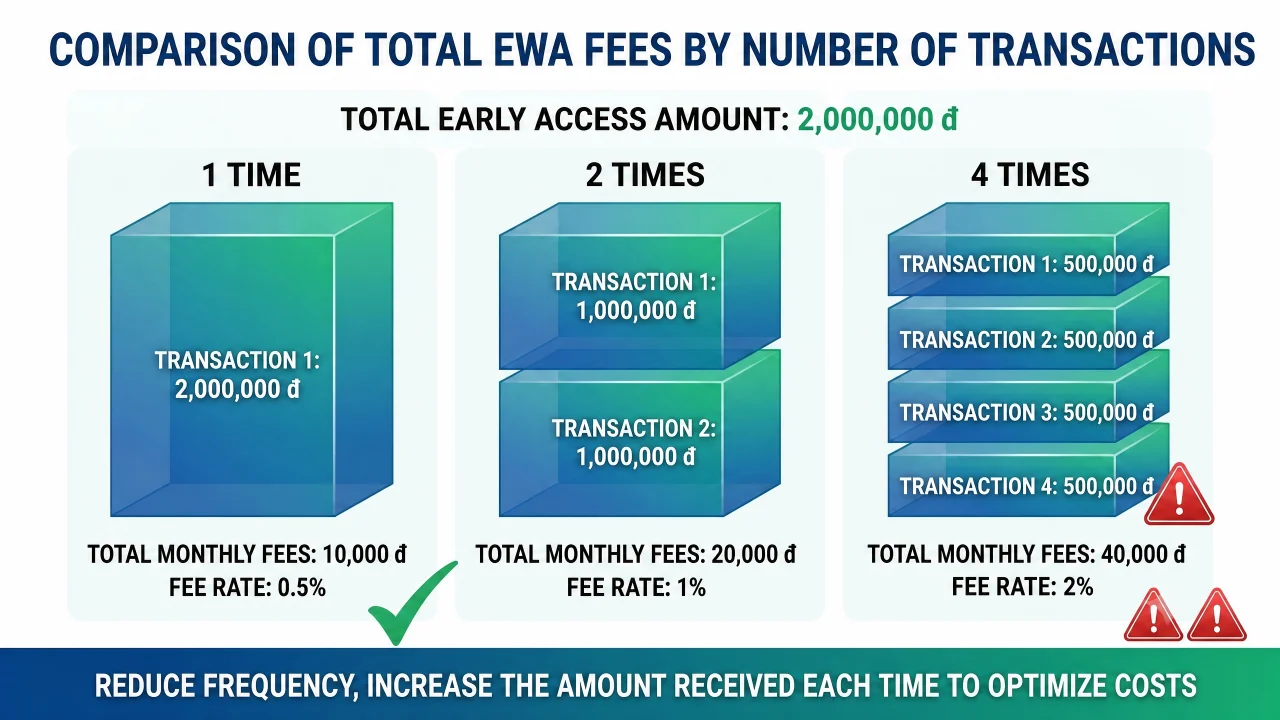
Suppose a program specifies:
The worker pays VND 10,000 for each successful transaction.
There is no separate transfer fee.
The worker makes 4 transactions in the month.
The total amount received early is VND 2,000,000.
Then:
Total monthly fee:
10,000 × 4 = VND 40,000.Ratio of fee to total amount received early:
40,000 ÷ 2,000,000 × 100% = 2%.If combined into 2 transactions at the same fee each, the total fee falls to VND 20,000.
The example shows that looking only at "VND 10,000 per time" is not enough. Workers need to look at the total fee over the period, while the business needs to consider whether the fee structure inadvertently encourages many small transactions.
> Note: All figures in the example are illustrative assumptions, not the fees of earned wage access or any specific provider.
8 principles for EWA fee transparency
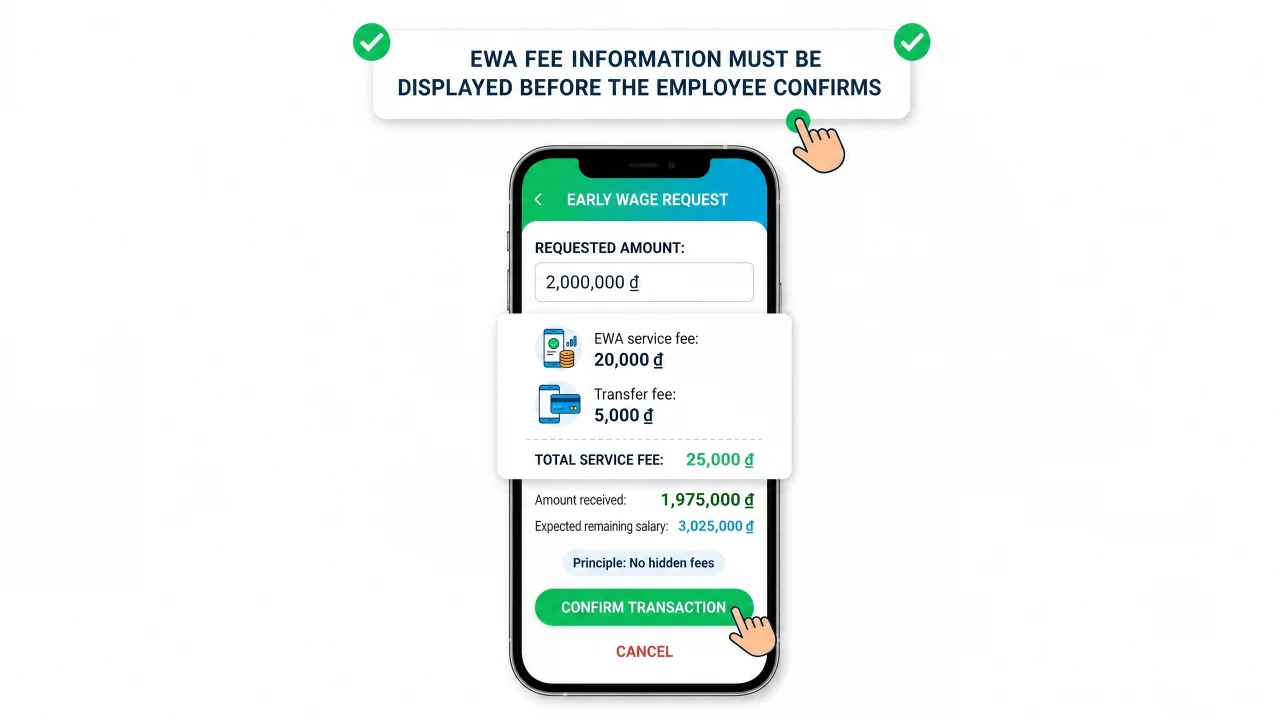
1. Show the fee before confirmation
Workers need to see at a minimum: the amount requested, each type of fee, the total fee, the amount actually received and the expected remaining wage.
2. Do not hide fees in lengthy terms
Full terms are still necessary, but the important information for each transaction must appear right at the confirmation step.
3. Name each item correctly
Platform fees, transaction fees, transfer fees and taxes, if any, must be separated clearly. Do not lump everything into a single "other costs" line.
4. Charge only for the defined status
The policy must state clearly whether the fee applies when the request is submitted, when the transfer succeeds or at another status. How fees are handled for failed or refunded transactions must also be announced upfront.
5. Provide a transaction history
Workers need to review the date and time, amount requested, amount actually received, fee each time and total received in the period.
6. Announce limits and frequency
If there is a cap on the number of times, a minimum/maximum amount or a transaction cut-off time, the system must display it clearly before use.
7. Provide a complaint and refund channel
There must be a defined point of contact, response deadline and a way to handle transactions that fail, are double-charged or where the money is not received.
8. Communicate fully, not just "0% interest"
The message should mention fees at the same time. A safe way to phrase it is: "No interest is charged; service fees and payment fees, if any, are displayed before the worker confirms" — but use this only when it matches the actual model.
If there is a service fee, is EWA a loan?
You cannot conclude that from the mere presence or absence of a fee. To determine its nature, you need to examine:
Whether the funds were created by the worker from days worked, or are an advance based on future income.
Who provides the source of funds.
Whether there is a loan contract or a credit-extension relationship.
Whether there is an independent repayment obligation, interest, late penalty or recourse.
Whether the transaction is reconciled in payroll or recovered as a separate debt.
Whether the fee is charged for the service performed or for the time the money is used.
A study in the June 2026 issue of the Banking Review also shows that classifying EWA in Vietnam requires looking at the nature of each model. Therefore, a business should not rely on the word "fee" or "0% interest" alone to reach an absolute legal conclusion (see Is EWA a loan?).
Which fee model should a business choose?
Manufacturing businesses with a large workforce
They can consider a scale-based package or a model where the business subsidizes a basic number of uses. It is necessary to check carefully the transaction cost at peak times, the attendance-approval process and the source of funds.
Businesses wanting to pilot EWA
They should choose an easy-to-measure fee schedule, a small scope and no hard-to-change long-term commitment. A pilot needs to record both provider fees and internal operating time.
Businesses that see EWA as a recruitment benefit
The business can subsidize the full cost or a portion so that the benefit message is clearer. However, it still needs responsible usage limits and an assessment of actual effectiveness.
Businesses with a limited budget
They can consider cost sharing, but must avoid a multi-tier structure that makes it hard for workers to know how much they actually pay.
Checklist for evaluating an EWA provider's fee schedule
[ ] All one-time, recurring and per-transaction fees are listed.
[ ] It is clearly defined whether the business or the worker pays each item.
[ ] You know whether the fee is charged on the request or only on a successful transaction.
[ ] You have checked fees for transfers, refunds, tracing and failed transactions.
[ ] You know how the fee is calculated when the number of users increases/decreases.
[ ] You have identified over-package fees and price-adjustment conditions.
[ ] Taxes and invoicing have been clarified against actual records.
[ ] You have simulated three usage scenarios: low, base and high.
[ ] You have accounted for the internal cost of HR, payroll, accounting and IT.
[ ] You have checked the interface that displays the fee before the worker confirms.
[ ] There is a process for handling complaints, deducting duplicates and refunding fees.
[ ] It has been approved by Finance and Legal.
Actual application of the daily earned-wage-access (EWA) program for workers at Nhan Kiet (updated to 5 September 2026)
As of 5 September 2026, Nhan Kiet is applying its earned-wage-access policy for its own workers as follows:
Eligibility: Employees who join the self-timekeeping program on Nhan Kiet's earned-wage-access system; or where the client allows Nhan Kiet to connect the timekeeping device; or where the client confirms the worker's number of days worked; or at locations where Nhan Kiet installs a timekeeping device for its own workers to use.
Under the current fee model, Nhan Kiet pays on behalf of the worker — costs such as verification, bank service fees and interest paid to the bank so that the worker can receive wages in advance before the client's payment cycle. Nhan Kiet's workers do not yet bear any of these costs. Nhan Kiet is applying this policy for 2026, and until any adjustment is announced it will notify workers in advance.
For other businesses to which Nhan Kiet provides services and which wish to join this program, Nhan Kiet is currently advising them to pay on behalf of workers in order to increase worker benefits.
The amount that can be withdrawn early is currently estimated at about 75% of the daily wage (this may increase or decrease case by case according to actual circumstances); the portion not yet received ensures the worker's obligations payable for social insurance, health insurance, unemployment insurance, union dues or personal income tax that fall to the worker. At the end of the month, Nhan Kiet prepares the payroll to recalculate all wage costs and the daily-wage advances, in order to pay the worker's remaining balance (if any).
Scale of application: As of 5 September 2026, more than 10,000 workers have joined the program, and this number continues to grow as workers see the benefits it brings.
Workers are entirely free to decide whether or not to take a daily-wage advance, while Nhan Kiet ensures readiness for workers joining the program to receive daily-wage advances.
All notices to workers are delivered as soon as the worker accesses the system, to ensure information is provided fully to workers joining this program.
Conclusion
An EWA fee is not just a "per-time" figure. A business must look at the entire structure — platform, transaction, transfer, integration, cost of funds, operation and exception handling. Workers need to know clearly the total fee and the amount actually received before confirming.
The four common models — employer pays, worker pays, cost sharing and subscription — all have advantages and disadvantages. The right choice depends on the benefit objective, budget, scale, usage behavior and operating capability of each business (consider this together with the risks of deploying EWA).
The most important principle is: no hidden fees, do not use "0% interest" in place of total-cost information, and do not let workers confirm before they know exactly how much they will receive and how much they must pay.
Businesses can ask Nhan Kiet to prepare a simulation of earned-wage-access costs by workforce size, usage frequency and the desired funding option at Earned Wage Access for businesses.
> Note: This article provides general information and does not replace legal, financial, tax or accounting advice for a specific model.
References
---
Author: Nguyen Minh Tuan — Strategy Team Specialist, Nhan Kiet Manpower Supply Co., Ltd.
Consultation for businesses: Hotline 0937.022.655 · Email info@nhankiet.vn · Earned Wage Access for businesses
FAQ
Is there a fee for receiving wages early?
It depends on each program's policy. The business may pay the full cost, the worker may pay per transaction, both may share it, or the fee may be included in a subscription package. Workers should review the information displayed before confirming.
Does "0% interest" mean it is completely free?
Not necessarily. A service can charge no interest but still have a service fee or a transfer fee. You need to look at the total amount payable and the amount actually received.
Is a fixed fee or a percentage fee better?
It depends on the value and frequency of transactions. A fixed fee is easy to understand but can be relatively high for small transactions. A percentage fee varies with the amount. A business should simulate several scenarios before choosing.
Are failed transactions charged a fee?
This must be clearly stated in the policy. A transparent design should specify which transaction status triggers a fee and the refund timeframe if one has already been charged.
Can several early-wage withdrawals be combined to reduce fees?
If the fee is fixed per transaction, reducing the number of times can lower the total fee. However, workers still need to balance their actual needs with the wage remaining at the end of the period.
Is the EWA fee deducted directly from wages?
How it is collected depends on the model and the applicable agreement. The business needs to review the contract, regulations, payment mechanism and legal basis before designing a deduction; it should not assume that every fee can be automatically deducted from wages.
Can a business waive a certain number of uses each month?
It is possible to design a program subsidizing a basic number of uses if it fits the contract and product policy. The interface needs to show the worker the number of subsidized uses, the number remaining and the fee for the next use.
How do I compare quotes from two EWA providers?
Convert them to total cost at the same workforce size, same number of users, same number of transactions and same period. Also include integration, operation, payment, exceptions and price-adjustment conditions.