
How Long Does It Take for Businesses to Implement Earned Wage Access?

How Long Does It Take for Businesses to Implement Earned Wage Access? From Survey to Go-live
There is no one-size-fits-all answer for every business. A client with existing HR data and standard timesheets can pilot much faster than a business using multiple timesheet templates, shifts, locations, or requiring deep API integration. The actual time depends not only on the software but also on the speed of policy finalization, data cleansing, and cash flow testing.
> In short: You can use 4–8 weeks as a reference framework for a controlled pilot. This is not a commitment from Nhan Kiet. Official timelines should only be announced after the survey and must clearly separate: installation completion, UAT success, real-money pilot, and expanded go-live.
> Warning: Do not shorten identity, transaction, reconciliation, or payroll controls just to meet a launch date. A duplicate payment, wrong person, or incorrect pay period error can cost more than delaying the implementation.
1. What Does “Implementation Completion” Mean?
(Preparation steps: see What Businesses Need to Prepare to Implement Earned Wage Access.)
Different parties often use the same term but understand it differently:
| Milestone | Meaning |
|---|---|
| Configuration complete | Customer, unit price, limits, and permissions have been entered |
| Integration complete | Data can flow between systems |
| UAT success | Business processes and exceptions have been accepted by users |
| Pilot | A small group operates within controlled limits |
| Go-live | Real users are allowed within the approved scope |
| Expansion | Increase in customers, workers, amounts, or automation |
Contracts and plans must define which milestone is acceptance and which is real-money operation.
2. Five Factors Determining Implementation Time
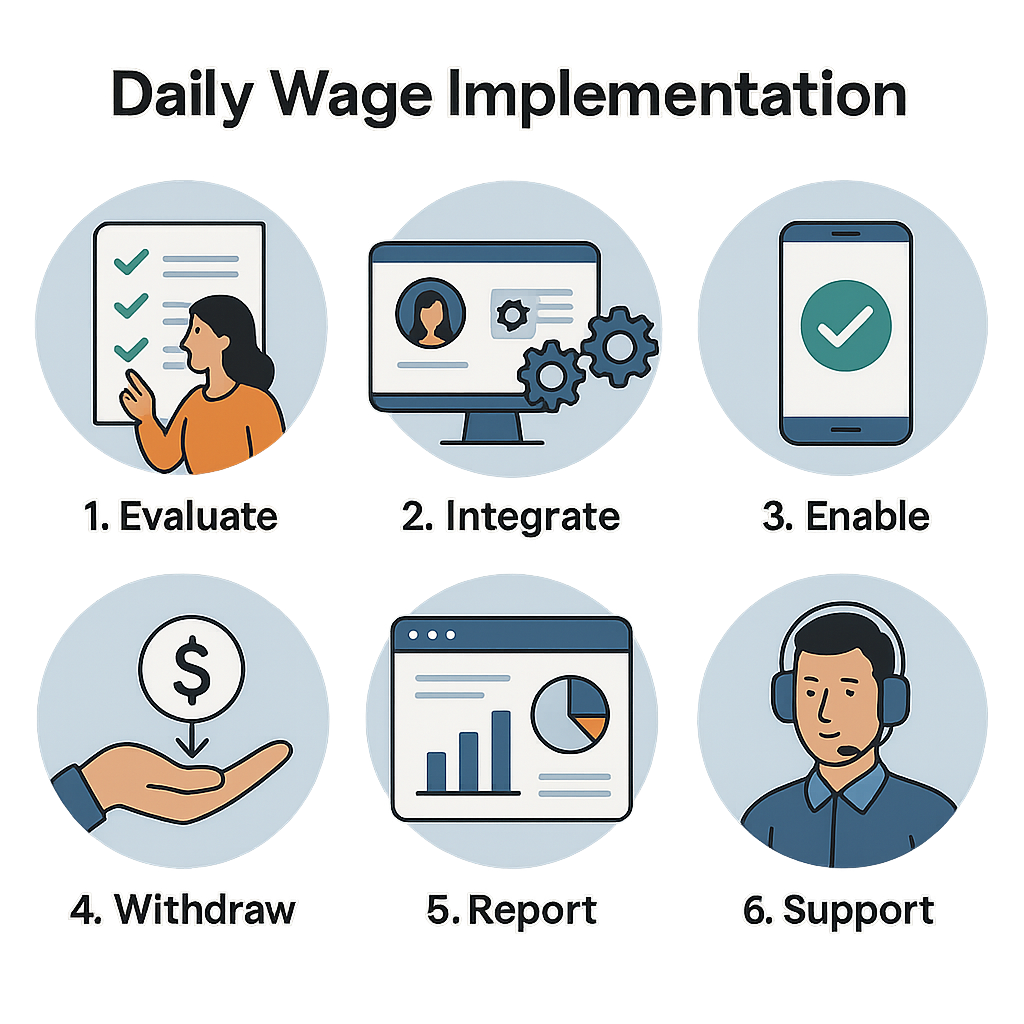
2.1. Quality of HR Data
The cleaner the names, ID numbers, employment status, customers, and timesheet codes, the faster the data matching.
2.2. Complexity of Timesheets
A stable template sheet is different from dozens of templates, unique symbols, night shifts, 12-hour shifts, or frequent changes.
2.3. Level of Integration
File/Google Sheet imports can be faster than building two-way APIs, webhooks, SSO, and automated payroll.
2.4. Decision-Making Speed
Delays in finalizing unit prices, limits, reserves, fees, funding sources, approvers, or cut-offs will stall the project even if the software is ready.
2.5. Worker Readiness
ID numbers, phones, official VPBank accounts, digital skills, and on-shift support capability directly affect the pilot date.
3. Reference Timeline of 4–8 Weeks
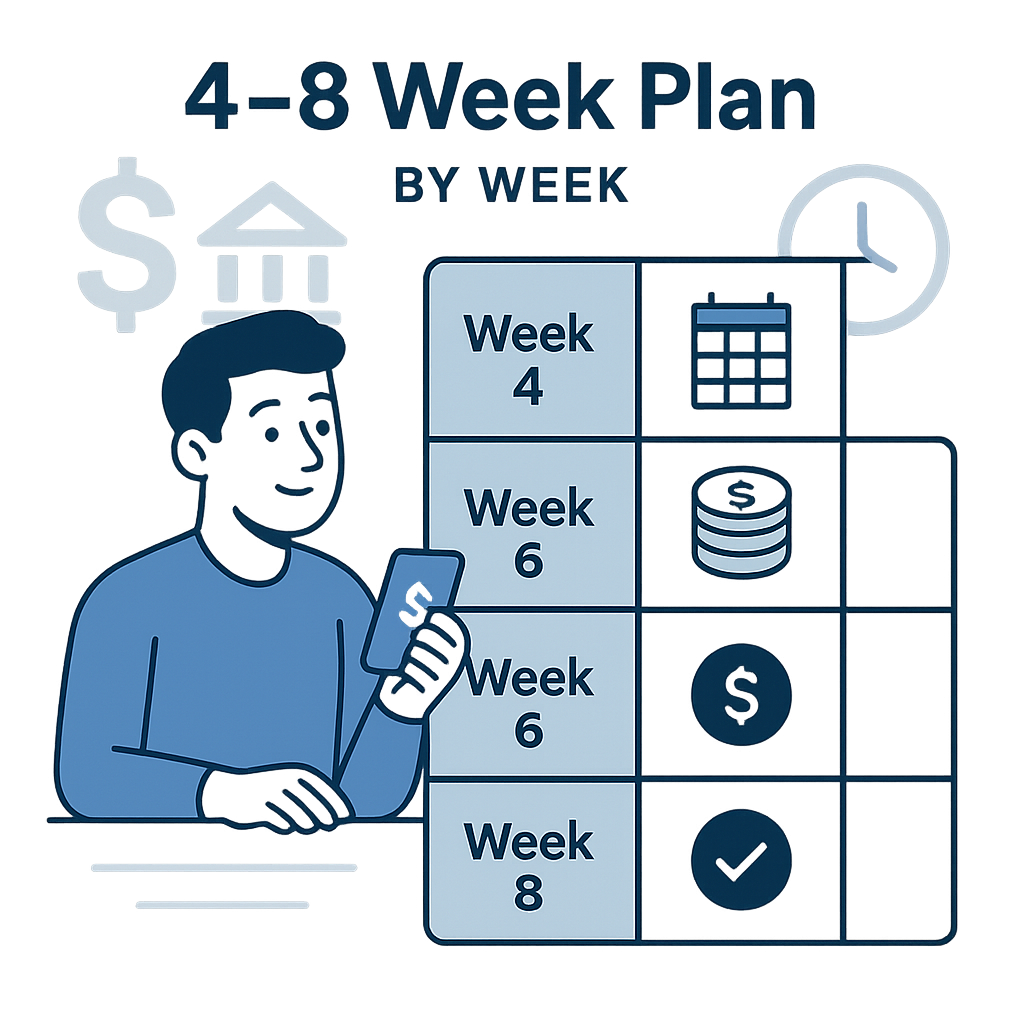
The durations below are planning frameworks, can run in parallel, and must be adjusted after the survey.
| Stage | Reference Duration | Output |
|---|---|---|
| 1. Survey and scope finalization | 3–5 days | Charter, RACI, data–money flow diagram |
| 2. Data/policy standardization | 5–10 days | Clean list, formulas, limits |
| 3. Configuration and integration | 1–3 weeks | Data sources, accounts, interface |
| 4. UAT and remediation | 1–2 weeks | Tests passed, blocking issues closed |
| 5. Controlled pilot | 1–2 short cycles | Real transactions, matched reconciliation |
| 6. Go-live/expansion | As per approval gate | Gradual scope increase |
Do not mechanically add up the time periods; many tasks can be parallel. Conversely, a data or legal error can extend the entire schedule.
4. Stage 1 — Survey and Scope Finalization
Need to Agree On
- legal entity and pilot customer;
- number of workers and locations;
- HR, timesheet, and payroll sources;
- timekeeping method;
- who approves timesheets;
- cash flow and VPBank's role;
- automation scope;
- fee, limit, and reserve policies;
- cut-off and reconciliation schedule;
- support and incident handling channels.
Mandatory Output
A one-page project charter, three-flow diagram—data, money, responsibility—and a list of open decisions.
Gate Condition
Both parties' leadership agrees on objectives, scope, ownership, and success criteria.
5. Stage 2 — Data and Policy Cleansing
HR Data
Check for duplicate ID numbers, names, timesheet codes, leave/transfer status, customers, and pay periods.
Timesheets
Create a dictionary of columns, symbols, shifts, timezones, cut-off dates, and approvers. Prepare templates for regular shifts, night shifts, missing hours, and post-approval corrections.
Policies
Finalize formulas, provisional unit prices, minimum levels, per transaction/day caps, reserves, and sufficient documentation conditions.
Default values in Earned Wage Access codes—50,000 VND/transaction, 3 million VND/transaction, 5 million VND/person/day—are only used when approved by Nhan Kiet and the customer.
Gate Condition
The rate of valid data meets the project threshold; all exceptions have an owner and completion deadline.
6. Stage 3 — Configuration and Integration
Possible Components Needed
- HR ERP synchronization;
- Google Sheet or customer timesheet system connection;
- timekeeping configuration in the app;
- customer portal
/khand permissions; - ID OCR and account matching;
- VPBank account name lookup;
- formula/limit configuration;
- disbursement flow;
- T+1 statement;
- file/API into payroll.
Control Points
Each interface must have a connection lock, schema, frequency, error record handling, resend, logging, and responsible person.
Gate Condition
Sample data runs end-to-end; no confidentiality breaches; basic monitoring and alerts are operational.
7. Stage 4 — UAT and Remediation
(Scenario set: see 60 UAT Scenarios for EWA Before Go-live.)
UAT is not just about testing successful flows. At a minimum, check:
- eligible and ineligible individuals;
- pending, approved, and corrected timesheets;
- formulas, reserves, and boundary values;
- correct/incorrect account names;
- two simultaneous requests;
- successful, rejected, and timeout bank transactions;
- pending/review transactions;
- matched and unmatched statements;
- transactions close to cut-off;
- payroll and payslips;
- resignations, device changes, and cross-permissions.
Article 96 provided a reference set of 60 UAT scenarios.
Gate Condition
No P1/P2 errors affecting money, rights, or data; remaining errors have risk assessments and approvers.
8. Stage 5 — Controlled Real-Money Pilot
(Roadmap: see 90-Day EWA Pilot Plan and Pilot Plan Template and Expansion Criteria.)
Scope Should Be Limited
- one or a few customers;
- group of workers with clean records;
- appropriate low money limits;
- clear timeframe;
- on-call HR, operations, bank, and payroll personnel;
- daily reconciliation;
- tested stop switch.
Should Not Open Immediately
- entire workforce;
- all timesheet templates;
- unlimited automatic disbursement;
- multiple policy changes at once.
Gate Condition
Timesheet–transaction–statement–payroll match; complaints handled; no blocking errors; owner accepts remaining risks.
9. Stage 6 — Go-live and Expansion by Gate
(After go-live: see EWA Operations After Go-live.)
Expand one variable at a time:
- increase users within the same customer;
- increase limits/feature scope if approved;
- add customers with similar timesheet templates;
- add complex data templates;
- enable deeper automation;
- expand reporting and payroll integration.
With Earned Wage Access, automatic disbursement is coded but the default flag is off and gradually enabled per customer. This is a controlled implementation approach, not a sign of a system “lacking features.”
10. Who Needs to Participate and How Much Time?
| Role | Main Responsibility |
|---|---|
| Sponsor | Decide scope, budget, risk |
| Project Manager | Schedule, open decisions, dependencies |
| HR/Payroll | Records, policies, pay periods |
| Supervisor/Customer | Timesheets, approvals, shifts, exceptions |
| IT | Integration, accounts, environment |
| Finance–Accounting | Funding, reconciliation, liabilities |
| Legal/Data | Contracts, notifications, data roles |
| Information Security | Permissions, security, incidents |
| Customer Service | Guidance, tickets, escalation |
| Nhan Kiet/VPBank | Product, disbursement, review |
Not everyone needs to meet every day, but each decision must have a final responsible person.
11. Factors That Help Shorten Safe Timelines
- one person with policy decision authority;
- sample data provided early;
- choose pilot customers with stable timesheets;
- use standard configuration before customization;
- run legal, data, and technical tasks in parallel;
- prepare accounts/ID numbers before onboarding;
- use existing UAT sets;
- short daily stand-ups during pilot week;
- open decision lists always have deadlines;
- reconcile on the first day instead of waiting for the end of the period.
12. Common Causes of Delays
- Constant scope changes.
- Unclear which timesheet source is the truth.
- Worker codes cannot be matched.
- Limit/reserve policies not approved.
- Unclear who provides funds or bears fees.
- Lack of official VPBank accounts.
- Timesheet approvers not trained.
- UAT only tests happy paths.
- Payroll not involved early.
- No one to handle pending transactions.
- Communication left until the last minute.
- Setting go-live date before data survey.
13. Three Reference Implementation Approaches
Approach A — Fast, Minimal Integration
One customer, one standard Sheet template, small scale, standard configuration, enhanced reconciliation. Suitable for value verification but requires an upgrade plan.
Approach B — Enterprise Standard
Integrate HRM/timesheet/payroll, full UAT, permissions, and bridge reporting. Longer time but reduces manual operations.
Approach C — Multiple Customers/Multiple Shifts
Implement in waves; build mapping for each customer; test night shifts, multiple work locations, and exceptions; enable automation by gate.
14. Go-live Readiness Checklist
- Scope and RACI approved.
- Clean pilot participant list.
- Correct timesheets and approval status.
- Correct formula/limit/reserve configuration.
- ID numbers and receiving accounts verified.
- UAT set meets blocking conditions.
- Disbursement account and limits ready.
- Runbook for pending transactions.
- Statement reconciliation tested.
- Payroll receives and bridges data.
- On-site communication executed.
- Customer service and escalation ready.
- Monitoring/alerts operational.
- Stop/rollback plan approved.
- Steering committee signs off on opening.
15. Frequently Asked Questions
Can Earned Wage Access be implemented in a week?
Some configurations can be completed within a very standard scope, but promising a real-money go-live in a week is not advisable without data survey, policy, UAT, and reconciliation.
Can businesses without an API implement it?
You can start with Google Sheets or standard files if there are connection keys, approval processes, error checks, and reconciliation. API is not the only condition.
Why must the pilot extend through payroll?
Successful fund transfers do not prove correct settlement. The pilot must verify that received amounts appear correctly on timesheets/payslips.
When should automatic disbursement be enabled?
After technical conditions, funding, UAT, permissions, monitoring, reconciliation, and customer-specific approvals are met.
Who decides the go-live date?
The sponsor/service owner decides based on proposals from business, technical, financial, legal, and information security according to RACI—not solely by the software team.
---
Author: Nguyen Minh Khang — Strategy Team Specialist, Nhan Kiet Manpower Supply Co., Ltd.
Earned Wage Access Solutions Consultation for Businesses: Hotline 0937.022.655 · Email info@nhankiet.vn · Earned Wage Access for Businesses