
How to Build a Business Case and Calculate ROI for Earned Wage Access: From Hypothesis to Pilot

How to Build a Business Case and Calculate ROI for Earned Wage Access: From Hypothesis to Pilot
A business case for Earned Wage Access should not start with a market-derived turnover reduction rate. Businesses need to identify the problem they want to solve, what the current baseline costs are, how Earned Wage Access can impact through which mechanisms, and how the pilot will measure changes. ROI is only meaningful when benefits are cautiously converted and not double-counted.
> In short: Calculate three layers: total cost of ownership for Earned Wage Access, convertible financial benefits, and non-financial value. Then create three scenarios: cautious, base, and optimistic, run a pilot with a baseline or comparison group, and replace assumptions with actual data before deciding to scale.
> Note: Nguyen Minh Khang — Strategy Team Specialist, Nhan Kiet, or specific clients.
1. What Should an Earned Wage Access Business Case Answer?
A business case that can be presented to the board needs to answer seven questions:
- What is the specific business problem?
- What is the current scale and cost of the problem?
- Why can Earned Wage Access impact that problem?
- What does the business need to invest in and operate?
- What benefits can be converted into money, and which should only be monitored?
- What risks and assumptions could skew the results?
- How will the pilot provide sufficient evidence to decide on scaling?
If the document only states “Earned Wage Access is a trend” or “employees like it,” it is a proposal idea, not a business case.
2. Start from the Problem, Not the Product
Businesses should choose a maximum of two main issues for the pilot:
| Issue | Baseline Metric Needed | Earned Wage Access Impact Mechanism |
|---|---|---|
| Early turnover | 30/60/90-day turnover rate | Reduces mid-cycle cash pressure |
| Unexpected absenteeism | Missed shifts, hours short, replacement costs | Employees have funds for commuting/living expenses |
| Recruitment difficulty | Cost-per-hire, days to fill | Differentiated benefits in recruitment information |
| Manual advance requests | Number of requests, processing hours, errors | Automates conditions and disbursements |
| Lack of payroll transparency | Payroll/timesheet tickets, processing time | Displays approved hours and history |
| Low engagement | eNPS/surveys, activation rate | Increases control over earned money |
Earned Wage Access does not directly fix salary levels, work environment, management quality, or payroll errors. If the root cause lies in those factors, do not attribute all expected improvements to Earned Wage Access.
3. Map the Impact Chain Before Attaching Numbers
A reasonable chain might look like:
Faster approved hours → employees see available amounts more clearly → access part of wages when needed → reduce some cash pressure → may reduce absenteeism/early turnover → business can reduce replacement hiring or shift costs.
Each arrow is a hypothesis that needs measurement. If hours are not approved on time, the program does not create available amounts; in that case, you cannot conclude “Earned Wage Access is ineffective” without distinguishing implementation errors from product effectiveness.
4. Calculate the Total Cost of Ownership for Earned Wage Access
4.1. One-time Costs
- survey and process design;
- HRM/timekeeping/payroll integration;
- cleaning ID and timekeeping codes;
- customer, shift, limit, reserve configuration;
- testing, security, and legal;
- training HR, supervisors, payroll, and employees;
- communication and guidance documentation.
4.2. Recurring Costs
- platform or transaction fees if applicable;
- operational, support, and reconciliation personnel;
- integration maintenance and monitoring;
- banking costs;
- capital or opportunity costs;
- security, backup, and periodic testing;
- communication for new employees.
4.3. Expected Risk Costs
Can be estimated:
Expected Risk Cost = Event Probability × Damage When Occurred
Hypothetical example: if 0.1% of transactions are expected to have discrepancies needing resolution, 20,000 transactions/year, average cost 150,000 VND/case, then the expected handling cost is 3 million VND/year. The figure should be based on the pilot, not guessed for the final decision.
5. Benefit Groups Convertible to Money
(See also: How Earned Wage Access Reduces Manual Advance Requests.)
5.1. Reduce Manual Advance Processing Costs
Benefit = Reduced Manual Requests × Time Saved/Request × Personnel Cost/Hour
Hypothetical example: 1,000 requests/year, reduced by 700 requests, each request takes 20 minutes, full personnel cost 120,000 VND/hour:
700 × 20/60 × 120,000 = 28,000,000 VND/year.
Only count time truly freed up or shifted to valuable work; do not automatically consider every saved minute as cash recovered.
5.2. Reduce Replacement Hiring Costs Due to Turnover
Benefit = Avoided Turnover Instances × Average Replacement Cost
Replacement costs may include advertising, selection, training, uniforms, health checks, HR/supervisor time, and productivity shortfall. Do not use an international replacement cost percentage if the business can calculate from internal data.
5.3. Reduce Shift and Absenteeism Costs
Benefit = Reduced Missing Shifts × Additional Cost per Shift
Additional costs may include overtime, redeployment, transportation, coordination time, or service penalties. Exclude parts already counted in turnover benefits to avoid double-counting.
5.4. Reduce Errors and Reconciliation Time
Measure payroll/accounting hours spent finding discrepancies, adjustment tickets, and complaint handling costs. Only count benefits if the new process truly reduces these activities.
5.5. Value from Recruitment
If Earned Wage Access helps increase job acceptance rates or shorten time to fill, businesses can calculate value from reduced days without staff. However, need reliable A/B recruitment campaigns or comparisons; do not attribute all changes to Earned Wage Access when simultaneously increasing salaries or changing recruitment sources.
6. Benefits That Should Not Be Forced into Money Immediately
- perceived empowerment;
- transparency of approved hours;
- employee experience;
- employer brand reputation;
- financial literacy;
- reduced self-reporting stress;
- better timekeeping data quality.
These metrics are still important but should be presented on a strategic scorecard rather than assigned a baseless monetary value.
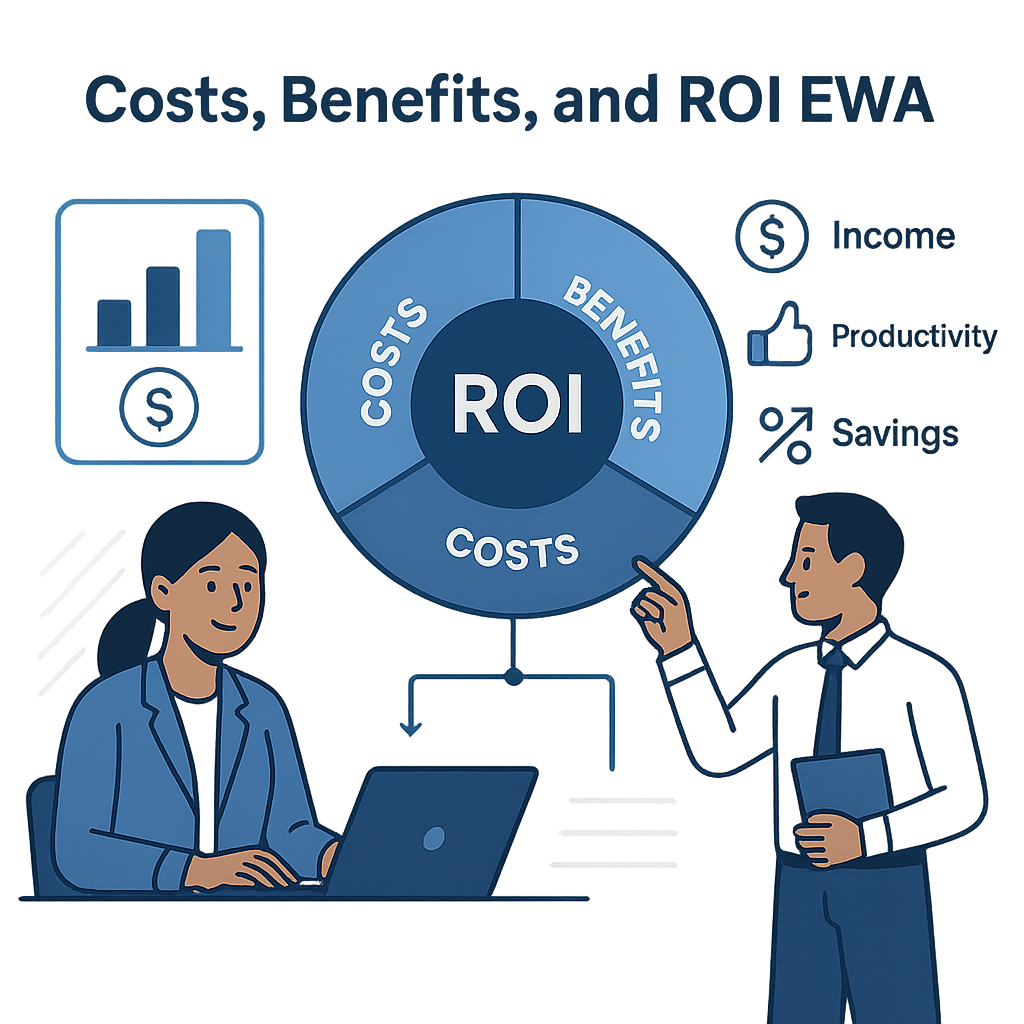
7. ROI Formula and Payback Period
ROI
ROI (%) = (Total Financial Benefits − Total Costs) / Total Costs × 100%
Net Benefit
Net Benefit = Total Financial Benefits − Total Costs
Payback Period
Payback Period = Initial Investment Cost / Average Monthly Net Benefit
If benefits vary significantly seasonally, use monthly cash flow instead of averaging.
8. Hypothetical Business Case Example
A business with 2,000 employees builds a one-year scenario:
Hypothetical Costs
| Item | Value |
|---|---|
| Setup and Integration | 180 million VND |
| Training and Communication | 40 million VND |
| Operations/Platform | 240 million VND |
| Support, Reconciliation, Control | 80 million VND |
| Risk Reserve | 20 million VND |
| Total Costs | 560 million VND |
Hypothetical Benefits
| Item | Value |
|---|---|
| Reduce Manual Advance Processing | 80 million VND |
| Reduce Replacement Hiring | 300 million VND |
| Reduce Shift/Absenteeism | 180 million VND |
| Reduce Reconciliation Time | 70 million VND |
| Total Benefits | 630 million VND |
Thus:
Net Benefit = 630 − 560 = 70 million VND
ROI = 70 / 560 × 100% = 12.5%
This is just an example of the formula. If “reduce replacement hiring” and “reduce shift” both stem from one non-missing shift, review to avoid counting the same benefit twice.
9. Build Three Scenarios Instead of One Attractive Number
| Variable | Cautious | Base | Optimistic |
|---|---|---|---|
| Activation Rate | 25% | 45% | 65% |
| On-time Approved Hours | 70% | 85% | 95% |
| Avoided Turnover | Low | Medium | High |
| Integration Cost | High | Estimated | Low |
| Support Tickets | High | Medium | Low |
The business case should be accepted when the cautious scenario is still within the enterprise's risk tolerance, not just because the optimistic scenario is attractive.
10. Design a Pilot to Measure Real Impact
(Roadmap & KPI: see 90-Day Earned Wage Access Pilot Plan and Measuring Earned Wage Access Effectiveness with KPIs.)
10.1. Choose the Scope
- one or two relatively stable clients/factories;
- a group large enough to signal but small enough to control;
- at least one payroll cycle running in parallel;
- do not simultaneously change too many major policies.
10.2. Create a Baseline
Collect at least 8–12 weeks before the pilot for metrics with volatility. If there is a strong seasonal effect, compare with the same period last year or use a similar group.
10.3. Choose a Comparison Group
If feasible, choose a group not yet opened to Earned Wage Access but similar in location, shift, salary, tenure, and management. Do not compare a stable factory with a newly opened site and then conclude from the difference.
10.4. Define Success and Stop Thresholds
For example:
- at least 90% of eligible hours approved on time;
- reconciliation discrepancies below approved thresholds;
- no duplicate disbursements;
- severe tickets resolved within pilot SLA;
- usage and feedback meet thresholds;
- one or two business metrics show improvement trends.
Official thresholds must be agreed upon by the business and Nhan Kiet, not directly taken from this example.
11. What Should a Pilot Dashboard Include?

(Sample report: see Earned Wage Access Pilot Results: KPIs and Lessons.)
| Group | Metric |
|---|---|
| Access | Eligible, activated, verified with VPBank |
| Operations | On-time approved hours, time from hours to availability |
| Usage | Users, disbursements, median value, frequency |
| Money | Success, failure, pending, reconciliation time |
| Payroll | Total disbursed, total deducted, discrepancies |
| Support | Tickets/1,000 people, causes, resolution time |
| HR | Absenteeism, early turnover, job acceptance, retention |
| Experience | Correct product understanding, satisfaction, complaints |
Separate leading indicators and outcome indicators. For example, on-time approved hours is a leading condition; reduced turnover is an outcome that may appear later.
12. Mistakes That Inflate ROI
Using Market Data Instead of Business Data
Benchmarks are only suitable for forming hypotheses, not achieved numbers.
Double-counting Benefits
An avoided turnover instance should not count the entire replacement cost, entire productivity, and entire shift cost if overlapping.
Ignoring Internal Costs
HR, IT, legal, payroll, and supervision hours are real resources, even if there is no supplier invoice.
Attributing All Changes to Earned Wage Access
If simultaneously increasing salaries, changing management, or recruitment bonuses, need a method to separate impacts.
Only Measuring Users
Employees who actively use Earned Wage Access may differ from those who do not. Need analysis by eligibility, invitation, activation, and usage.
Not Accounting for Capital Costs and Risks
Who provides capital, recovery time, unrecovered amounts, and opportunity costs must be included in the model when the official policy is clear.
13. What Data Does an Earned Wage Access Business Case Need?
From the system, data fields can be formed such as:
- number of employees with approved hours;
- available value by day;
- request counts and amounts;
- transaction status;
- reconciliation time;
- amounts received per cycle;
- discrepancies and unrecovered amounts;
- source of hours and approvers.
Nhan Kiet needs to connect additional business/HR data:
- hire–termination dates;
- absenteeism and shift changes;
- recruitment costs;
- manual advance processing hours;
- HR/payroll tickets;
- capital and operational costs;
- employee surveys;
- customer/industry/shift groups.
Only when these two data layers are connected by appropriate identifiers and time periods can reliable ROI analysis be conducted.
14. Who Owns Each Line in the Business Case?
| Section | Lead | Collaborate |
|---|---|---|
| Problem and Objectives | HR/Operations | Board of Directors |
| Recruitment/Turnover Costs | HR | Finance |
| Capital and Operational Costs | Finance | Nhan Kiet |
| Hours/Transaction Data | Product Operations | IT/Payroll |
| Measurement Method | BI/Finance | HR |
| Legal/Data Risks | Legal/DPO | IT |
| Scaling Decision | Executive Sponsor | Project Board |
Solution vendors can support the model, but businesses must own assumptions and approve input data.
15. One-page Summary Template for the Board
- Problem: one sentence and three baseline metrics.
- Target Audience: who, where, how many people.
- Solution: flow from approved hours to payroll deduction.
- Costs: one-time, recurring, capital, and risks.
- Benefits: financial and non-financial, no double-counting.
- Three Scenarios: cautious, base, optimistic.
- Pilot: scope, time, metrics, stop thresholds.
- Risks: legal, data, money, operations.
- Decision Needed: budget, sponsor, scope, and scaling conditions.
16. Frequently Asked Questions
Does Earned Wage Access Guarantee a Positive ROI?
No. Results depend on baseline issues, usage rates, approval speed, costs, operational design, and actual impact at the business.
How Soon Can ROI Be Measured?
Operational metrics can be seen in a few weeks; retention or recruitment takes longer. Set evaluation times by metric group rather than waiting for a single number.
Can International Data Be Used in the Proposal?
It can be used as a benchmark with a source, but must be labeled as a reference. Scaling decisions should be based on pilot data and internal costs.
Should We Stop If Financial ROI Is Low?
Not necessarily. Businesses may view Earned Wage Access as a strategic benefit or data infrastructure. However, clearly state objectives and budget, not turning non-financial benefits into baseless numbers.
Does Earned Wage Access Have Actual ROI Data Yet?
Current system information does not provide confirmed business data on reduced turnover, absenteeism, or recruitment savings. Nhan Kiet needs to extract and verify before publishing.
17. Conclusion
A reliable Earned Wage Access business case does not promise results before measurement. It turns a benefit idea into a chain of hypotheses with costs, evidence, and decision thresholds. Businesses should start with real issues, use their baseline data, calculate total costs, avoid double-counting benefits, and design a pilot good enough to answer: Where does Earned Wage Access create value, for whom, under what conditions, and at what cost?
---
Author: Nguyen Minh Khang — Strategy Team Specialist, Nhan Kiet Manpower Supply Co., Ltd.
Earned Wage Access Solution Consultation for Businesses: Hotline 0937.022.655 · Email info@nhankiet.vn · Earned Wage Access for Businesses