
Map of Earned Wage Access Models in Vietnam

Map of Earned Wage Access Models in Vietnam: How Should Businesses Classify and Compare?
The Vietnamese market uses various terms such as Earned Wage Access (EWA), flexible wage access, flexible salary payment, advance on earned wages, and salary advance. Similar names do not necessarily mean similar architectures. To make accurate comparisons, businesses must consider public data sources, methods of determining earned wages, funding sources, costs, approval rights, and end-of-period reconciliation.
> In short: Do not choose EWA solely based on the question "Is the money fast?" Verify through six layers: right person → right confirmed work → right available amount → right account → right transaction → right payroll period.
> Warning: This article is a map of business classification, not a ranking of providers or legal opinion. How an entity describes its product does not determine its legal nature. All conclusions must be based on contracts, cash flows, fees, rights, and actual processes.
1. How Should EWA Be Understood?
Operationally, EWA allows employees to access a portion of income that has arisen from work already performed before the regular payday. The three core elements are:
- available amount linked to accrued labor data;
- employees proactively request within policy limits;
- transactions are offset or settled in the correct payroll period.
If the amount is not based on work done, if independent credit obligations arise, or if the payable exists outside the wage relationship, businesses need separate assessments rather than automatically calling it EWA.
2. Why Can't We Map Just by Application Name?
An application may only be an interface layer, while labor data comes from the company's HRM, money comes from a financial partner, and payroll is handled by another party. Conversely, a system may manage nearly the entire chain from timekeeping to payroll reconciliation.
Therefore, "Provider A has EWA" is not enough for comparison. Questions to answer include:
- who confirms the employee is working;
- what source proves the work done;
- who approves or locks labor data;
- what formula generates the available amount;
- whose account the money is disbursed from;
- what fees employees or businesses pay;
- how failed, pending, or duplicate transactions are handled;
- who reconciles with the payroll at the end of the period.
3. Six Common Models When Businesses Survey EWA
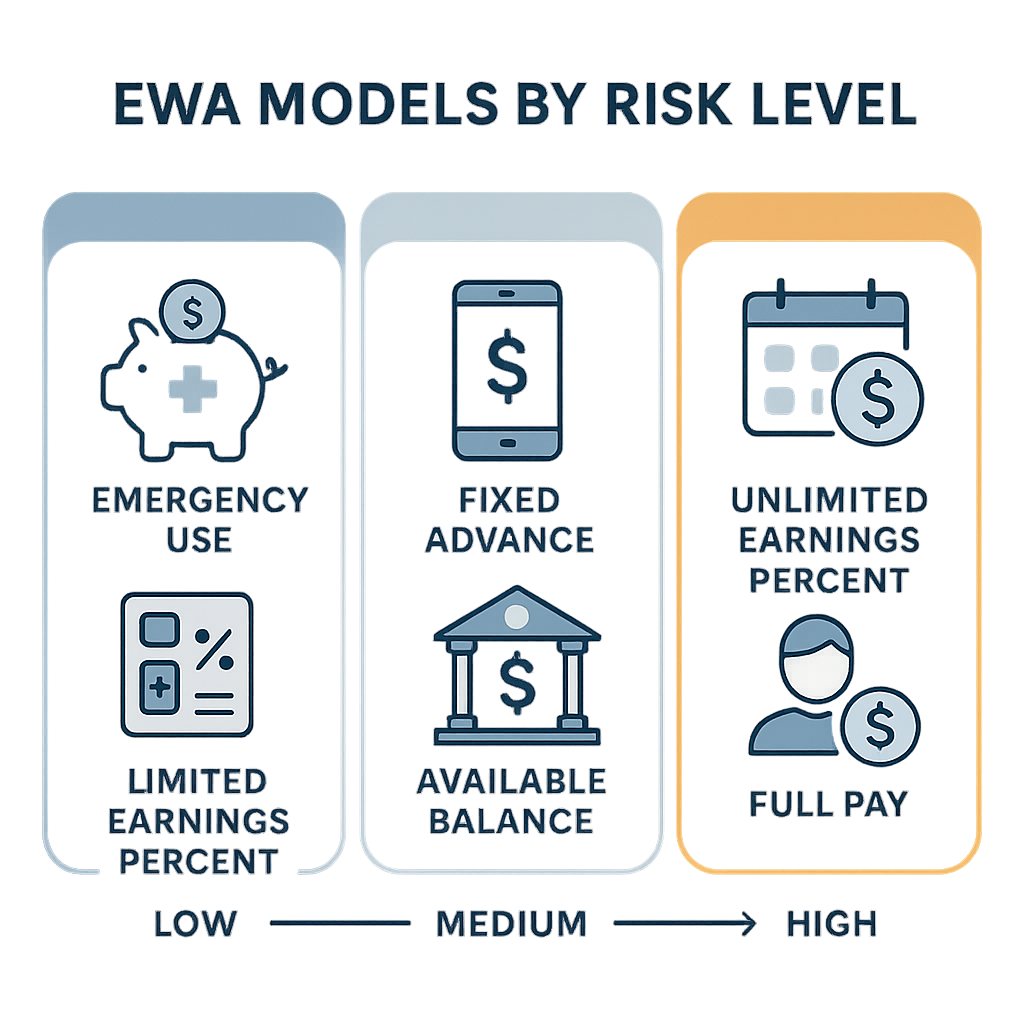
(Comparison with advances: see How Traditional Salary Advances and EWA Differ.)
This classification is based on architecture, not asserting that the market only has six types.
Model 1 — Traditional Salary Advance Managed by the Company
Employees submit requests; management, HR, or accounting checks; the company disburses and recovers in the payroll period.
Suitable when: small scale, low demand, and policies with many exceptions needing manual approval.
Points to note: processing time, approval rights, documentation, payroll pressure, and risk of inconsistent decisions.
This may be an internal advance regime, not necessarily a digitized EWA system.
Model 2 — EWA Integrated with HRM or Payroll
The provider receives personnel, labor, or income data from the company's system. The available amount is automatically calculated and transactions are sent back to payroll for settlement.
Advantages: reduces procedures and can be deployed on various timekeeping systems.
Key questions: how often data is updated, who is responsible when labor data is corrected, and mechanisms to prevent reusing the same income portion.
Model 3 — Closed-loop EWA from Timekeeping to Payroll
Timekeeping, labor approval, available amount calculation, money request, disbursement, reconciliation, and payroll slip are in a traceable chain.
Advantages: reduces data breakpoints, facilitates investigation of discrepancies from results to source.
Challenges: broader data processing scope, requires authorization, security, business continuity, and tighter audits.
Nhan Kiet's Earned Wage Access follows this architecture within the system: labor sources can come from apps, customer labor tables, or ERP; only approved labor generates available amounts; successful transactions are included in reconciliation and payroll periods.
Model 4 — EWA Funded by a Third Party
The provider or financial partner advances the money; the company fulfills settlement obligations as agreed.
Potential advantages: the company does not have to organize every daily disbursement directly.
Clarifications needed: funding entity, recourse rights, fees, cases of employee resignation, reduced labor, and unrecoverable transactions. Legal nature cannot be inferred solely from "0% interest".
Model 5 — EWA Bank Partnership
EWA provider, company, and bank collaborate to determine access rights and execute payments. Some platforms describe their solution as a partnership with businesses and banks to allow employees to access earned wages before payday.
Points to evaluate: whether the bank acts as a payment or funding entity; money transfer time; account conditions; fees; reconciliation; responsibility when transaction status is unclear.
Model 6 — Financial Wellness Platform with EWA as a Component
EWA is placed alongside financial education, benefits, internal communication, or other services. Some platforms describe themselves as "flexible salary payment" solutions, connecting with businesses, updating labor/income, and providing financial content; others describe EWA as access to earned wages, placed within an employee benefits package.
Points to note: clearly separate EWA functions from other products, what data types are shared with whom, whether employees truly volunteer, and the cost of each component.
4. Quick Comparison Matrix
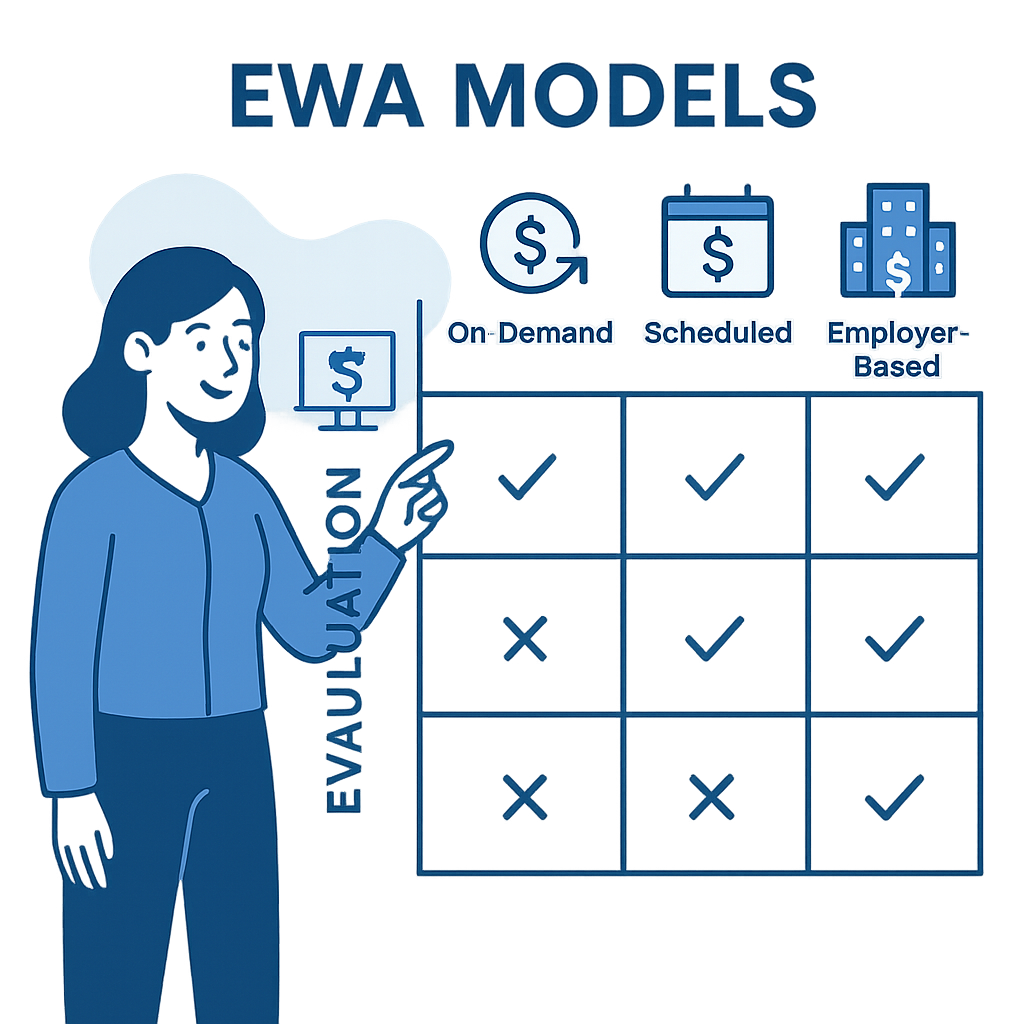
| Criteria | Traditional Advance | HRM/Payroll Integration | Closed-loop Chain | Third-party Funding | Bank Partnership | Wellness Platform |
|---|---|---|---|---|---|---|
| Labor Data | Manual check | From company system | In chain or multi-source | From company | From company/partner | Configurable |
| Speed | By approval | Can be automatic | Can be near real-time | Depends on integration | Depends on bank | Depends on EWA component |
| Funding Source | Company | Contract-dependent | Design-dependent | Provider/partner | Needs verification | Needs verification |
| Payroll Reconciliation | Internal | Through integration | In traceable chain | Multi-party exchange | Multi-party | Provider-dependent |
| Main Risk | Slow/wrong approval | Data mismatch | Large system scope | Funding/recourse | Inter-party status | Mixed purpose/data |
The matrix is just a starting point. A provider may combine multiple models.
5. 12 Axes Businesses Must Use for Assessment
(Criteria set: see Checklist for Choosing an EWA Provider and How Businesses Evaluate EWA Providers.)
5.1. Employment Relationship
Who confirms the employee is active, has left, transferred, or works in multiple places? Is data updated by event or schedule?
5.2. Labor Data Source
Is the source of truth the timekeeping machine, app, Google Sheet, HRM, or payroll? If two sources differ, which one prevails?
5.3. Permissible Labor Status
Does the system use newly recorded labor, finalized labor, or approved labor? Does it block current and future days?
5.4. Available Amount Formula
The formula must reflect unit price, amount received, reserve, limits, and rounding. HR should be able to recalculate a sample using original data.
5.5. Limits and Responsible Use
Check minimum levels, per order cap, daily/period cap, accessible ratio, and retained portion for settlement.
5.6. Funding Source
Is the money from the company, provider, or financial partner? Who bears the risk when labor is reduced or employees leave?
5.7. Costs
Who pays the fees: employee, company, or another party? Are fees transaction-based, subscription, percentage, or package? Are optional services available?
5.8. Identification and Receiving Account
Is the account in the employee's name? Are there name checks, eKYC, device/account change controls?
5.9. Transaction Safety
Are there stable transaction codes, duplicate prevention locks, response verification, and fail-closed mechanisms when status is unclear?
5.10. Reconciliation
Is there system-bank-payroll reconciliation? Who handles pending amounts and what is the timeframe?
5.11. Data and Security
Who decides the purpose, who processes, where data is stored, for how long, and which third parties have access?
5.12. Legal and Contractual
Contracts must accurately describe the service, cash flow, fees, responsibilities, data, complaints, incidents, termination, and balance handling. Businesses must seek legal advice for specific models.
6. Where Does Earned Wage Access Fit on This Map?
(See also: How Earned Wage Access Differs from Independent Salary Advance Apps and Who Provides Funding for Earned Wage Access?.)
According to Nhan Kiet's system documentation, Earned Wage Access is designed around the chain:
eligible employee → approved labor → available amount → request → bank disbursement → reconciliation → payroll
Technical verification points include:
- three labor source groups: app, customer labor table, and ERP;
- customers or supervisors have approval rights; modifying approved labor returns it to pending and logs it;
- formula uses approved labor minus received amount and reserve;
- server rechecks conditions before each transaction;
- VPBank account of the employee is name-checked and locked after standard authentication;
- unclear status is held pending rather than assumed failed;
- pending amounts are traced and reconciled with T+1 statements;
- used workdays are marked to prevent rollover to the next period.
Points not yet used as market statements unless approved by Nhan Kiet include: commercial funding source, long-term fee policy, official legal conclusions, transaction scale, impact on turnover rate, and position compared to other solutions.
7. 20 Questions to Ask Providers Before a Demo
- What is the system's definition of "earned wages"?
- What labor source is used and update frequency?
- Does unapproved labor generate available amounts?
- What happens if labor is corrected after the employee has received money?
- What is the formula and rounding rules?
- Is there a reserve or retention rate?
- Who configures and approves limits?
- From which legal entity's account is the money disbursed?
- Are there any financial partners involved?
- What fees do employees and companies pay?
- To which account does the money go and how is ownership verified?
- How is duplicate transaction prevention handled?
- What does the system do when the bank times out?
- What is the reconciliation cycle for statements and payroll?
- Who bears unrecoverable amounts?
- How is support provided for employees who leave or work in multiple places?
- What data is collected, how long is it stored, and who is it shared with?
- What are the SLA, RTO, RPO, and incident procedures?
- Can companies export data/audit logs?
- How are data and balances handled when terminating the service?
8. Six Signs to Pause for Further Assessment
- only mentions "no interest" but does not disclose full fees;
- cannot explain the source of available amounts;
- future labor or unconfirmed income is still used;
- unclear bank status but system allows immediate resend;
- no report bridging transactions with payroll;
- uses "EWA" as a substitute for legal and contractual analysis.
9. Which Model Should Businesses Choose?
There is no one-size-fits-all model for every business. The choice depends on scale, labor data quality, payroll capability, cash flow, industry, location dispersion, and risk appetite.
- Small businesses with low demand may optimize the advance process first.
- Businesses with stable HRM/payroll may prioritize integration.
- Companies with many frontline workers, multiple work sites, or varied labor tables should evaluate deeper traceable chains.
- Businesses not wanting to organize cash flow themselves need thorough assessment of funding models and multi-party responsibilities.
Run a pilot with a small scope, recalculate sample transactions, simulate exceptions, and only expand after the three ledgers labor – bank – payroll match.
10. Frequently Asked Questions
Are EWA and salary advance completely the same?
They should not be assumed to be the same. "Salary advance" is a broad term; EWA often emphasizes the portion of income that has arisen and the ability to trace from labor data to settlement. The specific nature depends on processes, contracts, and applicable law.
Is EWA a loan?
It cannot be concluded for all products just from the EWA label. It is necessary to see if the amount is based on work done, if there is an independent repayment obligation, any fees/interest, who funds it, and recourse rights.
Does "0% interest" mean free?
No. There may be transaction fees, subscription fees, optional service fees, or costs borne by the company. A full fee schedule must be requested.
Is timekeeping integration necessary?
If the system wants to calculate available amounts based on work done, it needs a reliable data source. Integration can be via API, file, Sheet, payroll, or timekeeping within the same system.
Should providers be compared by money transfer speed?
Speed is important but not sufficient. A fast transaction with wrong labor, wrong person, or unreconciled will create greater risk than benefit.
Market Reference Sources
- CFPB: Data Spotlight on the Paycheck Advance Market — Consumer Financial Protection Bureau.
- Federal Reserve Bank of Kansas City: As Earned Wage Access Grows, Oversight Tries to Catch Up.
The article describes models by general type, does not mention specific brands, and does not independently verify the effectiveness, market share, or legal nature of any provider.
---
Author: Nguyen Minh Khang — Strategy Team Specialist, Nhan Kiet Manpower Supply Co., Ltd.
Earned Wage Access Solution Consultation for Businesses: Hotline 0937.022.655 · Email info@nhankiet.vn · Earned Wage Access for Businesses