
How Many People Does a Business Need to Operate Earned Wage Access?

How Many People Does a Business Need to Operate Earned Wage Access? Staffing Model and RACI
Implementing Earned Wage Access doesn't necessarily require setting up a new department. Most roles can be handled by existing HR, payroll, finance, IT, and customer service teams. However, businesses still need someone responsible for end-to-end processes and capable of managing sensitive points: attendance approval, bank transactions, reconciliation, and complaint handling.
> In short: Don't ask first "how many people are needed"; measure the number of employees, customers, attendance templates, transactions, exceptions, support shifts, and automation level. A small pilot can be run by a cross-functional team; larger scales require dedicated roles and rotating shifts.
> Warning: Ngô Nhã Kỳ — Biên tập viên ban biên tập, not staffing recommendations by Nhan Kiet. Actual workload must be measured in a pilot before deciding on staffing or committing to 24/7 support.
1. Why User Numbers Alone Aren't Enough for Staffing?
Two businesses with 5,000 employees each may require very different resources:
Business A has a standard attendance system, one payroll cycle, few exceptions;
Business B has 20 customers, multiple Sheets, night shifts, employees working in various locations, and decentralized attendance approval.
Operational workload mainly comes from exceptions, not just successful transactions.
2. Ten Variables Determining Resource Needs
Number of eligible employees.
Number of active users and transactions per day.
Number of customers/locations/shifts.
Number of attendance templates.
Rate of unmatched/unapproved attendance.
Rate of unverified ID/account.
Rate of pending/failed transactions.
Payroll cycle and complexity.
Support request hours.
Automation level, SLA, and acceptable risk.
3. 11 Core Roles
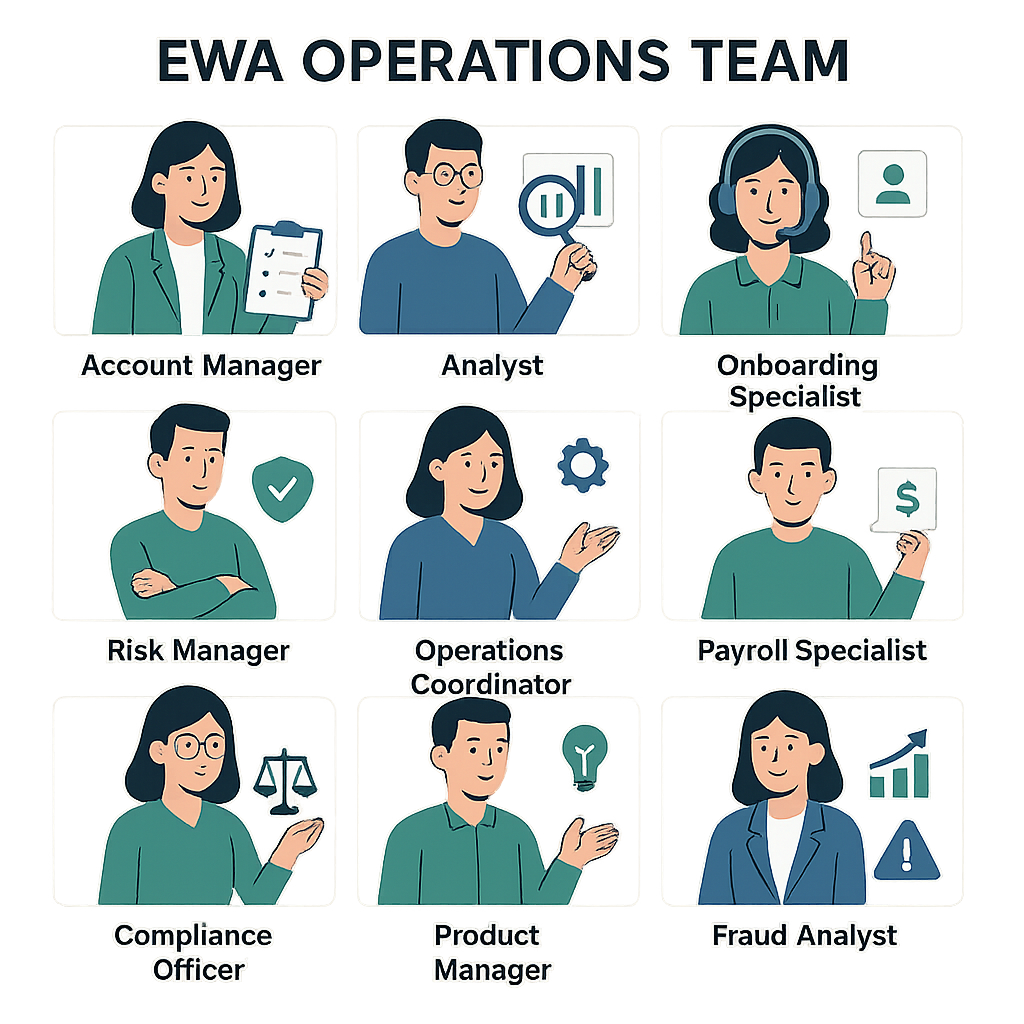
(See also: Operating EWA Post Go-Live: RACI, Controls, and Incident Management.)
1. Executive Sponsor
Approves objectives, budget, scope, risk appetite, and decisions to expand or halt.
2. Service Owner
Responsible for end-to-end service quality, not just one system. This role should not be left vacant.
3. Product/Process Owner
Manages requirements, formulas, limits, processes, and prioritizes improvements.
4. HR Master Data
Manages records, ID verification, employment status, transfers, terminations, and customer relations.
5. Attendance Operations
Manages attendance sources, mapping, shifts, synchronization errors, and approver coordination.
6. Payment Operations
Monitors payment orders, dedicated accounts, pending transactions, reconciliation, and emergency stops.
7. Reconciliation/Finance
Reconciles EWA ledger–statements–debts; handles discrepancies and unrecoverable amounts.
8. Payroll
Ensures correct transactions for the right person/cycle, prepares bridging reports and payslips.
9. Customer Support
Provides single-point-of-contact, verification, classification, updates, and ticket closure.
10. Engineering/SRE/IT Security
Integration, monitoring, release, incident management, security, backup, and recovery.
11. Legal/Data/Compliance
Contracts, regulations, personal data, communication content, and legal changes.
One person can handle multiple roles in a pilot; however, conflicting rights must be separated.
4. Model A — Small Pilot
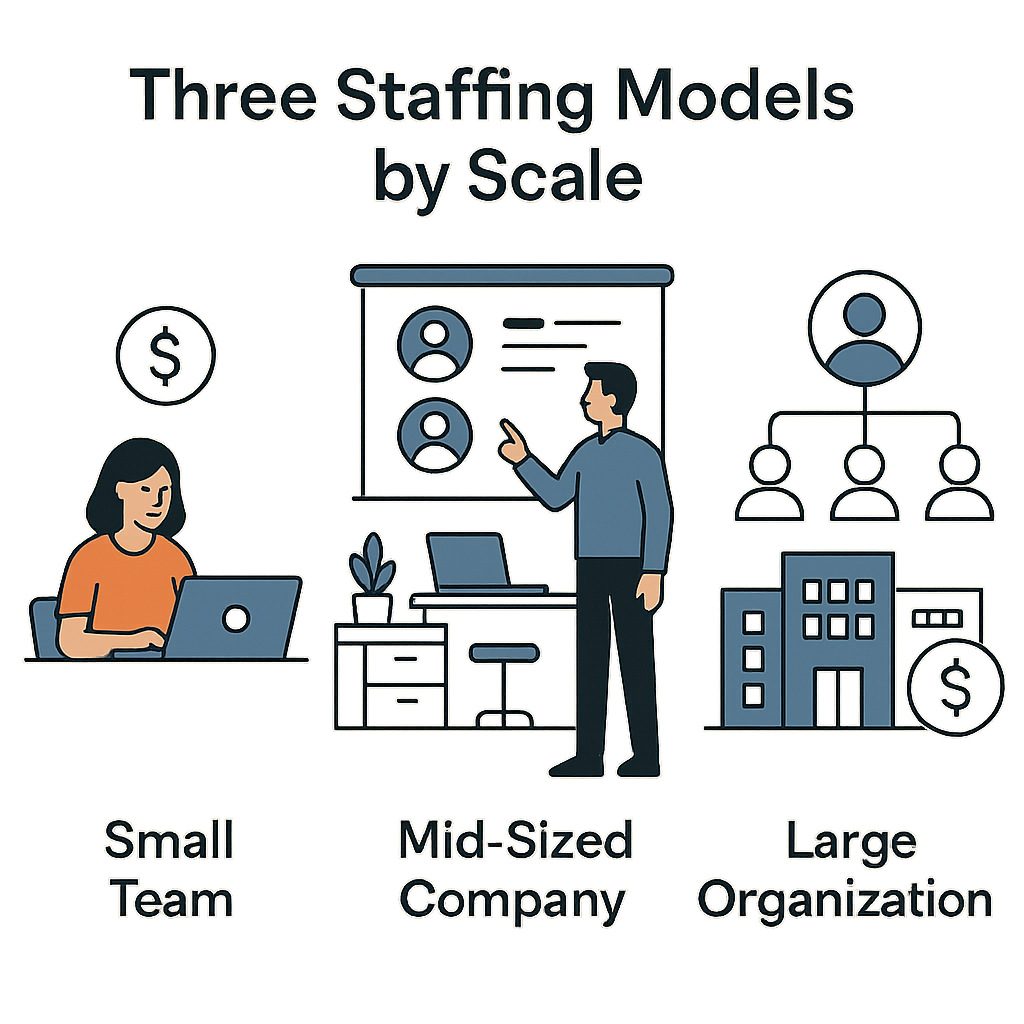
Illustrative Scope
100–1,000 eligible employees;
one–two customers;
few attendance templates;
support during defined hours;
low transaction/money limits;
daily reconciliation.
Reference Core Team
Role | Participation Level |
|---|---|
Service/Project Owner | 0.3–0.5 FTE |
HR + Attendance | 0.5–1 FTE |
Payment + Reconciliation | 0.5–1 FTE |
Payroll | 0.2–0.5 FTE |
Customer Service | 0.5–1 FTE |
Engineering/IT Security | On-call/cross-functional |
Legal/Data | As per approval milestones |
The actual number of people may be 5–8 cross-functional, not 5–8 full-time FTEs.
5. Model B — Medium Scale Operations
Illustrative Scope
1,000–10,000 people;
multiple locations/customers;
stable daily transactions;
some attendance templates;
expanded SLA and support shifts.
Reference Structure
one dedicated Service Owner;
one Product/Process Owner;
1–3 HR/attendance personnel;
1–2 payment/reconciliation personnel;
1–2 customer service personnel per shift;
payroll per cycle, with backup personnel;
engineering/SRE on-call;
IT security, legal, and data per review schedule.
Staffing must adjust according to exception rates and actual workload.
6. Model C — Large Scale, Multiple Customers
Characteristics
tens of thousands of employees;
hundreds of customers/locations;
multiple sources and attendance templates;
out-of-hours support;
large transactions and cash flow;
high control/separation of duties requirements.
Should Organize by Pods
Service Governance: owner, KPI, risk, vendor.
Workforce Data: records, attendance, mapping, approval.
Money Operations: funds, payment orders, reconciliation.
Reconciliation & Payroll: statements, debts, payroll.
Worker Experience: onboarding, customer service, personal finance.
Technology & Trust: engineering, SRE, IT security, data.
Each pod has a team leader and backup schedule; Pod 1 has an Incident Commander independent of change initiators.
7. Workload-Based Staffing Formula
Can estimate:
FTE = total minutes of task processing in cycle ÷ useful working minutes per FTE
Example for Customer Support:
Tickets/day × average minutes/ticket × post-check factor ÷ useful minutes/shift
Example for Reconciliation:
Exceptions/day × minutes/exception + total check time + reporting
Do not use 480 minutes/day as absolute productive capacity; subtract meetings, training, breaks, and load fluctuations.
8. Data to Collect in Pilot for Staffing
(See also: Earned Wage Access Pilot Results: KPI and Lessons and 90-Day EWA Pilot Plan.)
number of new/modified/terminated records;
number of attendance lines and error rates;
pending approvals and age;
mismatched accounts/OCR;
transactions by hour/shift;
success/pending/failure rates;
number of reconciliation exceptions;
tickets by type;
processing and reopening times;
number of configuration changes;
payroll volume by cut-off;
incidents and on-call hours.
Measure over at least one payroll cycle to avoid underestimating end-of-month load.
9. Sample RACI
Activity | R | A | C | I |
|---|---|---|---|---|
Employee Records | HR Data | HR Owner | IT | Employees |
Attendance Mapping | Attendance Ops | Process Owner | Customer/Supervisor | Customer Service |
Attendance Approval | Customer/Supervisor | Attendance Source Owner | HR | Employees |
Limits/Reserve | Product Ops | Service Owner | Finance/Legal | Customer Service |
Account Verification | Payment Ops | Service Owner | Bank/IT Security | Employees |
Automated Payments | System/Ops | Service Owner | Finance/Bank | Customer Service |
Reconciliation | Reconciliation | Finance Owner | Bank/IT | Payroll |
Payroll | Payroll | Payroll Owner | Finance/EWA | Employees |
P1 | Incident Team | Incident Commander | Legal/IT Security | Leadership/Customer |
Production Changes | Engineering | Change Approver | Product/SRE | Ops |
10. Roles That Should Not Be Fully Combined
person correcting attendance and approving the same record;
person changing limits and approving them;
person issuing/adjusting transactions and closing reconciliation;
developer deploying production changes and confirming them;
person holding bank keys and deciding all orders;
person handling incidents and approving log deletions;
person preparing payroll and final approver.
In small teams, four-eye controls can be used instead of immediate hiring, but separation must not be skipped.
11. Shifts and On-Call
If the system allows 24/7 transactions but support only works business hours, it must be clearly communicated:
which functions are automated 24/7;
which P1s have on-call support;
when regular tickets are responded to;
who receives balance/pending transaction alerts;
escalation to the bank;
authority to use emergency stop;
shift handover.
Do not commit to 24/7 just because the app is always accessible.
12. Minimum Runbook for Each Role
(See also: When Earned Wage Access Encounters Issues and EWA Complaint Handling Playbook.)
HR/Attendance
Incorrect records, unmatched attendance codes, terminations, transfers, approved attendance corrections.
Payment Ops
Mismatched accounts, pending transactions, timeouts, reconciliation, insufficient funds, emergency stops.
Reconciliation
Missing/excess lines, incorrect amounts, refund transactions, cross-cycle discrepancies.
Payroll
Cut-off, transactions near cycle, double deductions, post-closing refunds, misaligned payslips.
Customer Service
Verify inquirer, reason codes, minimum data, SLA/escalation, response content.
Engineering/IT Security
Alerts, rollback, log preservation, P1, data breaches, recovery.
13. KPI for Operations Team
Should Measure
eligible records;
timely approved attendance;
matched record rate;
successful transactions;
pending transaction age;
timely reconciliation;
payroll accuracy;
response/resolution time;
ticket reopening rate;
money/data errors;
timely RCA actions.
Should Not Use Alone
number of withdrawals;
total disbursed amount;
number of accounts with app installed;
number of closed tickets without considering reopen/quality.
KPIs should not incentivize employees to transact just for the team to meet targets.
14. On-Site/Customer Personnel
Each customer needs at least to identify:
sponsor or management contact;
list administrator;
attendance approver and backup;
onboarding support per shift;
payroll/accounting contact;
incident/escalation contact.
For multiple shifts, a "shift ambassador" model helps guide but must not hold OTPs, passwords, or transact on behalf of employees.
15. Role-Based Training
Role | Mandatory Content |
|---|---|
Supervisor | Approve/correct attendance, cut-off, audit trail |
HR | Records, ID verification, terminations/transfers, communication |
Payment Ops | Status, fail-closed, reconciliation |
Payroll | Bridging reports, cycle, refunds/adjustments |
Customer Service | Verification, data protection, playbook |
Engineering | Idempotency, monitoring, incident |
Leadership | KPI, risk, expansion gateway |
Each course requires practical exercises and assessments, not just document distribution.
16. Staffing Plan for Expansion
(See also: Sample EWA Pilot Plan and Expansion Criteria.)
Gateway 1 — Increase Users
Check customer service, reconciliation, balance, and pending attendance.
Gateway 2 — Add Customers
Evaluate attendance templates, approvers, and on-site contacts.
Gateway 3 — Increase Automation
Check monitoring, on-call, emergency stops, and permissions.
Gateway 4 — Out-of-Hours Support
Design shifts, allowances, handover, escalation, and on-call team health.
Do not expand scope first and then hire/assign people to handle exceptions.
17. Operations Organization Checklist
A Service Owner is appointed.
RACI has no activity missing an "A".
Attendance approvers have backups.
Payment Ops and reconciliation are separated.
Someone monitors pending transactions.
Payroll is involved from the pilot.
Customer Service has a single point of contact and Case Owner.
Engineering/SRE has appropriate on-call.
Incident Commander is designated.
Legal/IT Security has a review schedule.
Workload is measured by exception type.
Staffing considers peak/end-of-cycle hours.
Each role has a runbook.
Training and drills are completed.
Expansion must go through resource gateways.
18. Frequently Asked Questions
Does a 500-person pilot need dedicated staff?
A cross-functional team can be used, but a Service Owner, attendance approver, payment/reconciliation, payroll, customer service, and designated on-call technical support are still needed.
Why is Payment Ops needed if the system is automated?
Automation handles standard flows; Payment Ops monitors funds, pending transactions, reconciliation, exceptions, and emergency stops.
Is 24/7 Customer Service necessary?
Depends on transaction windows and SLA. If not supporting 24/7, clearly state response hours and have on-call for critical financial incidents.
Who should be the Service Owner?
Someone with authority to coordinate HR, attendance, funds, payroll, technical, and customer aspects; not necessarily the IT department head.
When is it necessary to increase staffing?
When backlog, exception age, SLA, overtime, or separation of duties risk exceeds thresholds—not just when user numbers increase.
---
Author: Ngô Nhã Kỳ — Biên tập viên ban biên tập, Nhan Kiet Manpower Supply Co., Ltd.
Earned Wage Access Solutions for Businesses: Hotline 0937.022.655 · Email info@nhankiet.vn · Earned Wage Access for Businesses