
What is Salary? Legal Basis, Principles, and Forms of Payment in Vietnam

What is Salary? Legal Basis, Principles, and Forms of Payment in Vietnam
Short Answer: According to Clause 1, Article 90 of the 2019 Labor Code, salary is the amount paid by the employer to the employee as agreed to perform the job. Salary includes the wage according to the job or title, salary allowances, and other additional amounts.
The wage according to the job or title must not be lower than the minimum wage. Employers must ensure equal pay without gender discrimination for work of equal value.
> Legal Note: The article is updated according to the Labor Code No. 45/2019/QH14 and Decree 145/2020/ND-CP, checked on 04/09/2026. The content is for general knowledge; specific cases require reference to contracts, agreements, regulations, and valid documents at the time of application.
Main Legal Basis
Labor Code No. 45/2019/QH14, issued on 20/11/2019, effective from 01/01/2021;
Decree 145/2020/ND-CP, issued on 14/12/2020, effective from 01/02/2021;
Documents stipulating the minimum wage in effect at the time of payment;
Labor contracts, collective labor agreements, and the company's legal regulations.
When publishing or updating the article, additional checks on amendments, replacements, or new minimum wages are necessary.
How is Salary Understood in Labor Relations?
Salary exists in the relationship between:
Employee: performs work as agreed;
Employer: employs labor and is obliged to pay wages;
Job: defined in the contract or legal agreement;
Payment Level: agreed upon by the parties but must comply with the legal minimum and principles.
Not every amount an individual receives is salary. Sales money, rental income, loans, support not linked to labor relations, or remuneration from a service contract may have a different nature.
To determine whether an amount is salary, consider:
Is there a labor relationship?
Is the amount paid for performing work?
How is the amount described in the contract and payroll?
Is it linked to a title, working conditions, or work results?
Are there specific regulations in specialized law?
What Components Does Salary Include?
1. Wage According to Job or Title
This is the amount associated with the job or title the employee holds. This amount is agreed upon by the parties and recorded in the labor contract as prescribed.
The wage according to the job or title must not be lower than the applicable minimum wage. Determining the minimum must be based on the location, time, and applicable subjects of the effective document.
2. Salary Allowances
Allowances are often agreed upon to compensate or reflect factors not fully represented by the job/title wage, such as working conditions, complexity, living conditions, or labor attraction level.
The name of the amount does not automatically determine its nature. Consider the conditions for entitlement, calculation method, stability, and content recorded in the contract.
3. Other Additional Amounts
These are additional amounts agreed upon outside the wage and allowances. When constructing contracts and payroll, businesses need to clearly distinguish:
Amounts with a specific monetary value;
Amounts dependent on results or conditions;
Welfare/support amounts with a different nature from salary;
Non-regular amounts.
Classification can affect insurance obligations, taxes, overtime, and other regimes. Businesses should have legal, HR, and accounting departments review instead of relying solely on column names on the payroll.
How is Salary Different from Income?
Salary is a legal concept linked to the amount the employer pays for the employee to perform work. Income is a broader concept, which may include:
Salary;
Overtime pay;
Bonuses;
Support and welfare;
Income from sources outside labor relations.
Therefore, the “actual received income” in a month may differ from the “wage according to the job or title.” When communicating recruitment, businesses need to clarify which figure is salary, which amount depends on conditions, and which is just an estimate.
How is Salary Different from Bonuses?
Salary is an obligation to pay as agreed to perform work. Bonuses often depend on production, business results, work completion level, or the employer's bonus regulations.
Uncertain bonuses should not be used to make employees believe it is a fixed salary. Contracts, recruitment announcements, and pay slips should be consistent.
What is the Basis for Salary Payment?
Clause 2, Article 90 of the 2019 Labor Code stipulates that salary paid to employees is based on:
The agreed wage;
Labor productivity;
Quality of work performance.
In practice, businesses also need to consider:
Actual working time;
Completed output or volume;
Quality standards;
Work shifts;
Paid/unpaid leave;
Overtime, night work;
Contracts, agreements, and legal regulations.
Timekeeping data is an important input but not the only input for payroll.
Principles of Salary Payment
Article 94 of the 2019 Labor Code sets out core principles:
Employers must pay wages directly, fully, on time;
If the employee cannot receive directly, the employer may pay to a legally authorized person;
Employers must not restrict or interfere with the employee's right to decide how to spend their salary;
Employers must not force employees to use their salary to buy goods or services from the employer or designated unit.
These principles help protect the ownership and use of salary after the employee has been paid.
Employees Must Know How Their Salary is Calculated
According to Article 95 of the 2019 Labor Code, each time wages are paid, the employer must inform the employee of the wage statement. The statement must clearly state:
Salary;
Overtime pay;
Night work pay;
Content and amount deducted, if any.
Therefore, the pay slip should not only display a net amount. Employees need to be able to verify why the amount is formed and what has been deducted.
Three Forms of Salary Payment by Law
Article 96 of the 2019 Labor Code allows parties to agree on salary payment by:
Time;
Product;
Contract.
The agreed form must be maintained for a certain period. If changed, the employer must notify the employee at least 10 days in advance.
1. Payment by Time
Salary based on the time the employee works. It can be agreed upon by:
Month;
Week;
Day;
Hour.
Example: office staff receive monthly salary; seasonal workers may receive daily or hourly wages depending on the legal agreement.
2. Payment by Product
Salary based on the quantity and quality of products the employee completes according to the standard and product price.
Businesses must establish a standard based on evidence, measurable output, and clear quality standards. If only focusing on quantity without controlling quality, salary disputes may arise.
3. Payment by Contract
Salary based on the volume, quality of work, and time to complete. This form is suitable for work with a defined output or package.
The contract agreement should clearly state the scope of work, acceptance standards, deadlines, price, how to handle arising work, and responsibility when not achieved.
Method of Salary Payment: Cash or Account?
Article 96 allows salary payment by:
Cash; or
Through the employee's personal account opened at a bank.
If paid through a personal account, the employer must pay the fees related to opening the account and transferring the salary.
The form of salary calculation and the method of salary transfer are two different issues. For example, an employee may receive salary by product but receive money through a bank account.
Salary Payment Period
Article 97 of the 2019 Labor Code stipulates by group:
Hourly, Daily, or Weekly Wage Earners
Paid after the hour, day, or week of work. The parties may agree to pay in bulk but not more than 15 days must be paid once.
Monthly Wage Earners
Paid once a month or half a month. The payment time must be fixed according to the cycle and notified to the employee.
Product or Contract Wage Earners
Paid as agreed. If the work lasts many months, monthly employees are advanced wages according to the volume of work done in the month.
The form of salary payment does not mean the salary payment period. A person determined by daily wage may be paid in bulk as agreed within legal limits; a monthly wage earner may be paid half a month once.
How is Late Salary Payment Handled?
The general principle is to pay on time. In case of force majeure reasons where the employer has taken all remedial measures but still cannot pay on time, the delay must not exceed the legal limit. If delayed from the legal threshold, the employer must compensate the employee according to the mechanism in Article 97.
Due to reference interest rates and application methods that may change over time, in-depth articles on late salary payment need separate updates before publication.
Can Salary Deductions Be Made Arbitrarily?
(See more: Regulations on Salary Advances in Vietnam.)
No. Salary deductions are legally limited. Employees must be informed of the reason for deductions; the monthly deduction level in legal cases is still subject to limits after mandatory contributions.
Fines or salary cuts must not replace labor discipline handling. Businesses need to distinguish:
Deductions according to legal regulations;
Deductions for amounts the employee has received in advance;
Insurance/tax contributions;
Illegal fines.
This content should be presented in-depth in a separate article on salary deductions.
How Does “Daily Wage” in Law Differ from the Brand “Daily Wage”?
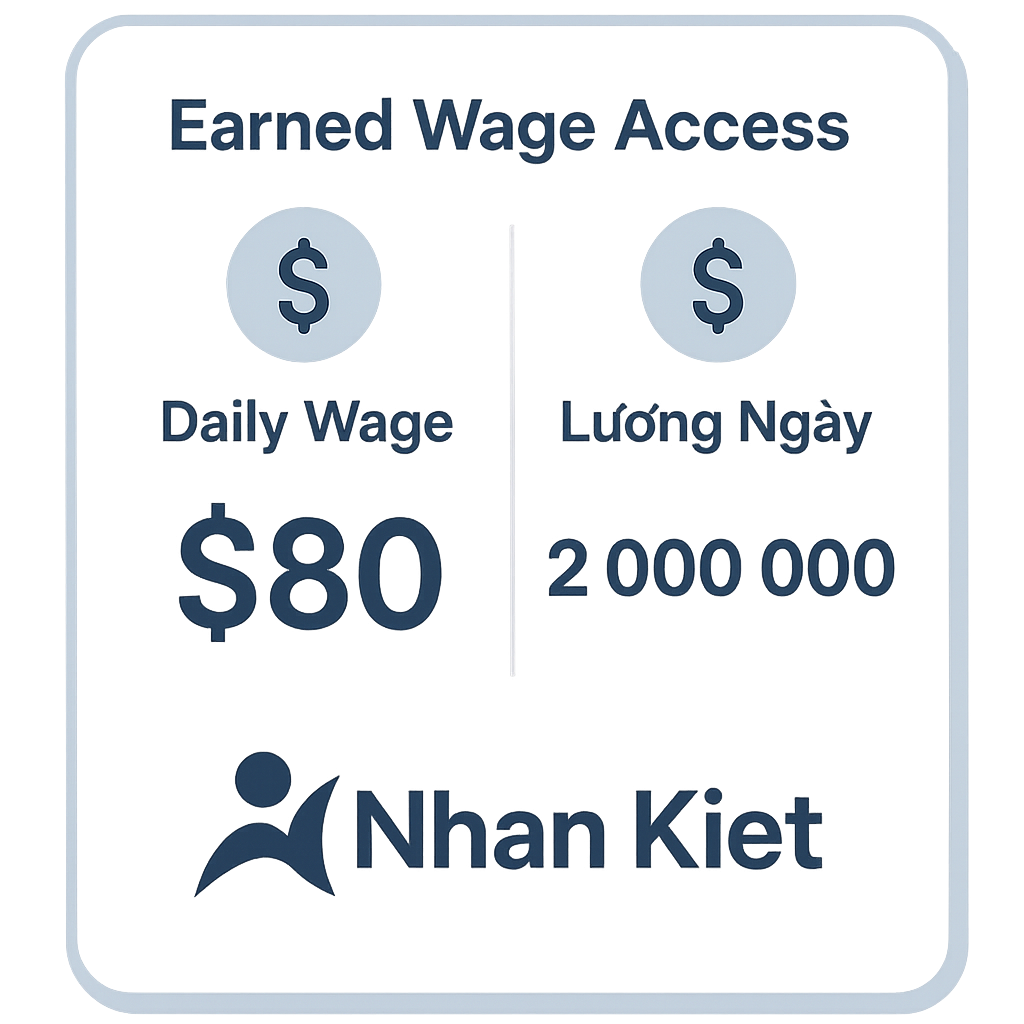
(See more: How Many Meanings Does Daily Wage Have? Distinguish 3 Understandings and What is Daily Wage?.)
Daily Wage by Form of Payment
Is the amount agreed upon for one working day, belonging to the group of time-based salary payments.
Daily Wage by Nhan Kiet
Is the name of the solution that allows eligible employees to receive a portion of their earned wages before the payday.
Monthly wage earners can still use Daily Wage if they are part of the program and the system determines the eligible wage value. Using the product does not automatically change the contract form from monthly to daily wage, nor does it automatically change the agreed payment period.
Example Distinctions
Example 1: Monthly Wage
The employee agrees on a monthly wage and is paid on a fixed day. This is a form of time-based salary payment calculated monthly.
Example 2: Daily Wage
The employee agrees on an amount for each working day. The payment period must comply with Article 97.
Example 3: Product Wage
The employee receives a salary based on the number of standard products, not just the time present.
Example 4: Using Daily Wage
The employee has approved work and receives an early portion through the application. This is the time to access a portion of the wage, not automatically deciding the salary form in the contract.
What Should Businesses Do to Ensure Transparent Salary Payment?
Clearly state the wage, allowances, additional amounts, and payment form in the contract;
Publish an easy-to-understand salary regulation;
Build verifiable timekeeping data;
Notify before changing the payment form;
Set clear payment periods;
Provide a statement each time payment is made;
Distinguish salary, bonuses, support, and deductions;
Keep a history of adjustments;
Have a complaint process;
Check the current minimum wage documents.
What Should Employees Check?
Wage in the contract;
Payment form;
Payment date;
How work and output are calculated;
Allowances and additional amounts;
Bonus conditions;
Overtime and night work;
Deductions;
Actual received amount;
Statement/pay slip.
Frequently Asked Questions
Is Salary Just Basic Salary?
No. According to Article 90, salary includes the wage according to the job or title, salary allowances, and other additional amounts.
Are Salary and Bonus the Same?
Not entirely. Salary is linked to the agreement to perform work; bonuses depend on the basis and bonus regulations according to the law.
Can Businesses Pay Salary with Company Products?
Employees cannot be forced to use their salary to buy goods/services from the company or designated unit. Salary is paid in cash or through a personal account as prescribed.
Can Businesses Change the Salary Payment Form on Their Own?
The salary payment form is agreed upon by the parties. If changing the agreed form, the employer must notify in advance according to the legal deadline.
Does Daily Wage Mean Being Paid Every Day?
Not necessarily. The law allows for bulk payment agreements for hourly, daily, or weekly wage earners, but not more than 15 days must be paid once.
Does Receiving Money Through Daily Wage Change the Employment Contract?
Not automatically. Daily Wage is a mechanism to access a portion of eligible wages; the form and payment period in labor relations still depend on the contract and law.
Does This Content Replace Legal Advice?
No. Disputes or designing salary policies need legal experts to review specific records.
Conclusion
Salary is not just the amount employees receive in their account. It is a legal structure including the wage according to the job/title, allowances, and additional amounts, paid as agreed but must comply with principles of directness, completeness, timeliness, and transparency.
The three forms of salary payment are by time, product, and contract. “Daily wage” is a time-based calculation; while “Daily Wage” by Nhan Kiet is a solution allowing access to a portion of earned wages. The two concepts are related but not identical.
References
---
Author: Nguyen Minh Tuan — Strategy Team Specialist, Nhan Kiet Manpower Supply Co., Ltd.
Consultation for Earned Wage Access Solutions for Businesses: Hotline 0937.022.655 · Email info@nhankiet.vn · Earned Wage Access for Businesses