
Signs that personal cash flow is out of balance
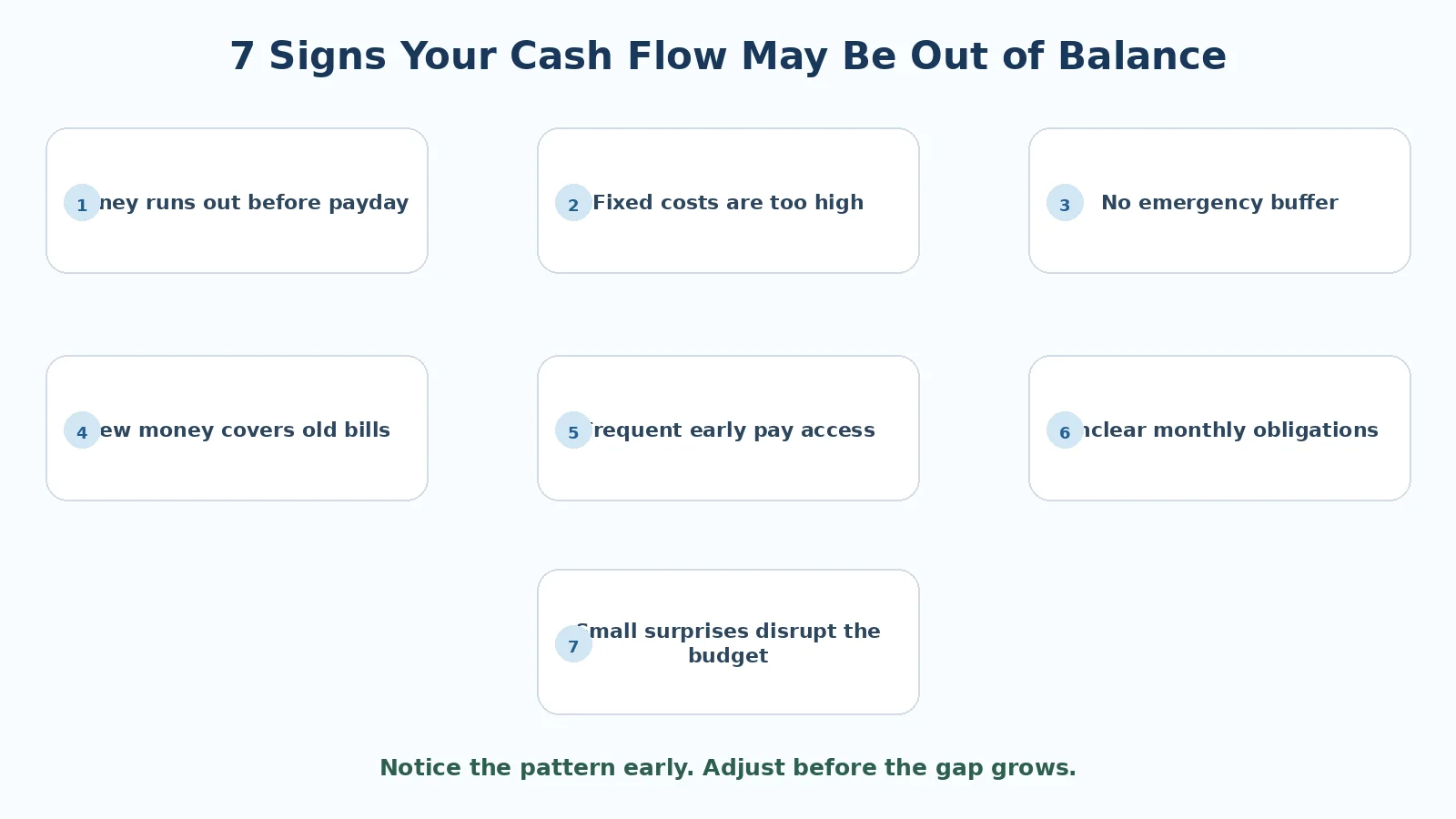
Personal cash flow may be out of balance when a worker repeatedly runs out of money before payday, does not know total obligations, uses new funds to cover old bills, or sees one small expense disrupt the whole budget. Early recognition helps separate a timing mismatch from a recurring structural shortfall that needs deeper adjustment.
Sign 1: Money always runs out before payday
One shortage may result from an unexpected event. Repetition across several cycles calls for review. Ask when the gap appears, which cost caused it, whether it repeats at the same time, and whether total income covers essentials.
If money is short just before rent every month, the main issue may be the payment date. Shortages at different times despite adjustments may point to the income-and-expense structure.
Sign 2: Fixed costs consume almost all income
Housing, transport, school costs, family support, repayments, and other fixed duties should be viewed together. If they consume nearly all income, little room remains for change. With income of 9,000,000 VND and fixed obligations of 8,300,000 VND, even a 500,000 VND repair creates an immediate gap. Track what remains after obligations, not salary alone.
Sign 3: No buffer for a small surprise
A buffer need not be large at first. But when the budget always approaches zero, medicine, vehicle repair, a higher utility bill, a family need, or extra travel becomes an emergency. Having no buffer makes cash flow highly sensitive to change.
Sign 4: New funds are used to cover old bills
Warning patterns include accessing pay early for a prior-period gap, taking new debt to pay old debt, using housing money for another duty, or moving debt between sources. The cash flow is becoming a cycle. More money offers only temporary relief; mandatory costs and reducible spending need a full review.
Sign 5: Early access increases but the shortage remains
Accessing some earned pay can bridge a timing mismatch. It may be exceeding that role when transactions rise, nearly all available funds are taken, little remains on payday, or another source is needed immediately after payday. Review the total accessed in the entire period, not each transaction alone.
Sign 6: Total monthly obligations are unknown
People often remember individual bills without adding them. List housing, utilities, school, family, phone, repayments, transport, and food. Without the total, it is hard to know what is flexible.
| Group | Amount | Due date | Adjustable? |
|---|---|---|---|
| Housing | [ ] | [ ] | No |
| Transport | [ ] | [ ] | Limited |
| Family | [ ] | [ ] | It depends |
| Repayments | [ ] | [ ] | It depends |
| Flexible | [ ] | [ ] | Yes |
Seeing the total may reveal why the gap repeats every month.
Sign 7: One small cost disrupts the whole budget
If a cost of 200,000–500,000 VND forces cancellation of other spending, the safety margin is very low. This is a signal to build a buffer and reduce adjustable obligations, not a judgment.
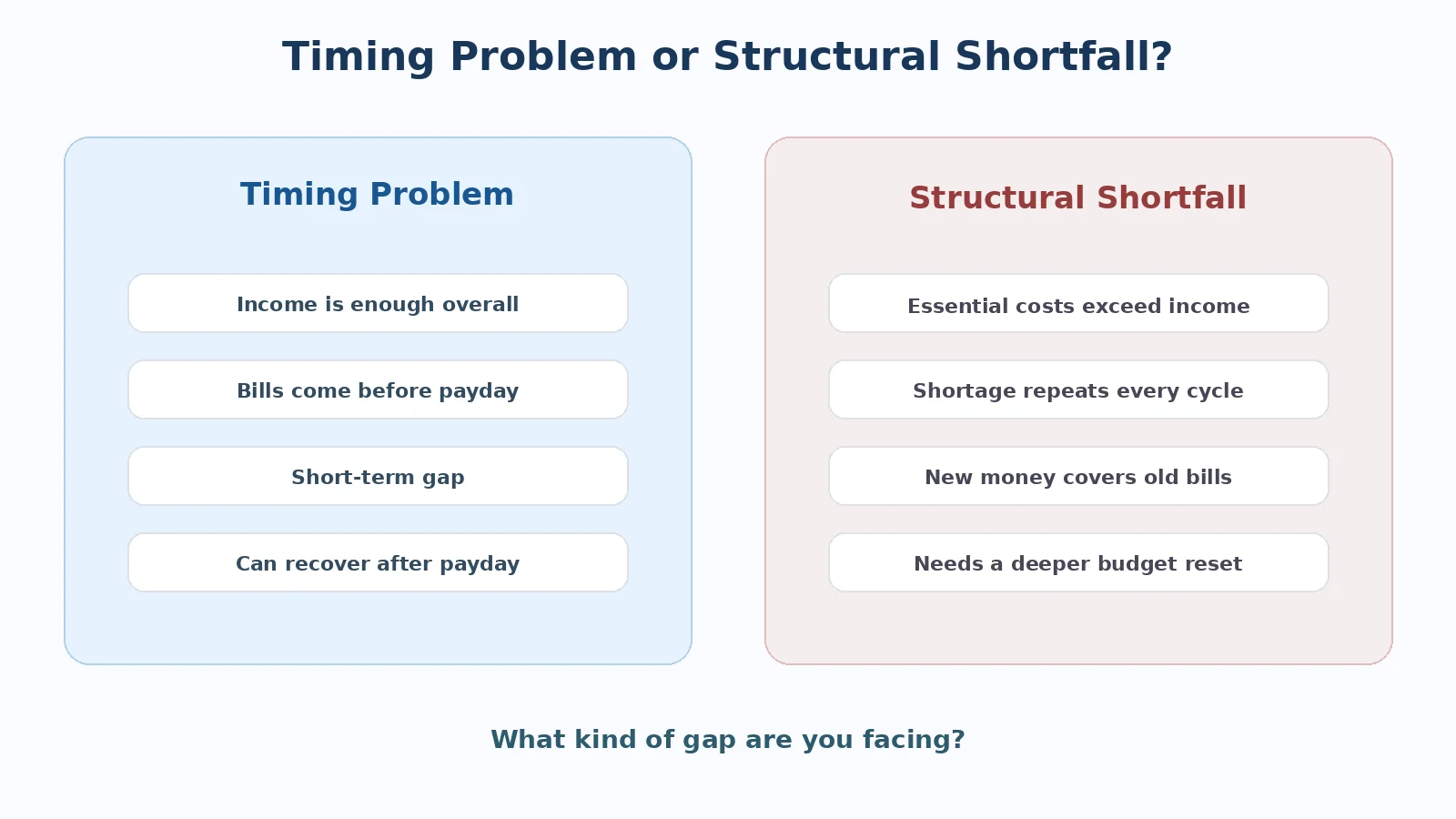
Distinguishing a timing mismatch from a structural shortfall
This is the most important step.
Timing mismatch
Total income may be enough, but incoming and outgoing dates do not align. For example, rent is due on the 20th and payday is the 30th.
Structural shortfall
Total income is below essential spending and fixed obligations. For example, recurring essentials are 9,000,000 VND while income is 8,000,000 VND.
Earned wage access can help with a timing mismatch because eligible workers can access part of pay already earned from approved workdays. It does not solve a structural shortfall by itself.
A ten-minute self-check
Workers can use three steps.
Step 1: Record expected net income
Use the expected take-home amount rather than gross pay.
Step 2: Record all mandatory obligations
Include small recurring items.
Step 3: Calculate the remainder
Remainder = expected net income − total mandatory obligations.
A positive remainder with repeated pre-payday gaps may indicate a timing issue. A remainder near or below zero over several cycles calls for a structural spending review.
Where does earned wage access fit?
The amount follows this principle:
Available amount = (approved workdays × daily rate) − amount already received in the period − portion retained under employer policy.
An early payment is not extra income; it changes when part of earned pay becomes available. If the imbalance is structural, taking more early can leave less on payday without addressing the cause.
When should the plan change instead of finding more money?
Review the whole budget when the same payment causes gaps for several months, fixed obligations keep rising, new funds cover old bills, the buffer disappears, early access increases, total obligations are unknown, or essentials exceed income. The goal is to shrink the gap, not merely move it.
Conclusion
Cash-flow imbalance often appears through early shortages, no buffer, unclear obligations, new money covering old bills, or rising early access. Recognizing these signs helps distinguish a timing mismatch from a structural shortfall and supports the right response instead of continually shifting money between periods.
Author: Do Huy Le — General Director, Nhan Kiet Manpower Supply Co., Ltd.
Earned wage access advice for employers: Hotline 0937.022.655 · Email info@nhankiet.vn · Earned wage access for employers
FAQ
Does running out before payday always mean imbalance?
No. A one-off surprise can happen. Repetition is the key signal.
Is early pay access a sign of poor finances?
No. It may simply address timing. Consider its purpose, frequency, and the payday balance.
What if total income is enough but money still runs out early?
The issue may be scheduling. Map income and payment dates and reserve early-due bills first.
What if essential spending exceeds income?
Review the budget and obligations or seek suitable support. Changing the payment date alone will not remove the shortfall.