
Five-week budget template for monthly pay: how to complete and review it
A five-week budget is a practical worksheet that divides a monthly pay cycle into its real weeks instead of assuming every month has four. Record the starting balance, bills, essentials, any early pay access, and the ending balance each week to see deviations early.
When should a five-week template be used?
Use it when payday is not at the start of the month, the cycle lasts 29–31 days, bills fall in different weeks, overtime varies, earned wage access is used, or the same weekly review format is helpful.
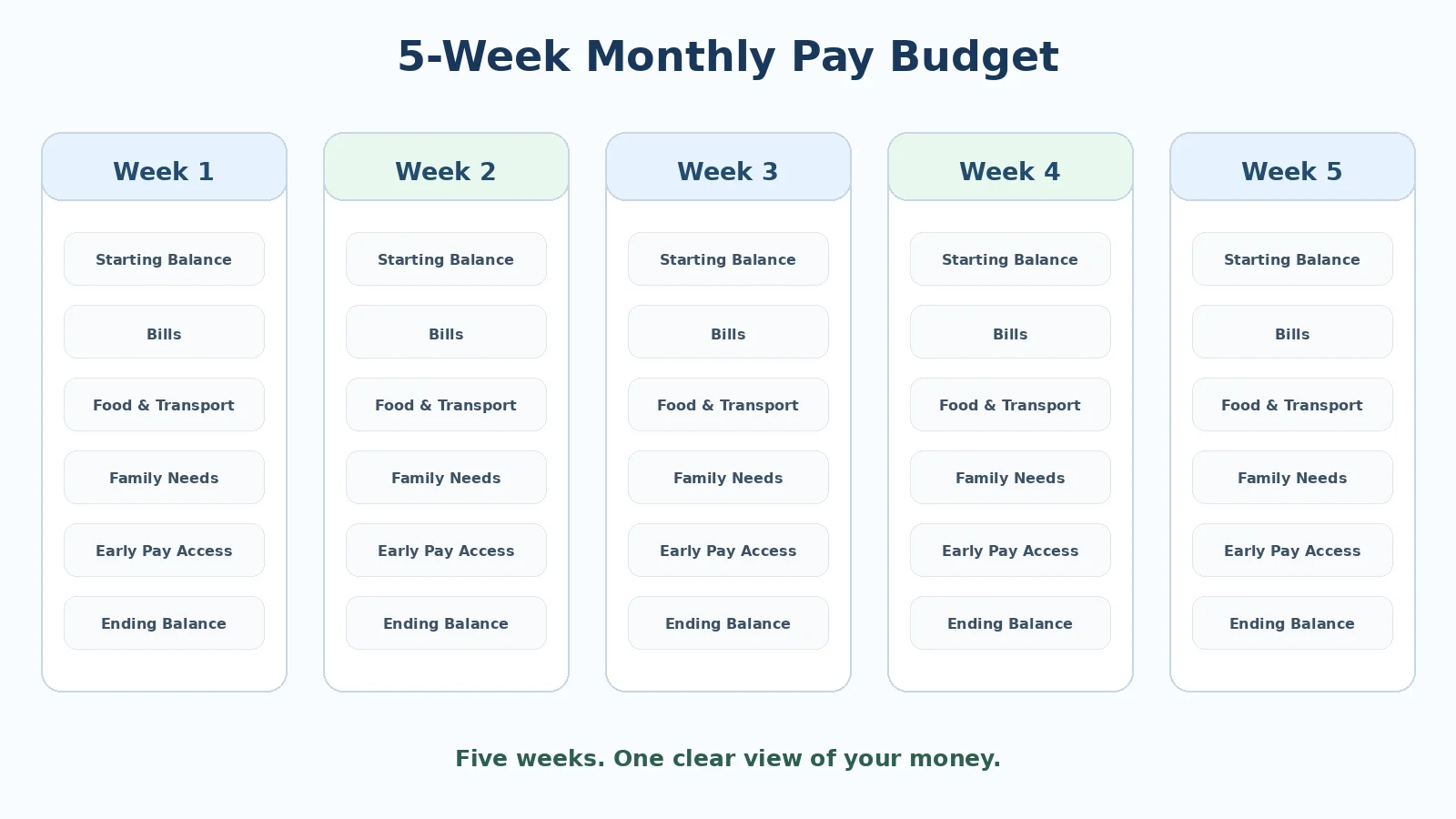
Unlike four equal portions, this template includes the extra days at the end of the cycle.
Step 1: Define the correct pay cycle
The cycle need not run from the 1st to the 30th. If payday is the 10th, plan from the 10th to the 9th. Record start date, end date, total days, and weekly segments. A 31-day cycle can be four seven-day weeks plus a three-day fifth week.
Step 2: Enter total resources for the period
Include only reasonably certain amounts.
| Source | Amount |
|---|---|
| Expected take-home pay | — |
| Certain side income | — |
| Other certain income | — |
| **Total resources** | **—** |
Do not add uncertain bonuses or overtime. Allocate extra income after it is actually received.
Step 3: Lock mandatory payments before dividing by week
List every obligation from this payday to the next.
| Mandatory item | Amount | Due date | Week |
|---|---|---|---|
| Housing | — | — | — |
| Utilities | — | — | — |
| School/family | — | — | — |
| Payment due | — | — | — |
| Other | — | — | — |
Only the amount remaining after these items are protected should be divided across weeks.
Step 4: Complete the five-week table
Use this basic worksheet.
| Week | Starting balance | Bills | Food and transport | Family | Flexible | Early pay access | Ending balance |
|---|---|---|---|---|---|---|---|
| Week 1 | — | — | — | — | — | — | — |
| Week 2 | — | — | — | — | — | — | — |
| Week 3 | — | — | — | — | — | — | — |
| Week 4 | — | — | — | — | — | — | — |
| Week 5 | — | — | — | — | — | — | — |
Weekly ending balance = starting balance + money actually received during the week − total spending.
One week’s ending balance becomes the next week’s starting balance.
How to record earned wage access without double-counting income
If expected pay is 8,000,000 VND and 1,000,000 VND is received early, total period resources remain 8,000,000 VND. Record 1,000,000 VND in the early-access column because only the timing changed.
Available amount = (approved workdays × daily rate) − amount already received in the period − portion retained under employer policy.
The early amount is part of expected monthly pay, not a separate new source.
Step 5: Use colors to identify risky weeks
Use green when a buffer remains, yellow when the balance is low and flexible spending should be limited, and red when the forecast is negative or another source would be needed.
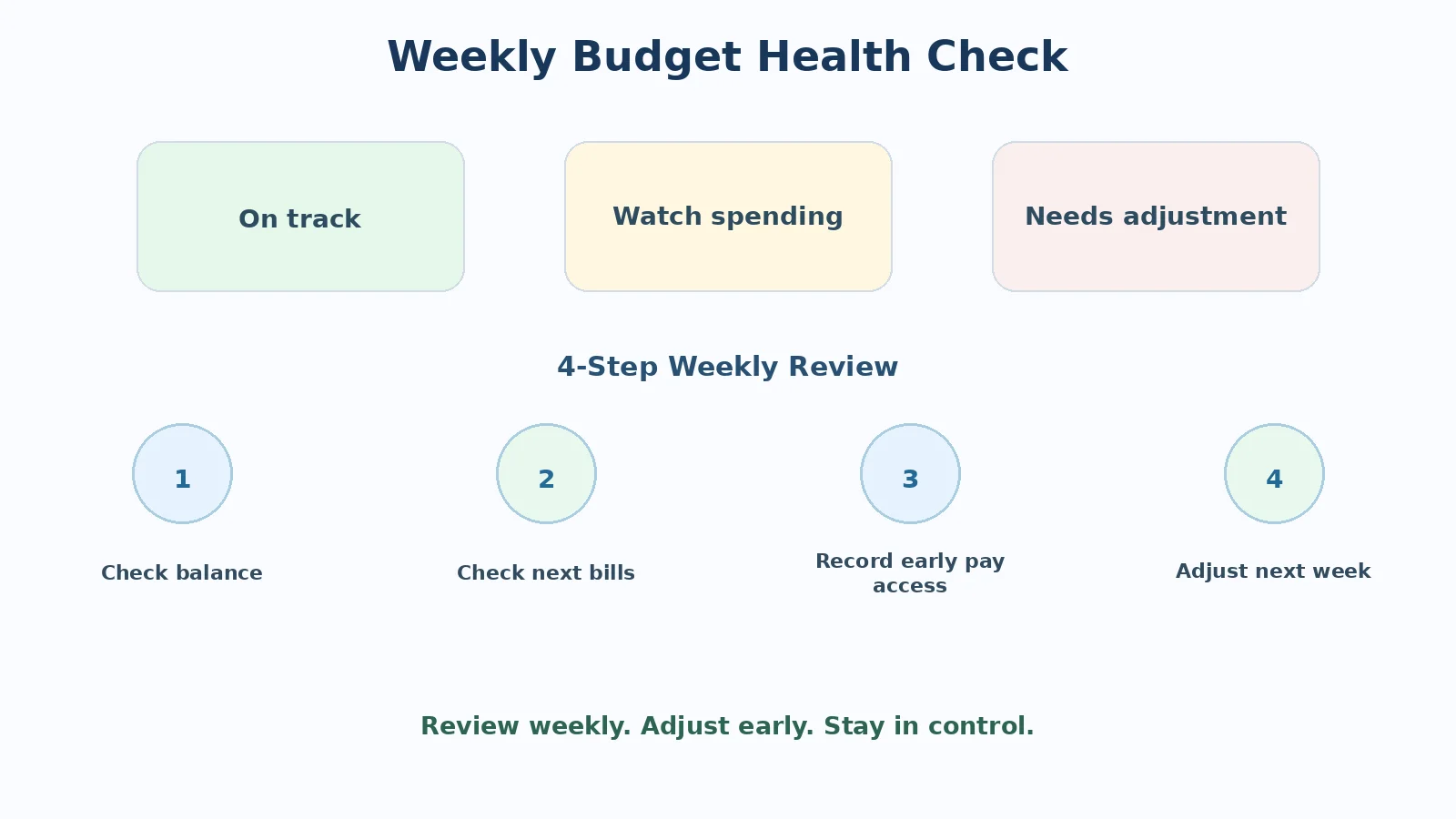
Colors are an early-warning tool, not a source of pressure.
Step 6: Run a short weekly budget review
On the same day each week, compare actual balance with the table; check bills due before the next review; identify overspending; record any early pay access and reduce the period-end budget accordingly; adjust next week; and move any surplus to the buffer. A brief repeated review is more useful than a detailed sheet that is forgotten.
Example with 8,000,000 VND
Assume take-home income of 8,000,000 VND, fixed obligations of 3,600,000 VND, a 400,000 VND reserve, and 4,000,000 VND for 31 days.
| Period | Budget |
|---|---|
| Week 1 | 950,000 |
| Week 2 | 950,000 |
| Week 3 | 950,000 |
| Week 4 | 900,000 |
| Week 5 — 3 days | 250,000 |
| **Total** | **4,000,000** |
This is only an illustration. If a 400,000 VND cost arises in week 2 and earned pay is accessed, record it and adjust later weeks.
Three mistakes that make a five-week budget inaccurate
1. Forgetting week 5
Four weeks cover only 28 days, so an on-paper plan can fail near period end.
2. Treating early pay access as new income
This counts the same resources twice.
3. Not updating actual figures
The worksheet is useful only when forecasts are replaced with actual weekly amounts.
A short template to copy
```text
CYCLE: ___ / __ to __ / ___
EXPECTED TOTAL TAKE-HOME INCOME: __________
PROTECTED ITEMS:
- Housing: __________
- Bills: __________
- Family: __________
- Reserve: __________
Week 1
Starting balance: ______
Actual spending: _____
Early pay access: _______
Ending balance: ______
Week 2
...
Week 5
...
```
This simple format makes it possible to begin without a complex finance app.
Conclusion
A five-week worksheet turns a general budgeting principle into a practical routine. Define the pay cycle, protect mandatory payments, divide the remainder into five stages, record early access correctly, and review every week. The aim is to identify deviations early enough to adjust.
Author: Do Huy Le — General Director, Nhan Kiet Manpower Supply Co., Ltd.
Earned wage access advice for employers: Hotline 0937.022.655 · Email info@nhankiet.vn · Earned wage access for employers
FAQ
Why is there a fifth week in a 30-day month?
Four weeks contain only 28 days. The remaining two or three days still need a budget.
Should all five weeks receive equal amounts?
Not necessarily. Weeks with large bills need different allocations.
Which figure should be used when income varies?
Plan with a cautious income estimate and allocate additions only when received.
Where should earned wage access be recorded?
Record it separately in the early-access column, without adding it beyond total expected pay.