
What is the Reserve Hold in Earned Wage Access? Is it a Fee or Lost Money?
What is the Reserve Hold in Earned Wage Access? Is it a Fee or Lost Money?
Short answer: The reserve hold is the portion of wages not yet opened for early access by employees. By default configuration, clients may be set to hold the most recent workdays and/or hold 10.5% when the advance reaches a threshold. This is not interest, not a fee for using Earned Wage Access, and not inherently lost money.
The remaining eligible wages will be processed during payroll settlement. The hold exists to create a safety buffer before the work schedule, deductions, and end-of-period wages are fully finalized.
> Note: The formulas and rates mentioned are default configuration values and do not imply that all businesses apply them the same way. The official policy displayed on the app and payslip at the time of use is the basis users need to check.
Simplified Understanding with an Example
Suppose an employee has 8 approved workdays. The client's system is configured to hold the 2 most recent workdays. In this case:
8 days may still appear in the work history;
The 2 most recent days are in the reserve hold;
The remaining 6 days are considered for creating the amount available for early access;
At the end of the period, the 2 held days do not automatically disappear but continue to be part of the payroll calculation if the work remains valid.
This example is for illustrative purposes only and not a universally applied configuration.
Where Does the Reserve Hold Fit in the Earned Wage Access Formula?
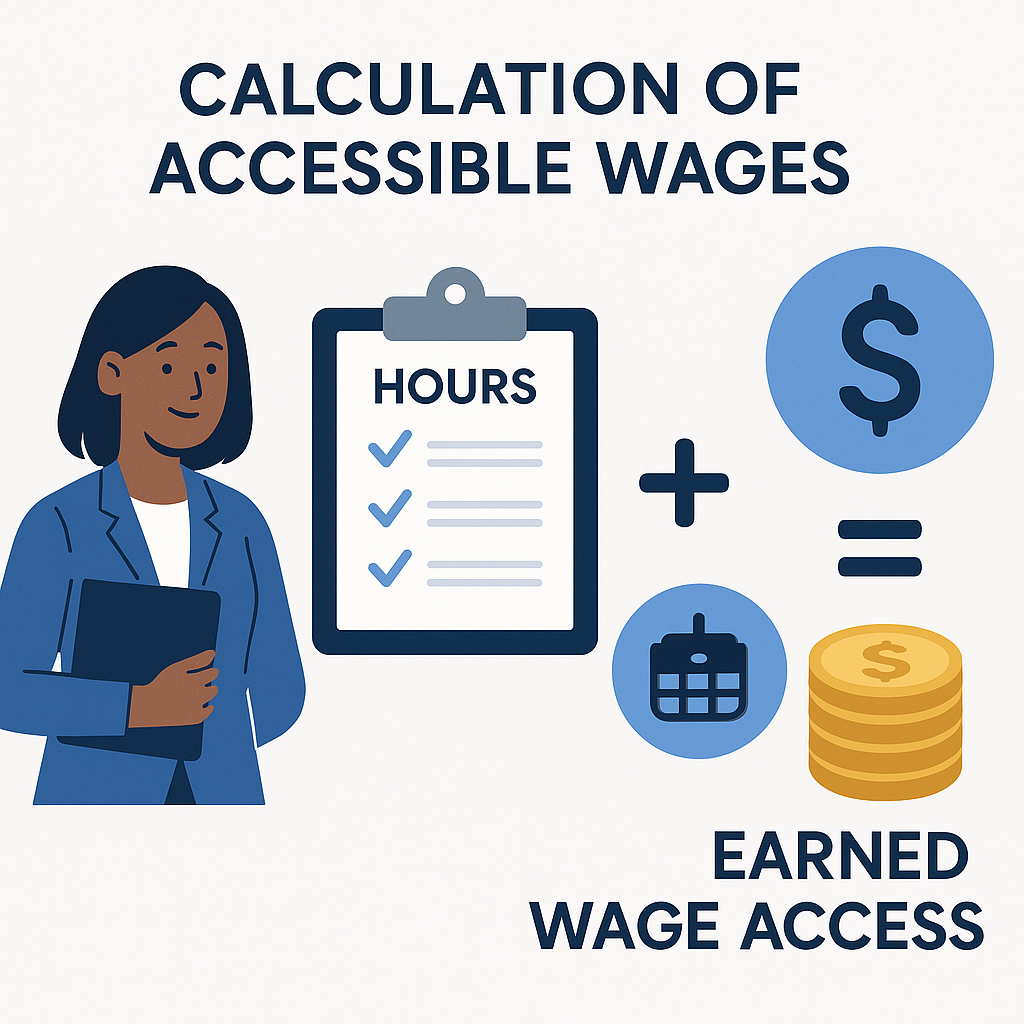
According to the current configuration:
> Amount receivable = Approved workdays × client's daily rate − amount received during the period − reserve hold
The result is rounded down to the nearest 1,000 VND. Additionally, the system does not allow receiving money from today’s unfinalized or future days.
Therefore, the hold only affects the portion available for early access at the current time, not altering the essence of the total wages to be settled according to valid work data and payroll policy.
How is the Reserve Hold Different from Fees, Interest, and Deductions?
(Why this is not a loan: see Is EWA a Loan?.)
Concept | Nature | Does it reduce the total eligible wages? |
|---|---|---|
Reserve Hold | Portion not opened for early access | Not automatically; processed during settlement |
Service Fee | Charge for using the service | May require additional payment if the policy includes fees |
Loan Interest | Cost of credit over time | Not part of the current operational model |
Amount Received During the Period | Wages already advanced | Deducted from the remaining amount at the end of the period to avoid double payment |
Valid Payroll Deductions | Amount deducted during settlement based on applicable grounds | May reduce the actual amount received at the end of the period |
In the current operational flow, the system does not charge interest and does not charge employees fees; it only deducts the exact amount already received from the wages. The official fee policy displayed on the app and agreement at the time of transaction is the basis users need to check.
Why Doesn't the System Allow Early Access to the Entire Estimated Wages?
1. Work in the Period May Still Be Adjusted
An approved record may need entry/exit time or shift corrections when discrepancies are found. The system will revert the corrected record to pending approval status and log the before/after changes.
If the entire estimated value has been withdrawn before adjustments, the amount disbursed may exceed the final work value.
2. Payroll Has Not Been Settled
The amount on Earned Wage Access is calculated based on the daily rate and approved workdays for early access. The end-of-period payslip also depends on the payroll process and components confirmed by Nhan Kiet and the client.
3. Employees May Leave or Transfer During the Period
In the labor supply model, the employment status may change. The hold creates a safety buffer to reconcile changes not fully reflected at the time the employee requests payment.
4. Data Comes from Multiple Sources
Work data may come from the app, the client's Google Sheet, or related ERP data. Each source updates at different times; a reserve portion helps mitigate risks when end-of-period data is not fully stable.
5. Reducing the Risk of Unrecoverable Amounts
The system has a ledger for unrecoverable amounts in cases where work is reduced after disbursement or the employee leaves. The hold does not eliminate all risks but adds an additional control buffer.
Two Reserve Hold Methods Available in the System
Holding the Most Recent Workdays
Clients may be configured to hold N most recent workdays. This is the work near the current time, often still subject to checks or changes.
For example, if configured to hold 2 days, the system will not open the value corresponding to the two most recent eligible days. The number N depends on each client's configuration; it should not be assumed to be 1, 2, or 3 days.
Holding 10.5% When Reaching the Threshold
The source code has logic to hold 10.5% when the advance reaches the threshold. Details of the threshold, business basis, and client application need confirmation from Nhan Kiet.
10.5% should not be interpreted as:
Earned Wage Access fee;
Interest rate;
Fixed tax;
Amount Nhan Kiet collects from employees;
Mandatory rate for all clients.
From a system perspective, this is a reserve rate in the calculation of the portion available for early access.
Can Both Mechanisms Be Applied Simultaneously?
Technical documentation shows that clients can configure to hold the N most recent workdays and/or the 10.5% rate when reaching the threshold. This indicates the system can use one or both depending on the configuration.
The specific calculation order when both mechanisms operate may vary according to each company's configuration.
Example of Calculating Hold by Workdays
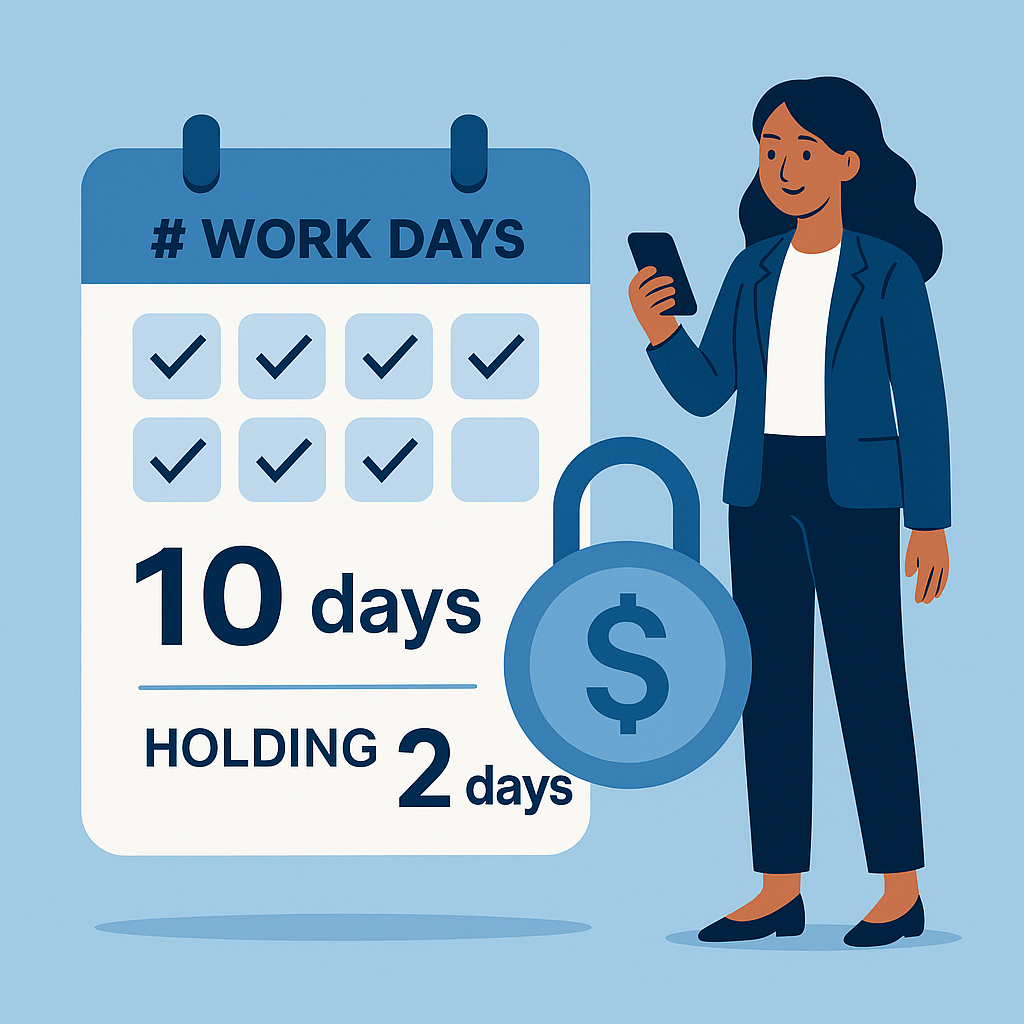
Suppose:
The employee has 10 approved and eligible workdays;
Illustrative rate: 300,000 VND/day;
Illustrative configuration: hold 2 most recent days;
The employee has received 500,000 VND during the period.
Illustrative calculation:
Content | Value |
|---|---|
Total value of 10 workdays | 3,000,000 VND |
Value of 2 reserve hold days | 600,000 VND |
Amount received during the period | 500,000 VND |
Remaining amount available for early access | 1,900,000 VND |
The result also depends on transaction limits, rounding, and other conditions. The example is not a commitment to actual limits.
Example Illustrating Hold by Percentage
Suppose the eligible calculation base is 4,000,000 VND and the 10.5% hold configuration is applied:
> Illustrative hold = 4,000,000 × 10.5% = 420,000 VND
The amount before deducting the amount received and other limits is 3,580,000 VND.
However, the source code has a condition "when the advance reaches the threshold." Since there is no official operational policy in the provided data, the publication should not state that having work automatically results in a 10.5% hold.
Why Can the Hold Change Over Time?
The hold is not necessarily a static number. It can change when:
Additional workdays are approved;
Older days exit the "N most recent days" group;
Work is corrected and returns to pending approval;
The employee receives more money during the period;
The estimated amount exceeds or falls below the configuration threshold;
The employee transfers clients;
Nhan Kiet changes the approved configuration for the client.
Therefore, users should examine each component in detail rather than just comparing two snapshots of the total limit at different times.
Is the Hold Returned the Next Day?
It cannot be generally affirmed. If held by N most recent days, when new work is approved, older days may exit the hold group; but new days become the reserve portion. If held by percentage or threshold condition, the hold changes according to the calculation base.
The hold does not operate like a deposit with a fixed "return" date. It is a portion temporarily not opened for early access and is processed during payroll settlement.
How is the Hold Processed at the End of the Period?
(Settlement process: see How Much is Left After Using Earned Wage Access?.)
In principle, at the end of the period:
Work and payroll data are finalized;
The amount the employee received early is reconciled;
Only the valid disbursed amount is deducted to avoid double payment;
The remaining eligible wages, including the portion previously not opened for early access, are processed according to the payroll procedure.
The display of the hold on the payslip, line names, and payment timing may vary by company; refer to the official payslip.
When Might the Hold Indicate a Need for Review?
(See also: Why is the Earned Wage Access Limit Zero or Not Increasing?.)
Employees should request a review if:
The app does not explain where the hold is calculated from;
The number of held days differs from the notified configuration;
The hold is recorded as a fee but the policy states it is free;
At the end of the period, the eligible amount does not appear in the settlement;
Work has been adjusted but the hold is not updated;
Working for multiple clients but the hold is mixed, source not traceable;
The amount received and the hold are deducted simultaneously;
There is no history of configuration changes.
Self-Check Process for the Hold
Step 1: Check the Correct Client and Period
An individual working in multiple places may have different configurations. Select the correct client and time period.
Step 2: View Workdays by Status
Differentiate recorded, pending approval, and approved workdays. Only use approved and eligible workdays for reconciliation.
Step 3: Identify the Type of Hold
The app should indicate if the hold is due to N most recent days, percentage, or both. If not displayed, the employee should request an explanation.
Step 4: Deduct the Amount Received Separately
The amount received and the hold are two different concepts. Do not combine them into one "lost" amount.
Step 5: Reconcile the End-of-Period Payslip
Check total wages, early received amounts, valid deductions, and the remaining actual amount. If not matching, use transaction codes and work details for reconciliation.
Sample Request for Hold Explanation
> I need assistance checking the reserve hold in Earned Wage Access. Name: …; employee ID/timekeeping code: …; client: …; current period: …; approved workdays: …; amount received during the period: …; displayed hold: …; available amount: … . Please inform me if the hold is calculated by days, percentage, or configuration and how the remaining part is processed during settlement.
No need to send OTP, password, or full account number for calculation explanation.
How Should the System Display the Hold?
To prevent employees from misunderstanding it as a fee, the screen should clearly separate:
Component | Suggested Explanation |
|---|---|
Total value of approved workdays | Estimated value from eligible work |
Received during the period | Amount successfully transferred before payday |
Held by workdays | Value of N most recent days not opened for early access |
Held by percentage | Reserve portion according to configuration when conditions are met |
Available now | Remaining portion after calculation and limits |
To be processed at the end of the period | Portion to continue being settled, not called a fee |
Sample notification:
> Reserve Hold: 600,000 VND. This is the value of 2 most recent workdays not opened for early access, not a fee. The eligible wages will continue to be processed during payroll settlement.
What Should Employees Understand Before Requesting Payment?
The limit is not the entire end-of-period wages;
Early access only changes the timing of receiving a portion of wages;
The hold is not a cut bonus;
The amount received will be deducted from the remaining payment;
The limit may change when work or approval status changes;
Do not use the entire available amount just because the app allows it;
Keep a budget for expenses due on payday.
Frequently Asked Questions
Is the Reserve Hold a Fee for Earned Wage Access?
No. In the current operational system, the hold is the portion not opened for early access. The current flow does not charge interest and does not charge employees fees.
Why Does Earned Wage Access Hold 10.5%?
It is a reserve mechanism in the code when the advance reaches the threshold. The threshold, client scope, and policy basis need confirmation from Nhan Kiet; 10.5% should not be considered a fee or tax.
Why Does the System Hold the Most Recent Workdays?
Days near the present may not be fully stable or may still need adjustments. Holding some days creates a safety buffer before settlement.
Is the Held Portion Lost?
Not inherently. If the work remains valid, that portion continues to be processed during the payroll period. Employees should reconcile with the end-of-period payslip.
Is the Hold the Same for All Clients?
Not necessarily. Clients may be configured with different numbers of days and percentages.
Why Is the Hold Higher Today Than Yesterday?
It may be due to new work, approval status changes, reaching the percentage threshold, client transfer, or configuration changes. Check each component in detail.
Can Employees Request to Remove the Hold to Receive the Entire Amount?
Employees cannot change the configuration themselves. Application is configured by Nhan Kiet according to client and approved policy.
Is Interest Paid on the Hold for Employees?
This is not a deposit or loan. The provided data does not show a mechanism for paying interest on the hold.
Where to Check the Hold at the End of the Month?
Reconcile work details, received history, and payslip/settlement. Refer to the line names displayed on the official payslip.
Are the Hold and Transaction Limit the Same?
No. The hold reduces the portion opened for early access; the transaction limit specifies the minimum/maximum for each order or day.
Conclusion
The reserve hold is not a fee and not an automatically disappearing amount. It is a portion of wages temporarily not opened for early access to create a safety buffer when work data and payroll are not yet settled. The system can hold N most recent workdays and/or 10.5% when reaching the threshold, depending on client configuration.
Employees need to clearly distinguish the total work value, amount received during the period, hold, and amount available now. Nhan Kiet should display transparent calculations, state the reason for holding, and allow reconciliation to the end-of-period payslip. This transparency helps Earned Wage Access be correctly understood as an advance on earned wages, not a loan, and not losing part of the salary for using the service.
References
---
Author: Ho Tan Dat — Assistant to the Deputy General Director of Strategy, Nhan Kiet Manpower Supply Co., Ltd.
Earned Wage Access solutions for businesses: Hotline 0937.022.655 · Email info@nhankiet.vn · Earned Wage Access for businesses
Read more articles
- What Data is Needed to Integrate Earned Wage Access with Timekeeping, Payroll, and ERP? · Doanh nghiệp
- When to Opt for Early Wage Access? Responsible Earned Wage Access Usage Principles · Người lao động
- Earned Wage Access Transaction Limits: Minimum, Maximum per Transaction, and Daily Limits · Người lao động
- Does Changing or Losing Your Phone Affect Earned Wage Access? How to Protect and Re-Verify Your Device · Người lao động
- Who is Responsible When Earned Wage Access Errors Occur? · Doanh nghiệp
- 20 Clauses to Check in an Earned Wage Access (EWA) Implementation Contract · Doanh nghiệp
- Who Can Use Earned Wage Access? Registration, Verification, and Receiving Conditions · Người lao động
- How is Earned Wage Access calculated and paid when working for multiple clients? · Người lao động
- EWA for Retail, F&B, and Chain Stores: How to Manage Flexible Shifts? · Doanh nghiệp
- Clocked In but No Workday or Available Limit Increase: Causes and Solutions · Người lao động